Wednesday, May 07, 2008

Yom HaZikaron and Yom Ha'Atzmaut

It's a strange time of year. The Jewish month of Nissan is a time of Joy. Of course, all the kids are let out of school on the first day of the month, and we remember how that feels. During our davening (prayers,) the tachanun prayer of penance and beseeching for the rebuilding of the Holy Temple in Jerusalem is suspended for the entire month. And of course, on the fourteenth of the month, we celebrate Pesach (Passover,) the festival of our physical redemption from Egyptian captivity and our spiritual liberation to dedicate our lives to Hashem. At the same time, immediately after the first day of Pesach, even during Chol Hamoed (the intermediary festival days,) we enter a period of mourning for a plague which struck the students of Rabbi Akiva, during which we do not listen to music, cut our hair, shave our beards, get married, or purchase any items of great significance.

Add on top of that the Israeli state's addition of Holocaust Remembrance day, when sirens sound throughout the country, and everything, from the Israeli stock market, to traffic on the busiest freeways, to the rambunctious arguments passing through our yeshivah, comes to an abrupt stop as everyone drops what they are doing and stands at attention.

This morning was another siren, for Yom Hazikaron, the day of Rememberence of Israel's fallen. Those who own televisions watch the brief, one or two minute biographies of soldiers who fell in various wars, which continue, one after the next, broadcast on every Israeli station for twenty four hours non stop. In yeshivah this morning, we took a moment out of our Tanachic studies to discuss the importance of obligation and sacrifice, and we all stood for the siren. But now, outside my window, the fireworks rage. Yom Hazikaron is over, Yom Ha'Atzmaut, Israel's day of Independence, has begun! Just as the time is a mixture of the joy and sorrow of life in Israel, so too, religious Jews begin the dispute over what is the appropriate response to this day. After all, secular Zionism was intended to replace and obliterate Judaism. Even today, among the National Religious, who have supported the Jewish state from the very beginning in spite of it's anti-Jewish tendancies, there is much dispute over continuing to support a state which expelled 5,000 Jews from their homes in Gush Katif two years ago. How can we celebrate its success?


Traffic stops, standing at attention in honor of Israel's fallen


Then again, Zionism resulted in the fulfillment of the mitzvah of bringing millions of Jews home to Eretz Yisrael. It has created the strongest, most creative and successful religious Jewish community in the world. Today, more students study in Yeshivah then have ever studied before. Not every religious Jew lives here yet, but almost all would acknowledge that the levels of spiritual success which can be achieved today thanks to Israel are incomparable to anywhere else in the world. How can we not be grateful for the miraculous salvation Hashem has bestowed upon us?

As the Israeli expression goes, "If there were another Jewish state, I'd move there in a minute."

Monday, May 05, 2008

Herodion 4: Cisterns and Tunnels

While the lower Herodion was something of a Roman-era country club, ideal for large groups of visitors, upper Herodion was where the real business of state was taken care of.

The Ruins of Upper Herodion


Taking the path that snakes around the hill, we come to the entrance to the underground portion.


This network of three underground caverns was dug out when the hill was much lower, prior to Herod's building up of the palace above. Coated in thick plaster, the walls were completely watertight. This seems to be a system of cisterns. Since they are at a higher elevation than the pool, it seems that they would not have been filled by gravity like the aqueduct-fed pool below. Rainfall on the mountain top was also insufficient to fill the caverns. It seems that these vast caverns were filled, one donkey-load at a time, by slave workers.

Cistern 1. The floor actually goes down much further but is filled with dirt in this case.


Cistern 2, with the floor fully excavated.


A hole in the ceiling, through which people in the palace above would drop buckets into the cisterns to fill up.


Like many structures built by Herod, the Herodion was well-fortified, strong enough to hold up during a Jewish revolt until the legions of Rome could sweep in to the rescue. Like many of these well-fortified structures, it ended up being seized by the very Jewish rebels Herod had hoped to protect himself from, and holding out against Roman siege.

During the Bar Kochba revolt against Rome, 136 years after Herod's death, rebels captured the fortress. Facing the Romans on the open field of battle was suicide, so they began a system of underground fortifications in all of their strongholds. A maze of tunnels, stairways, escape hatches, and drop-offs were carved connecting the cisterns and the palace above.


The goal was to draw the Romans into the network and kill them on unfamiliar terrain. Needless to say, the revolt failed, the Temple was destroyed, the Jewish presence in Jerusalem was completely wiped out, and Jerusalem became a city forbidden to Jews.

Bar Kochba caves riddle the insides of the hill.

Sunday, May 04, 2008

Hashing it out with a Politically Correct Sloganeer

I've been having a lively back-and-forth slur-fest with someone who opposes my presence in the Holy Land in the comments section of my old post on the City of David (click on the link and scroll to the bottom to read the complete back and forth.) Normally, I would be content to leave it as is because, you know, internet people spewing out fashionably enlightened recycled sound-bytes are a dime a dozen. If you need that sort of thing, you can go to the comments section in any Haaretz article and waste an afternoon on it. However, this particular fellow does bring up quite a few of the more glaring examples of empty slogans and mindless accusations, and, well, what is a blog for if not my own little space to respond.

You are an orientalist, your descriptions of Arab areas in derrogatory [SIC] manner, and your portrayl [SIC] of them as erratic and not clean and orderly western things as superior: this is orientalist colonialist bs.

Orientalism is a term used in academic discourse referring to a tradition, both academic and artistic, of hostile and deprecatory views of the East by the West, shaped by the attitudes of the era of European imperialism in the 18th and 19th centuries. It was first coined by Edward Said, the late Colombia University academic who had invented Palestinian Nationalism a few years earlier.

The fact of the matter is, despite the gift from God of phenomenal oil wealth, the Arabs have still not managed to crawl out of the dark ages. By any measurable standard, be it infant mortality, literacy, median income, gross national product (minus oil), and academic papers published, man-for-man ability in conventional war, public sanitation, you name it, the Arabs today are still far, far behind the west. This isn't hostile, it's an observation of statistical fact, to which many Arab intellectuals will admit amongst themselves.

I believe the reference to "..your portrayl [sic] of them as erratic and not clean and orderly western things as superior," was to this post: Into Silwan. Never did I state that the western way of building is superior. I merely commented on what I saw, and leave it to the reader to make a judgment. Go re-read it if you don't believe me. Incidentally, the western concept of the building code and zoning laws tends to result sturdier structures which do not collapse and kill their occupants during earthquakes, and wide streets do, in fact, lead to speedier access for emergency services, so perhaps there is a causal link between the western concepts like the rule of law and higher western life expectancy?

However, what you are is a Jewish quasi fascist, you want territory without the people who live on it, you want to expand and settle land at the expense of others.

One could say the same for the Arabs, who thrice attempted genocide, in 1948, 1967, and 1973. They come to kill the inhabitants of Israel and grab the land, and they end up losing their own land. What perfect justice! And, for living in a country the size of New Jersey, facing down an empire a time and a half the size of the United States, we are portrayed as the imperialists.

When you're accused of being a fascist or a racist by a trendy multiculti type, you know you've won the argument. It's like watching a Nazi on death row chomp on a suicide cyanide capsule; a sort of last-ditch attempt to stave off complete moral failure. As if we are walking around with arm-bands following some screaming totalitarian psychopath. The accusation of colonialism is just as silly, as if Jews scraping out their existence, building their homes on the barren hillsides, are equivalent to colonial British plantation owners whipping their slaves on some sugar plantation in Jamaica a century ago.

Settling the land need not be done at the expense of others. Those who accept the seven Noahide laws and do not react homicidally to Jewish political independence are free to remain as many, such as the Druze, already have. The Arabs have repeatedly proved themselves incapable of self-rule without lapsing into enraged attempts to exterminate their Jewish neighbors. This behavior predates the Jewish state by at least thirteen centuries, since Muhammad exterminated the Jewish community of Mecca, repeated every few decades in communities throughout the Arab lands up through the present day.

Peace requires that concessions be made: the Palestinians will have to clamp down on terrorism...

Now why on earth would they do that? After all, spectacular acts of air piracy, slaughtering Israeli Olympic teams, blowing up Israeli school busses, and the like, is precisely what has gotten them so much attention in the first place. Nobody would have ever heard of them had they focused on building a state. This year, they received $7.5 billion in foreign aid. Do you think they would have collected this much loot had they refrained from criminal violence?

...and Israel will have to concede most of the west bank and Gaza and share jerusalem.

Okay, so here we go with the political mumbo-jumbo. Of course, Israel DID destroy all Jewish life in Gaza, and has repeatedly attempted to get out of the "West Bank" and Jerusalem. We have 1500 civilian fatalities over four years to prove it. Has it ever occured to you that perhaps there is no Israeli concession so great that it will satisfy Arab grievences? That, given their four-times-in-the-last-70-years violent rejection of an Arab State of Palestine on precisely these lands, perhaps statehood is not their goal and will solve nothing?

These are commonly accepted facts in Washington and capitols throughout the world, it is time for you to accept reality and start acting like a grown up instead of a wild west Jewish cowboy.

There are plenty of people in Washington and the capitols throughout the world who would disagree with that. There are many others who spout the surrender-the-territories views because, although on some level they understand that Arab grievences will never be redressed, they see no other way of temporary relief but to keep feeding the alligator hoping it eats them last.

The cowboys comment is nonsequitor, seeing as how cowboys are cool. Who is the more adult, one who rationally approaches challenges or who hides behind unoriginal slogans and New York Times cliche's?

Reform is necessary on both sides of the divide, and the sooner that people in Israel see your type for what they really are: settler zealotry will stop.

They already know me, and, while many of the multiculti upper crust elite in the Israeli media and government do detest me, most people are relatively accepting, and I'm happy to engage any of them in discussion. Remember, Tel Aviv, Haifa, and all the massive Jewish cities on the coast were formed with the same sort of build-the-land ethos as settlements were. Find an empty wasteland, start building, and bring more Jews home. Even Prime Minister Olmert, in his current post-Zionist incarnation, has clearly stated that he would have no moral problem with settling the "West Bank," it's just that he believes Israeli society is too weak to carry it out. Those who completely denigrate the settlement ethos delegitimize their own right to live in freedom.


Oh right, I forgot, don't throw the self hating Jew label at me. I love myself quite alright!


A friend of mine puts it best, "A self-hating Jew doesn't hate himself, he loves himself. It's the Jews he hates." There's nothing that a self-hating Jew hates more than a self-respecting Jew. By expressing denigration towards unenlightened self-respecting Jews he asserts his own differences with them and hopes to be accepted by his hostile peers. I don't know your personal background and am uninterested.

Just as Hadrian hated the Jews for refusing to worship the Roman Emperor (although many did,) Haman hated the Jews for refusing to worship idols (although many did,) Christians of the middle ages hated us for refusing to worship Jesus (although many did,) the nations of Europe hated us for refusing to worship the Fatherland (although many did,) today the multiculturalists hate us for not jumping into the non-particularistic melting pot (although many do.)

Shalom Ashav! Al Salaam al Aan! PEACE NOW!

Interesting. If you were to say "Shalom Achshav," in Israel, you would be a part of a legitimate political movement. "Peace Now" in America, too. However, if you were to, for example, write an article in a newspaper in the Palestinian Authority reading, "Al Salaam al Aan!" you could be publicly tortured and executed. What conclusions can you draw from this about Arab society?

Saturday, May 03, 2008

Herodion 3: Lower Herodion

Sorryfor the delay in my continuing Herodion posts. Anyway, onward!
The Herodion is divided into a, "Lower Herodion" and an, "Upper Herodion." Herod tapped into the Auba-Jerusalem Aquifer (which he also built) in order to have a steady flow of water to the site.
A photo of lower Herodion taken from the top of upper Herodion. Surrounding it are contempoirary Bedouin villages.

First, we got off our bus on an expansive flat space. In this hilly country, it's pretty clear that this space is not naturally flat, but it was filled and excavated by Herod's engineers. According to Josephus (a Jewish apostate to the Romans,) this area was filled with grass and an olive grove.

Getting off the bus in the flattened area. Imagine it with trees and grass.

Water from the aquifer flowed into an enormous rectangular pool. At the center of this pool was a small island protruding above the waterline. You could swim out to the island or take a small boat to enjoy a picnic.

Pool with small island in the center.

Around the pool, on three sides stood tall columns holding a shade roof for shade.

Roof-supporting columns surrounding the pool.

To the south, between the slopes of Upper Herodion and the pool, are the recently excavated ruins of a large village-like administrative center. To the east of this stood an artificial elevated platform.

Village ruins. The levated platform is today covered with Bedouin olive groves (platform is top left.) This platform was, in its day, used for processions.

In the village, the teltale Herodion stones, with the relief trim carved around the edges.


Carved stones and stone bricks, still in ruins.

At the western end, stands a Byzantine church.

Byzantine Church
The Byzantines did not so much conquer the Holy Land as inherit it after the disintegration of the Roman Empire. However, the Byzantines did Christianize, and Herod was considered a villain in Christian theology. The running theory until a year ago was that the Byzantines came upon Herod's grave and destroyed it, building a church on its ruins, as a sort of final vindication of Christianity over Herod's godless Greco-Roman ideology. However, a recent find inticates that Herod was, in fact, buried elsewhere. And someone else destroyed his grave.


A rebuffed attempt to enter the site of Herod's grave, excavations still ongoing.


Stay tuned!

Wednesday, April 30, 2008

Herodion 2: Who was Herod?

We don't really know what Herod looked like, but we know he descended from Idumeans, the descendants of the biblical Edomites, traditional enemies of the Jews. But over the 1200 or so years between Joshua's conquest of the land of Israel and Roman rule, the Edomites had gradually moved into southern Judea, which the land of Israel was called at the time, and slowly assimilated the beliefs and practices of their Jewish neighbors. After the Jewish revolt in 3597 (136 BCE) overthrew the Seleucid Empire and replaced them with the Jewish Hasmonean dynasty, the newly sovereign Jews weren't sure how to handle this minority. Finally, the Hasmonean kings simply converted them on mass. There are opinions that the conversion was forced, which, by halachah, would have made it invalid. Still, the Idumeans seem to have been absorbed into the Jewish people seamlessly and a few years later, when Judea was conquered by Rome, they did not return to their idolatrous roots but remained faithful to Judaism.


Then the Roman-appointed Idumean ethnarch (administrator) of occupied Judea passed away, his position passed to his son. Judea, being a border province, was subject, like all border provinces, to the occasional barbarian invasion. During one such assault, the Jews took advantage of apparent Roman weakness to try to revolt against the empire and reestablish a Jewish kingdom. Herod, following the advice of his late father, stuck with the romans, and so the Jews came after him. Fleeing on horseback, he, his family, and a contingent of loyal guards, made it about eight miles southeast of Jerusalem when his mother's carriage overturned.

Surrounded by the Jewish rebels, he decided, like a good Roman, that it was time to take his own life rather than be disgraced in capture. As he prepared to die, his mother told him she was not badly injured, to take heart, that he would yet survive. Regaining his will, he managed to fight his way out of the trap and escape to freedom.

Eventually, he made it all the way back to Rome and met with Emperor Octavian. To make a long story short, he managed to receive Octavian's blessing and an appointment as a proconsul-in-exile, and was dispatched with two Roman legions to recapture Judea for the Romans. He made short work of the Jewish revolt, and, in typical Roman style, began a period of mass executions, both of his military enemies, rabble-rousers, and his own political rivals within his family.

Territories ruled by Herod


Later in his life, with his rule firmly established, he began the construction of a massive palace on the exact spot where he had almost lost his life.


Today, the ruins of this palace, called the Herodion, stick out like a sore thumb from the surrounding Judean hills. For one thing, the mountain ruins of his fortress has an odd flattened top. The hill alongside it has also been shaved down a bit so there should be no competition. Herod spared no slave labor in the creation of his flashy palaces.


The Herodion as it must have looked.
While the Herodion was just as lavish as Herod's other building projects in the holy land, including his renovations of the Second Temple and construction of the Western Wall at which Jews pray to this very day, this project had one major difference. All of its opulence was hidden on the inside. Surrounding the palace was a sheer stone wall which sent a clear message to passers by. "What goes on behind these walls is none of your business."
A view taken from above, peering down into the Herodion itself, illustrates.
Photo not taken by me (our bus didn't fly.)
More tomorrow...

Tuesday, April 29, 2008

Herodion 1: Givat HaArba

Well, the week of Pesach is over, and I'm back to blogging! It was a wild and crazy Pesach, and I was darting all over the country on tours. One of my favorites was a tour to the Herodion, one of the most significant archaeological finds dating to the period of Roman rule.
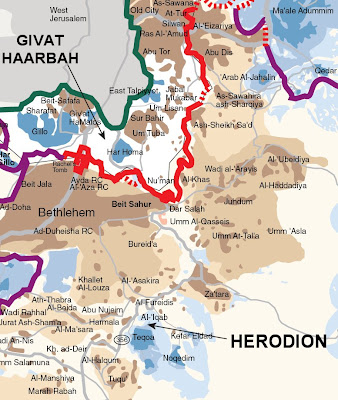
To get our bearings, we first went to Givat HaArbah, "The Hill of the Four," which was once a Jordanian position a few meters across the "Green Line," the 1949 armistice line between Israel and the Jordanian occupied territories. The hill got its name from four Israelis who strayed too close to the border and were killed by Jordanian sentries. Today, it provides a commanding view of the surrounding area.

TO the north is Kibbutz Ramat Rachel. This Kibbutz was founded in 1926. As was true for the entire country, the facts on the ground set the borders of the state. Because the Kibbutz was able to survive the Jordanian invasion of 1948 through to the end of the war, the "Green Line" was drawn to include it. The border ran right through the valley in between them (shown below.)


Olive groves in the border of Kibbutz Ramat Rachel
The fight to capture Givat HaArbah in 1967 was tough and bloody. Soldiers who tried to capture it by direct assult were gunned down in the fields. Eventually, the Air Force was called in and bombed out the bunkers.

Bombed out Jordanian bunkers.

Closer Up

To the west is the "contraversial" building project of Har Homa. This hill, which was across the border, housed the remains of a Byzantine era defensive fortress. The only clearly visible remain from a distance was the "Wall," or "Homa," in Hebrew. Israeli soldiers guarding the border looking across aptly named it "Har Homa," "Wall Mountain," and the name stuck. Recently, construction of a massive new Jewish neighborhood has been continuing apace, and Prime Minister Olmert incurred the wrath of his American handlers when he approved a few hundred additional housing units there last month.

Har Homa

Har Homa up close

To the south, is Beit Lechem, "The House of Bread," also known as Bethlehem. The birth village of David Hamelech, King David, it is today firmly under the anarchic realm of the Palestinian Authority.


Olive groves and terraces, on what is probably some of the most expensive real estate in the country, and Bethlehem.

The spires of churches in the old city of Bethlehem peeking up ober contemporary buildings. Today the city has been largely Islamified, and it seems likely that it will have been completely de-Christianized in the coming decades.


A large concrete wall shelters civilization from the Palestinian Authority.

And off in the distance is the Herodion. It's clearly artificial top, and the lowered top beside it, make it an obvious landmark.

Next stop... the Herodion.

Wednesday, April 23, 2008

In and Around Jerusalem

With Chol Hamoed Pesach (the indermediary days of the Passover Festival) upon us, millions are off of work, yeshivot and schools are empty, and I find myself wandering around the city. So I snapped some random shots.

The bridge is coming along now. You can see it from almost anywhere in the city.

A shul in Har Nof (Chareidi Neighborhood)
Flags are coming out, Independence day is coming up.
The public burning of the chametz (leaven products forbidden during Pesach.)
Ad for tours during Pesach.

And today I went hiking through the forests east of Jerusalem.

A natural spring East of Ein Kerem

A wandering scorpion

Looking towards Mevasseret Tzion

We came across a lool (chicken coop.) Life behind bars, no parole.

A view of Ein Kerem hospital and Har Nof in the background.

Monday, April 21, 2008

Journey to the Jordan 4: The Northern Shores of the Dead Sea

Our next stop was the northern shore of the Dead Sea (I seem to be coming here a lot lately.)

A British vacation house built on what was once the shore of the Dead Sea during the British Mandate (1917-1948.)

After Jews were free to return to the Arava region in 1967, after a 19 year absence, the Labor movement, which still controlled the entire state system, began the debate over what to do with the newly captured territory. Having reached the decision to settle, the first new settlements were built on the ruins of those which existed prior to 1948. Beit HaArava was one of the first, founded by the kibbutz movement. It was only one year before 1968, which was remembered worldwide as the year liberalism transformed into a more anti-establishment ideology. This is, not coincidentally, also the year Palestinian Nationalism was invented. The Israeli left gradually drifted into the same anti-establishment sentiments seen worldwide, which was particularly ironic since they were, themselves, the state. While the first labor-party Kibbutz, Beit HaArava, was founded by the Labor movement, and survives to this day, the secular-socialist settlement movement never really took off. The movement had already peaked and was in decline. Instead, it would be the religious settlers who would provide the bulk of the numbers for this new wave of building.

Meanwhile, the state made some deals with Arab investors across the river in the Hashemite Kingdom of Jordan to try to develop the region. Such deals, of course, had to be kept secret, since Israel and Jordan were still at war, and Jordan still claimed this region as its own.

The hotels, built along the northern Dead Sea, never really took off, and today their ruins still litter the roadside.

An abandoned, 1970's-era hotel.

The hotel had an ampitheater, open to the dead sea, where concerts could be held.

The Ampitheater

The shores of the Dead Sea used to come right up to the steps. Today the sea has retreated probably about a kilometer away as it slowly dries up.

Steps into the phantom water.

One tenant (grasshopper) never checked out.

The hotel is in need of some minor structural repairs.

On the walls is a cool-looking mural of the Holy Land, based on a Midieval manuscript.

The Galilee

The Hula
The artist got creative and painted flames shooting out of Sdom (Sodom.)


It's not pretty, but the structure still stands. Given the building ban and housing crunch in the Jericho region, perhaps some day some enterprising youth will come to put the structures back to use as a yeshivah or a school. I know just the types to do it.