Wednesday, October 18, 2006

Gettin Out There

Living in the telecommuting bubble can be easy. Almost too easy. Listening to news all day in English, talking with my coworkers... in English, it's easy to forget that I actually live in another country. Mail comes in, I don't understand some of it, so I just sort of put it aside for later. And later becomes never.

But the thing about Israel is that it's the details that kill you. Small mistakes on paperwork or unpaid bills can come back to haunt you. Of course, that's true anywhere.

I recently read a horror story of an oleh who didn't pay his rent and ignored a warning letter because he didn't understand, and ended up in a perilous legal situation. I've been having this sneaking suspicion that somewhere, somehow, I've missed something, so I decided to leave the bubble for a day and follow up on every loose end I could think of.

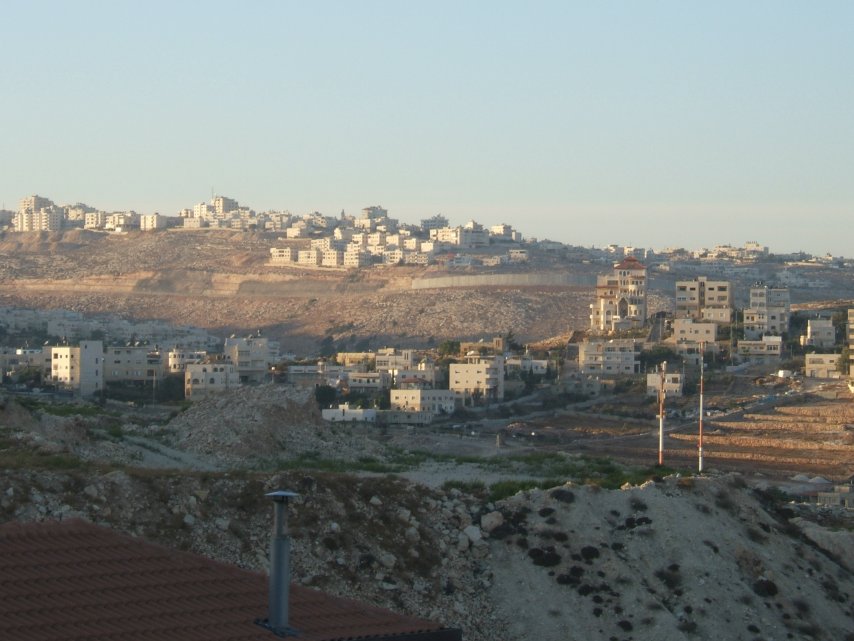
I left the house. From the bus stop I have a pretty good look at my street.

My house in the middle of my street.


I proceeded to Kikar Tzahal (army square) next to the old city walls. They have been working on the Jerusalem Light Rail System since the last time I lived here, four years ago. Expected date of completion, June, 2006! But, since they're nowhere near done, they decided to put up this poster of what the Kikar Tzahal station would have looked like if they had finished on time.
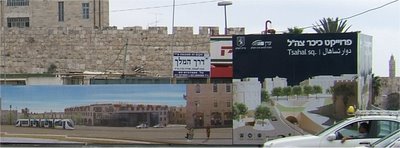


Kikar Tzahal


I came to my bank and found the hours posted on the door.
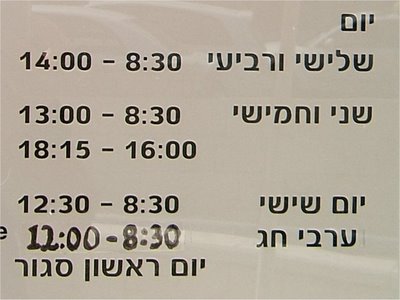


Everybody has their little piece of Hebrew that they'll never get used to, mine is reading "Opening Hours" signs because, while Hebrew is read from right to left, numbers are still left to right.

You have to do it in the following order, illustrated below:

1. Read the day (In this case Tuesday and Wednesday.)
2. Since numbers are still left to right, you have to skip ahead to the beginning of the next number.
3. Reverse direction and read from left to right (8:30 PM)
4. Switch directions again, and go from right to left to get to the hyphen.
5. Read the hyphen right to left.
6. Skip ahead to the beginning of the next number.
7. Reverse direction and read the number (in this case, 14:00, or 2PM.)

And now you're done! The bank is open from 8:30 AM to 2 PM.

The equivelant in English would be to read a sign that says:

Tuesday 00:8 - 00:41

Speaking of hours, what ever happened to nine to five? And notice that each day has different hours? Hello?

Not only that, every office, be it the bank, post office, ticket counter, you name it, has it's very own, special hours, which are usually different on each day of the week. And sometimes you show up at the right time and the doors are locked anyway.


Anyway, I managed to make it to the bank when there were actually other humans there, which was no small feat. I checked my account balance, no, no disasters, nothing in the negative, no erronious transactions. Beautiful!

Next, I headed to Kanyon Malchah, where I bought my fridge. The problem was that since I ordered the new one over the phone, I didn't have a receipt for it. I had at the back of my mind that they could be charging me just about anything for that fridge and claim I had okayed it, so I figured it would be worthwhile to check.

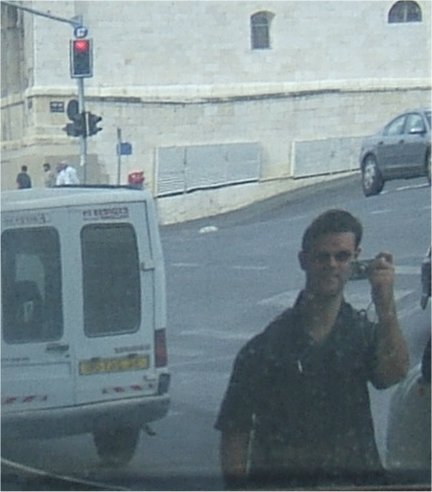
On the way, I paused for a moment of self-reflection (below.)
I went back into the electronics store, found my salesman who was, shall we say, a bit apprehensive at seeing me. But when he realized all I wanted was the receipt he relaxed a bit. I checked the bill and... no mistakes, they didn't overcharge. But something still felt wrong.

Meanwhile, Moshe showed up to say hi and give me a ride.


Blurry Moshe

We went back to his place and he helped me read through the pile of mail I had been struggling with. Eventually we found a suspect bill. It was a bill from Bezek, with whom I had opened an account, then closed it after realizing that they were physically incapable of installing the line. Moshe immediately got on the phone and started yammering questions at the operators. Half an hour later, we understood that it wasn't a problem. The bill had been sent before they had closed my account. No problem. But something still felt wrong.
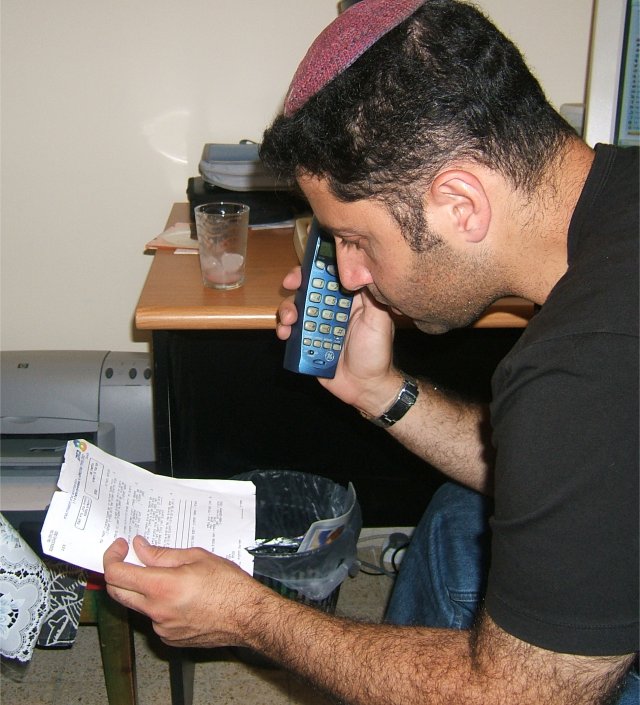
Moshe haggles on the phone.

Later, Moshe took me to Talpiot and helped me negotiate for a bed, as my air mattress has finally sprung a terminal leak. We found a decent deal for 900 shekels total, and he took me home.

I came home and sat at my computer. Strange... nothing went wrong. I was sure that... well, here's an email from my father. Some sort of scanned piece of mail. A letter from Wells Fargo.

MY WELLS FARGO CREDIT CARD IS DELINQUENT! Aha! I forgot to give them my forwarding address, so I haven't been paying the bills, and now my account has been forwarded to a collection agency. Yes! Thank GOD! I figured it out! So I called them up to deal with it, wasn't too bad, and they speak English.

And I'm already getting ready for the next big trip tomorrow. I have a shidduch in the morning (wish me luck,) then a bus to Ashdod to visit my old Be'er Sheva roommate Yigal, and then off to stay with some farmer cousins at the religious moshav (agricultural settlement) nearby, Moshav B'nei Darom. I'll be off the blog for a couple of days but the pictures will be a'comin'!
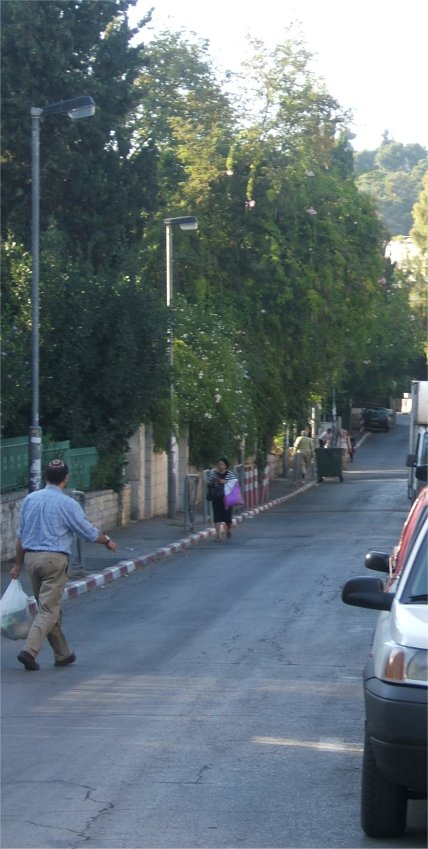
Emek Refaim Photos

I've been sick for the past couple of days and so have not been able to blog (or do much of anything.) Today I finally got out of the house, and went down to Emek Refaim, a happenin' south Jerusalem neighborhood, for some fresh air.
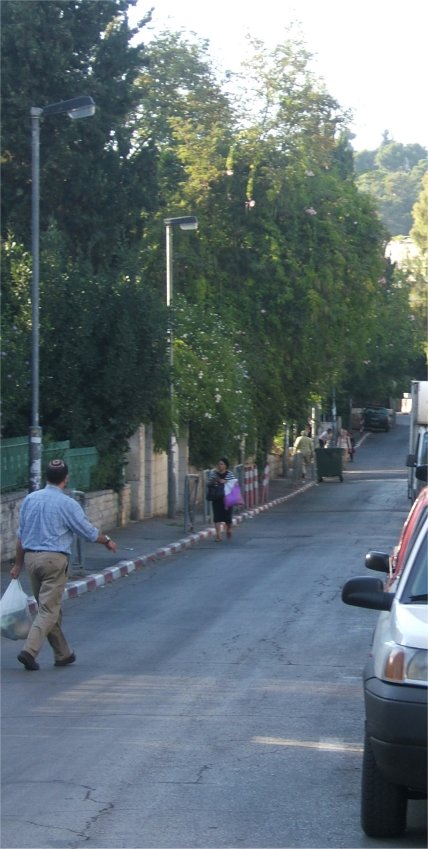
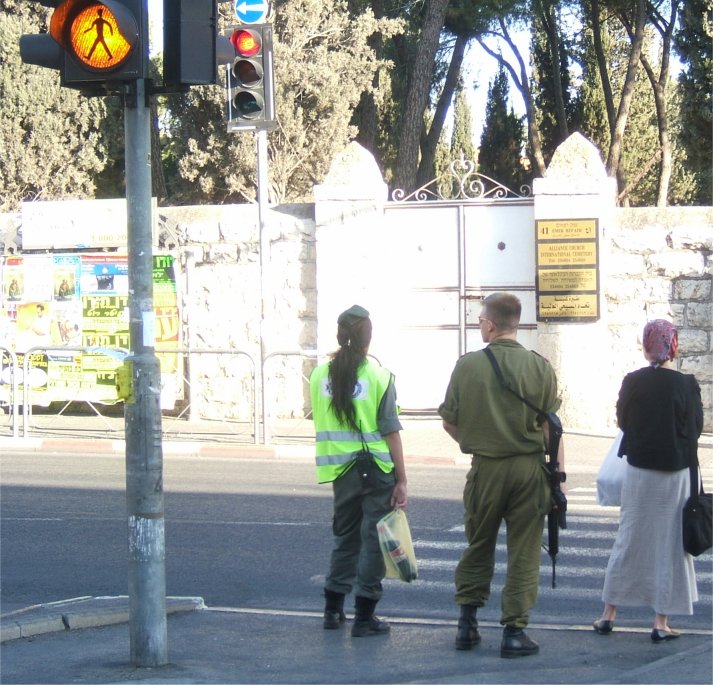
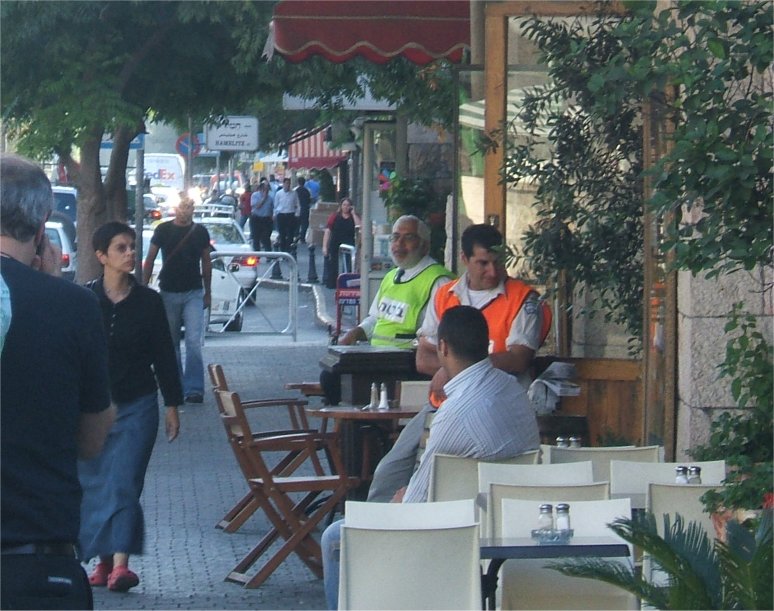
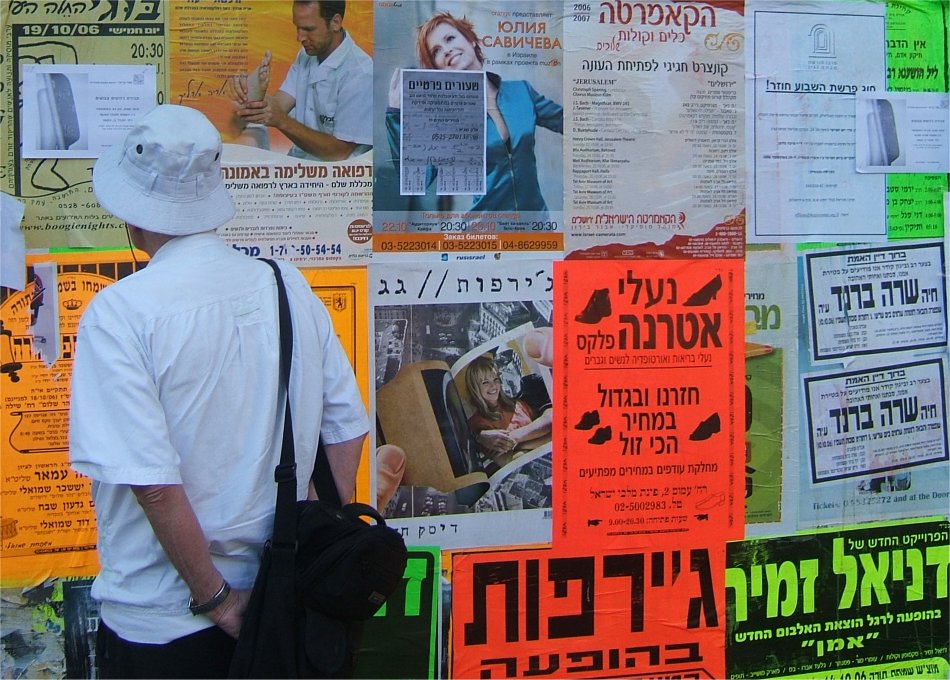
Here are some street shots I took in the Emek Refaim area today.
Bus stop people

A quiet side street.


Crossing guards.


The performing arts center


Another side street.

Emek Refaim coffee shops. Security guards in flourescent.

The same scene from a different perspective.


The message board.

Sunday, October 15, 2006

And There Was Much Rejoicing! The Second Hakafot

In the far reaches of the diaspora, like Walnut Creek, the festival of Shmini Atzeret at the end of Sukkot, where we complete the yearly reading of the Torah and begin againis a two-day festival. The second day is the festival is called Simchat Torah (Happiness of Torah,) during which all the Torah scrolls are removed from the ark and carried around the shul (synagogue) with dancing and singing. Each circuit around the shul is a hakafah, and there are seven total (although the dancing goes on for hours and hours and hours.)

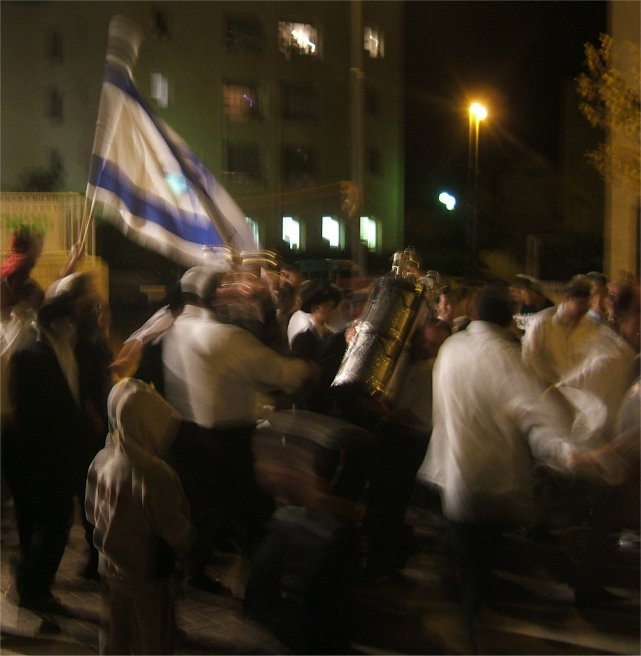
Within the land of Israel, holidays are celebrated for only one day rather than two, so Simchat Torah and Shmini Atzeret are all crammed into one day. But in the evening, after the holiday officially ends, those of us in Eretz Yisrael (the Land of Israel) celebrate a "Second Hakafot," this time with live instrments and electronic music (which are forbidden on Shabbat and Holidays.)

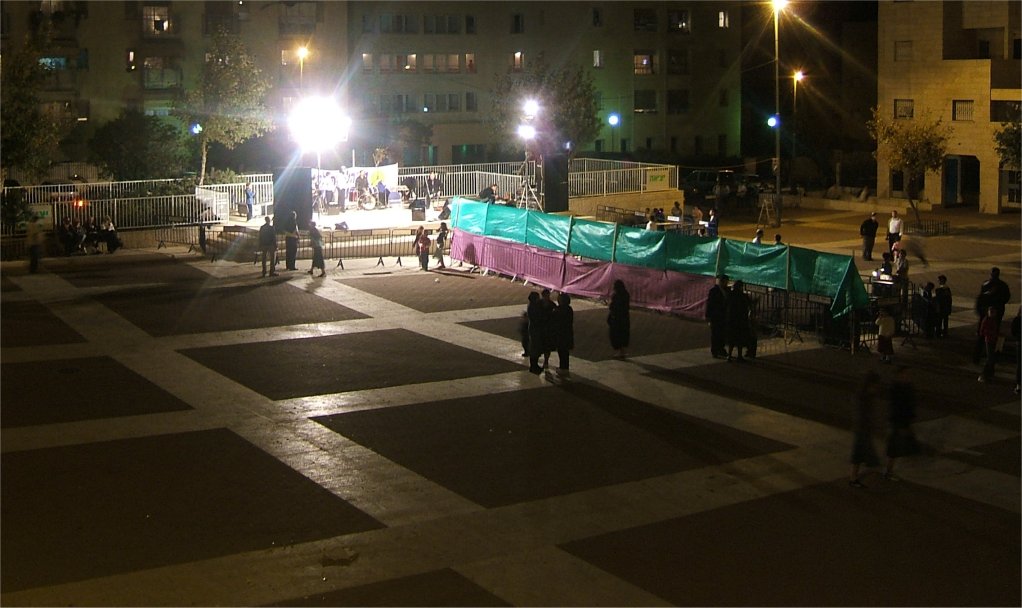
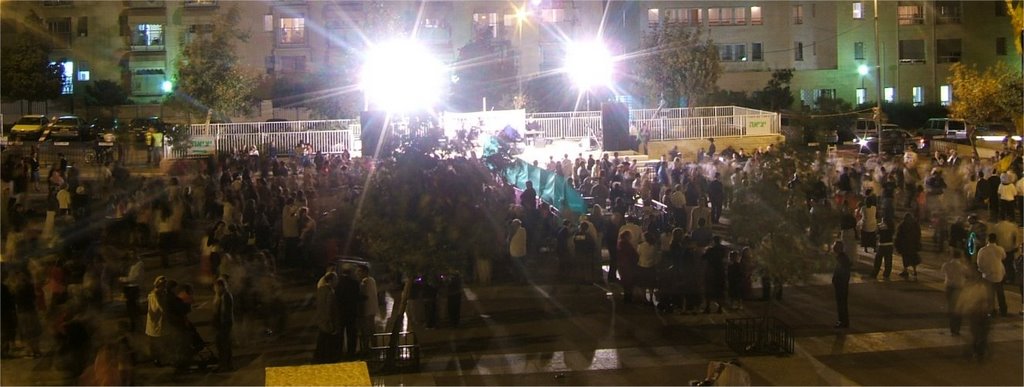
In Pisgat Ze'ev, the town square is set aside. Below, the setup begins, with the stage, lighting, and Mechitzah (separation for men and women.)


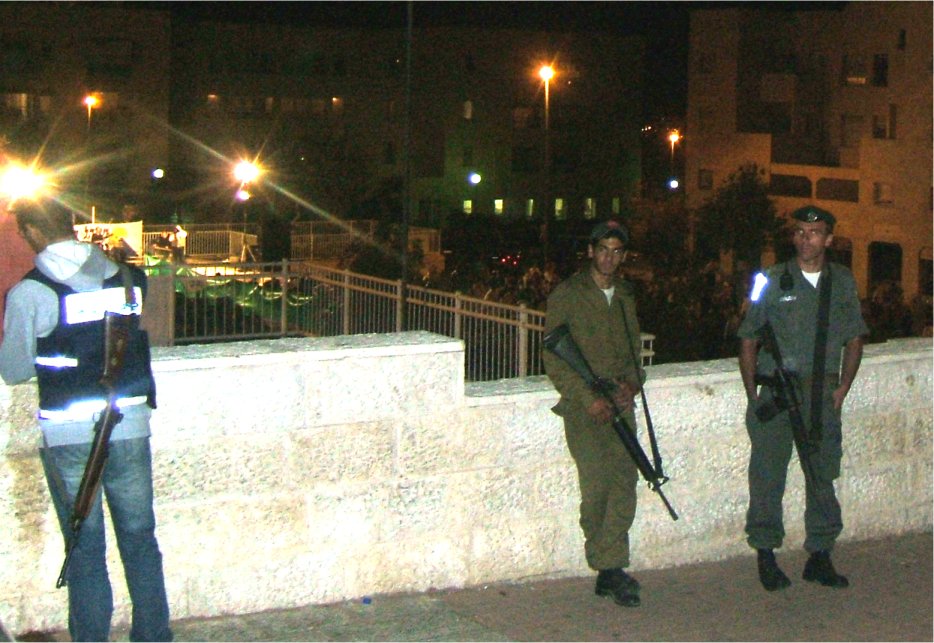
Lest we forget that we live in the middle east, the ever-present security forces take up positions.


Meanwhile the band warms up, and the teenagers get excited.


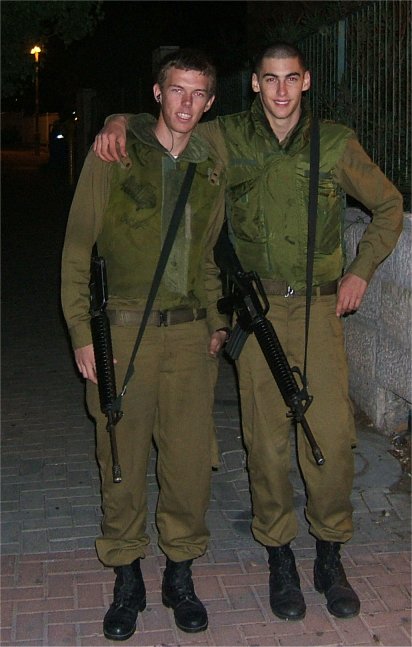
A couple of soldiers guard the parking lot.


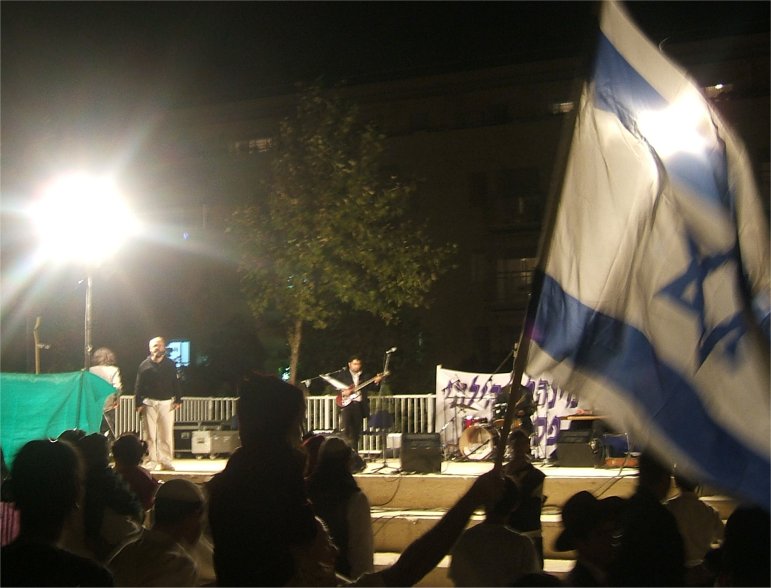
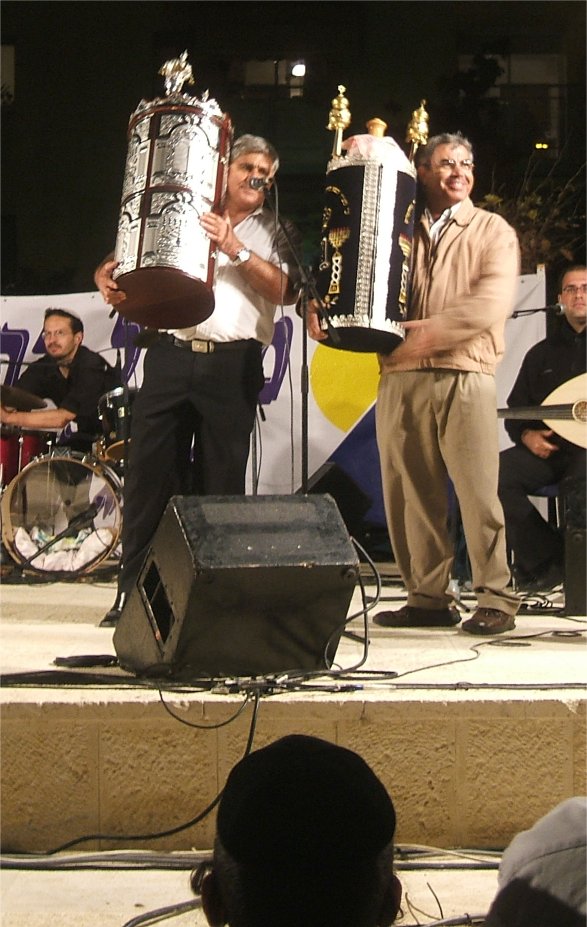
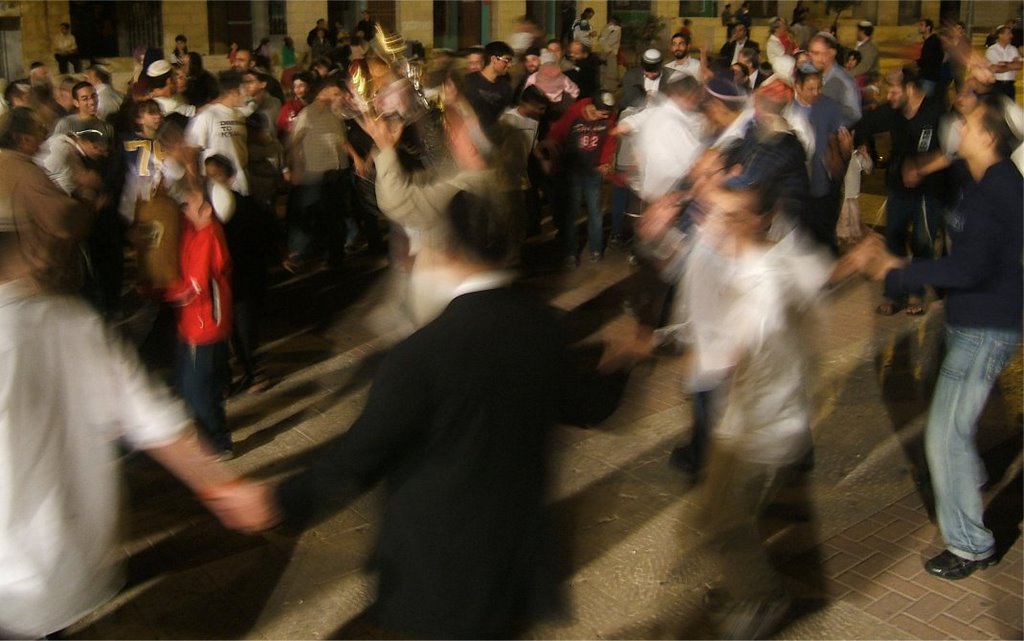
The music gets started, and people pour into the town square for dancing, waving flags and holding up Torah scrolls.


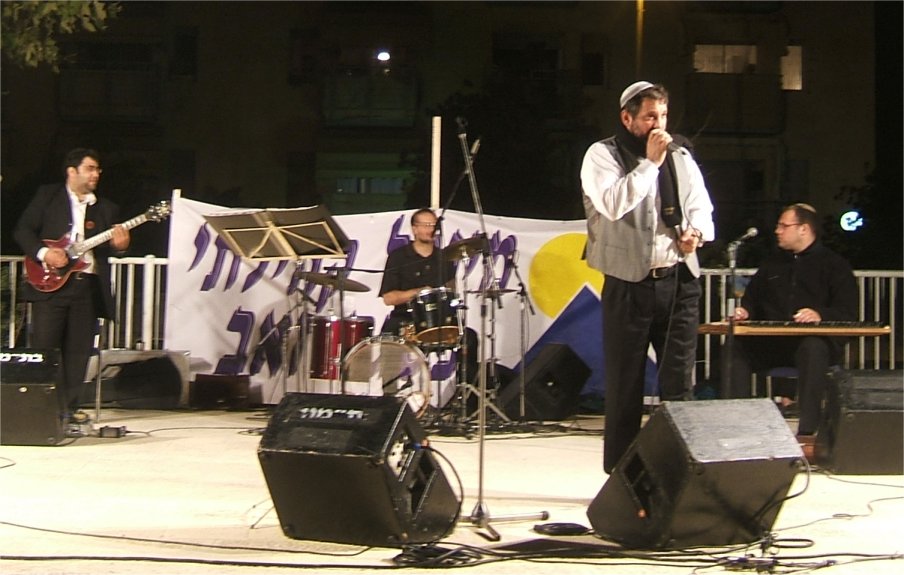
Cousin Rafi was the lead singer.


More Dancing.


For the first Hakafah, two representatives are called up to read Hakafot.


Meanwile, vendors show up with cotton candy and popcorn for the kids.


The dancing continues.


I bump into Shmulik, Rafi's brother (who I seem to bump into every day on the bus.)


Meanwhile, the dancing continues.


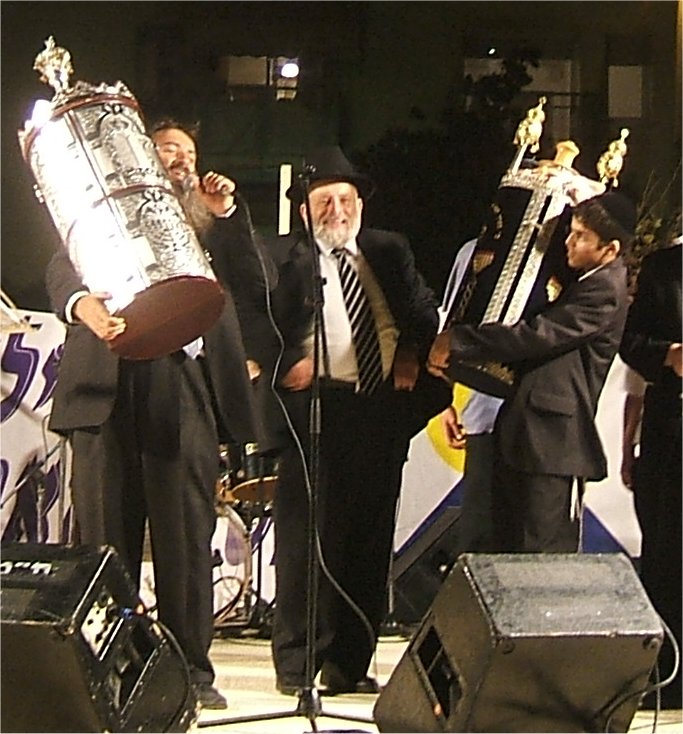
For the second Hakafah, Rabbi Shlomo Ish Ran, who happens to be Rafi's father, is called up to the stage (center.)


Rafi's brother in law, Yehudah (pronounced Yoodah) dances with a Sefer Torah.


Another Hakafah. This time, the honor is given to the chief of police and the security guards. Um.. guys, who'se guarding the entrance?


And the music continues...


... as does the dancing.


The crowd fills the square.


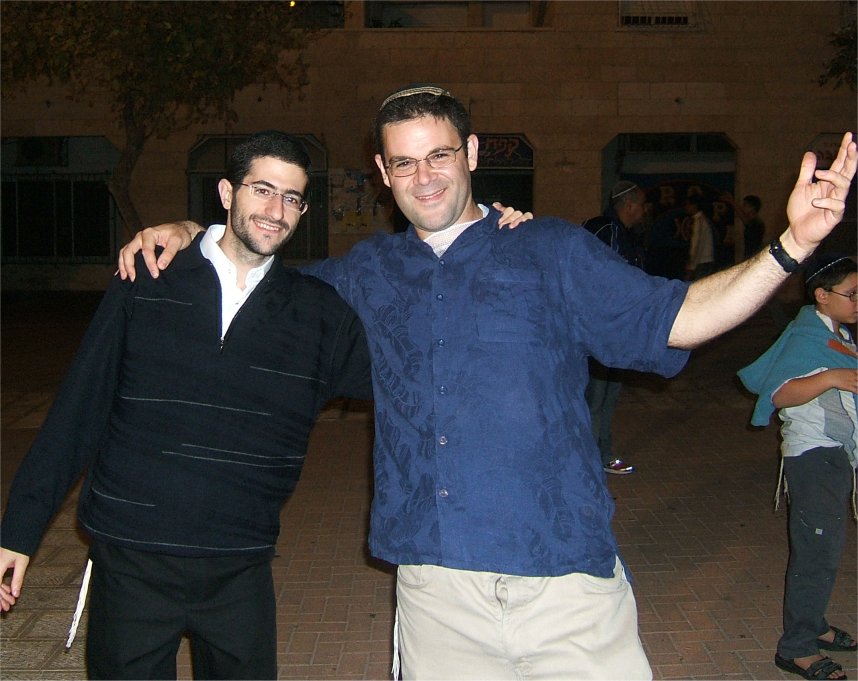
The Ish Ran boys: Yehudah, Rabbi Shlomo, Shmuelik.

And the band played on.


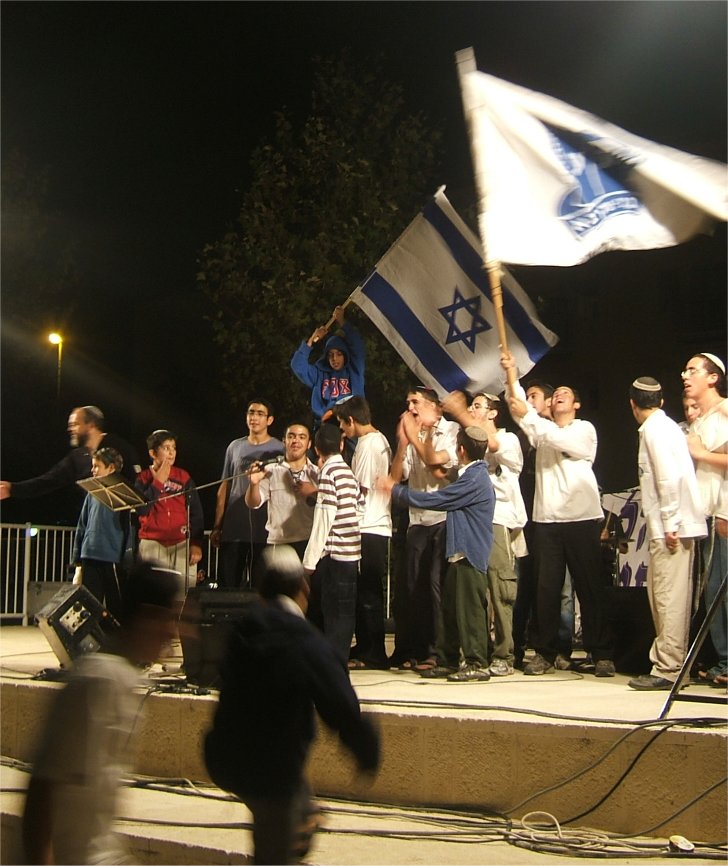
The final hakafah (I know, there were seven, but I skipped a few.) The boys from B'nei Akivah, the National Religious youth movement, run up to the stage.


Yet more dancing...


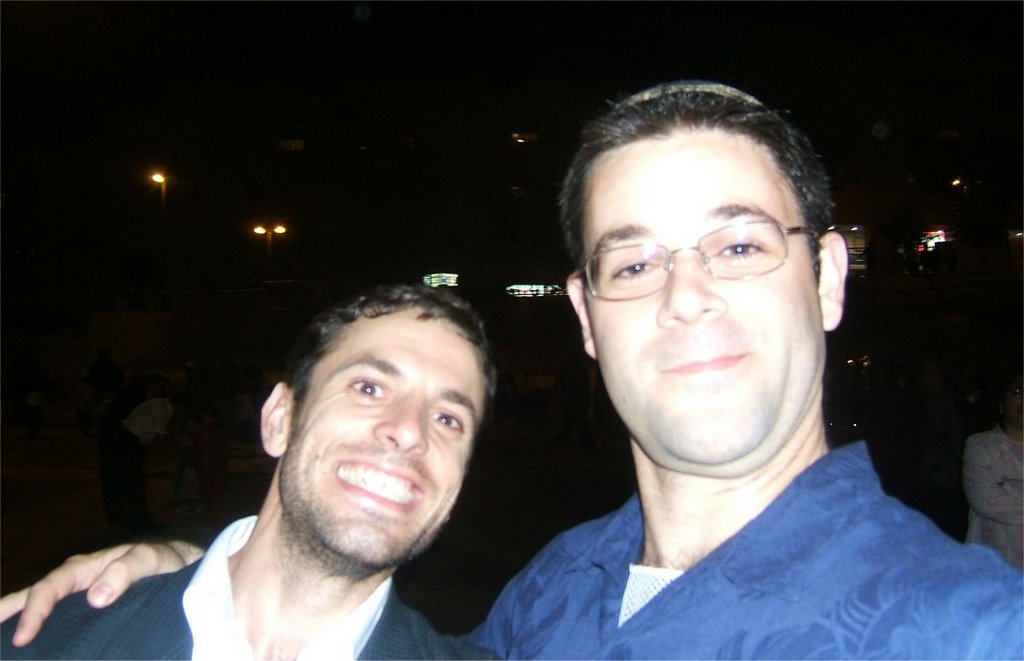
I bump into Yehuah in the crowd.


The party rocked on for four hours, ending at around midnight. Today, we all woke up and dragged our sore bodies back to work.

Friday, October 13, 2006

Hoshanah Rabbah

Today is Hoshanah Rabbah. We put away the lulav and etrog, and say goodbye to our sukkot. The shabbat siren just wailed over Pisgat Ze'ev, warning the town to light candles before the onset of the sabbath. My landlord invited me over for the evening, so I'll be getting to know him, and the whole family that lives upstairs from me, a little better.


My Cousin Rafi learning in the Sukkah


Tonight begins Shemini Atzeret and Simchat Torah. One of the most joyous days of the year. There will be much rejoicing and consumption of alchohol tonight and tomorrow. Chag sameach from Jerusalem!


Thursday, October 12, 2006

Settling In

A Plus: 1 Month, 3 Weeks, 5 Days
 
The Sukkot holiday is winding down.  In shul this morning, people's arba minim, the unpoened palm fronds, myrtle and willow branches, and etrogs shaken together during morning prayers for the Sukkot holiday, are starting to look a bit worn.  The leaves on mine have all but dried, and some fall off every time I shake them.  Tomorrow is Hoshannah Rabbah, the last day we use the arbah minim before the end of the holiday.  Meanwhile, I'm seeing more and more familiar faces as my local friends who left on vacation drift back into town.  Saturday is Shabbat (sabbath,) plus the festivals of Shmini Atzeret and Simchat Torah, three major celebrations wrapped up into one.  On Simchat Torah, we read the end of the Torah, rewind, and start again for the new year.  We also begin reciting the daily prayer for rain, marking the official onset of winter on the Jewish calendar.  As I was walking home from shul this morning, I found myself splashing through puddles.  Winter has jumped the gun, the rains started two days before we even asked. 
 
After the last thrilling couple of months, it's a relief to finally have a routine down.  I've got my place.  I have a fridge.  I know the town.  I'm working.  I'm here.  There don't seem to have been any technical glitches so far with my telecommuting scheme, and I'm now busy with two design projects.  Per my agreement with my employer, I am in my office from 6 PM until 10 PM Monday through Thursday (8 AM through Noon Pacific Standard Time,) so that they have dedicated hours when they know they can call and get a hold of me.  I am also free to work other hours as is needed, and they send me enough to keep me very occupied.  The advent of high-speed internet, which was just coming on line in Israel when I lived here four and a half years ago, has made a major shift in the entire aliyah experience.  When I set foot in my office, it's as if I've stepped back into California.  I can sit here in my Jerusalem office, talk over a nearly perfect phone connection to friends and coworkers in the states.  When I call equipment vendors, I usually don't even mention that I'm not in Walnut Creek any more, and they don't know to ask.   I listen to my familiar Bay Area radio stations, all of which have internet broadcasts, while I work.  Other olim (immigrants) still keep up with their local sports teams and watch internet broadcast television from the states.
 
Despite the major advantages of telecommuting; not having to start over all at once with a new career, new language, and a new, lower budget, the main drawback is that puts me into an Anglo-hermit lifestyle.  I can sit here in my apartment for the entire day, just listening to broadcast news and English talkshows while I work.   In the short run, it's comforting to swim in my own language, but at the end of the day, it's depressing to live without human interaction. 
 
Another problem I've been having has been getting shidduch dates.  When I first arrived I was amazed at how many offers I was hearing about, but there's very little follow-through, and ideas for shidduchim don't necessarily result in real dates.  The problem is that nobody comes directly to me, they usually go to cousins or friends to ask about me or mention potential shidduchim, so I only hear whispers that someone was asking about me, and I don't know where to go to follow up.  The fact that I disappear into my telecommuting bubble for most of the week doesn't help matters either.
 
So my next mission is to pop the bubble.  The local ulpan (intensive Hebrew course) starts next month, but it only convenes once a week, and the other Ulpanim don't start until January.  I have some open hours in the morning, and the holidays are ending, so I'm researching different programs or courses which will be starting up over the next couple of weeks.  Jerusalem is a big city, and I'm sure there's a spot for me out there somewhere.

Monday, October 09, 2006

Sukkot In Yerushalayim

Not much to report these days. I'm finally settling down into a routine, exercising again, and working evenings. The shidduch (dating) scene is a lot tougher than I thought it would be, but most things worth doing require hard work. The main problem is actually getting dates. I hear whispers (mostly through my cousins) of people asking about me, figuring out with whom I should be set up, but it doesn't always amount to much. People see me on Shabbat, they have the nice thought of setting me up, and then within a few hours it slips their mind. Because they never come directly to me, I can't really follow up after them.

Well, I do have a date tonight, and hope springs eternal.

In the mean time, Sukkot is moving ahead full steam, so here are some pictures. I went downtown to meet a friend for breakfast, and got a nice view of downtown Jerusalem during sukkot.

During the festival, one must eat all their meals inside of these sukkot (temporary dwellings made from vegetation.) In order to stay open, many restaurants in the city build their own Sukkot for outdoor seating.

A restaurant sukkah.

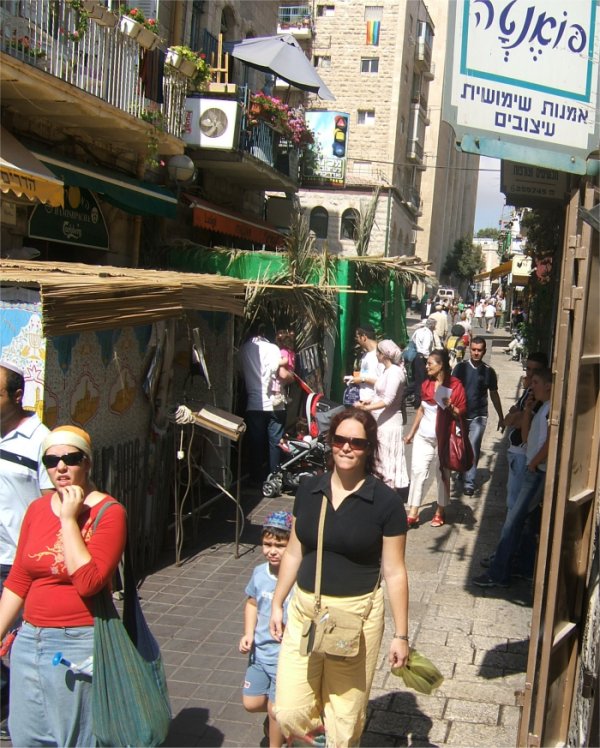
Sukkot in the Ben Yehudah area.
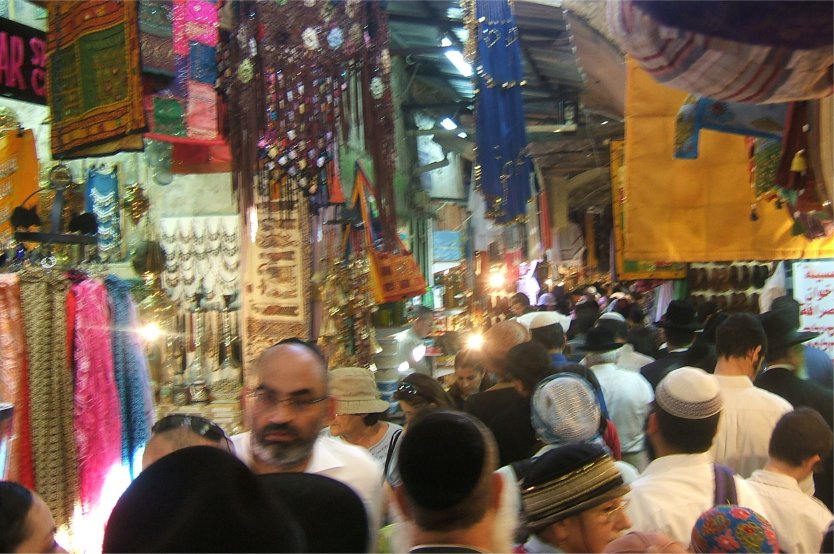
I decided to visit the Kotel (Western Wall) in the old city while I was at it. The city was extremely crowded. Reminds me of early 2000, before the intifadah.

Walking down the main strip.


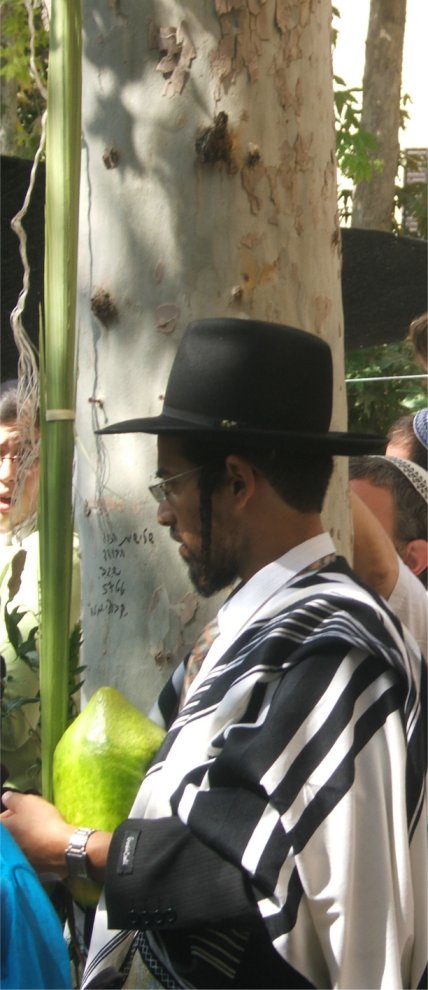
The Yemenites have these absolutely enormous etrogim (the big fruit he's carrying.) They leave them on the branchces for several years to get nice and large.

Rishon L'Tziyon, former chief Rabbi Mordechai Eliyahu. (He's the one with the turban and fancy coat.) Taken in the Jewish quarter of the old city.

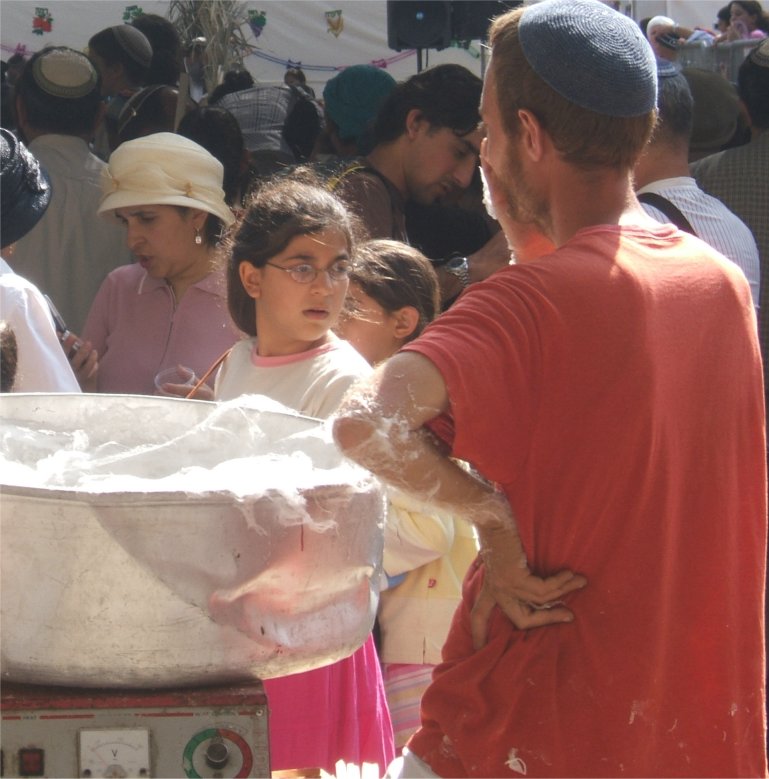
The cotton candy man.


At the Kotel, learning to shake a lulav.

Another one of those enormous etrogim.


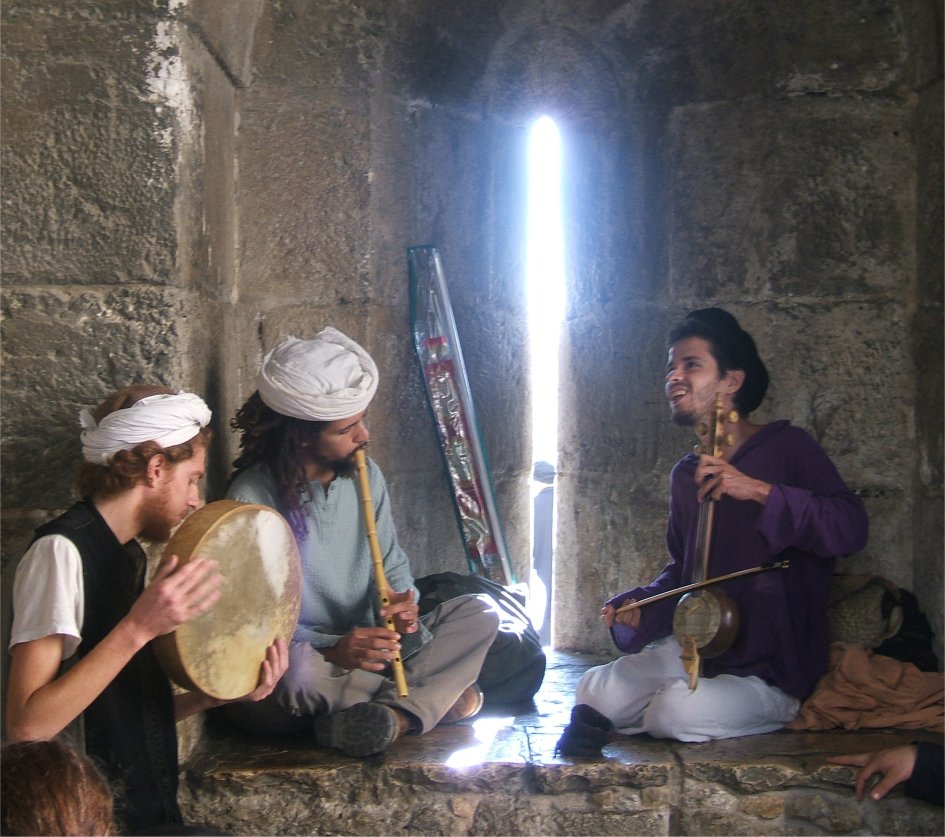
Musicians sitting in the city gate playing.