Monday, March 26, 2007

Sderot 3: Life Under the Rockets

Arriving at our destination, Noam Bedein of the Sderot Information Center met us near one of the older apartment complexes in the city. Built prior to the laws passed after the First Iraq War requiring all buildings to have bomb shelters, the original apartment blocks of Sderot are completely unprotected.


One of the original tenement blocks of Sderot, circa 1950's.

Overall, the security situation in Sderot is one of grinding misery. Since the rocket launches have started seven years ago, families living in unprotected homes have crowded into the most protected rooms they can find.
"One of my friends' families," Noam tells us, "has been sleeping together in the living room for two years. Parents, children, everyone."
Evidence of the rocket attacks are everywhere, if you know where to look.

Damage from an Arab rocket attack on a public market.


What looks like an ordinary pothole is a recently repaired crater from a rocket attack.

Grooves cut in the brick, dug by shrapnell radiating outward from the impact location.

A view of the site of the same attack. Qassam rockets fire deadly shrapnel over 100 feet. Note the new glass on all the store windows.


People living under rocket threat are forced to make unbearable choices.

"I was in shul a few days ago when the 'Red Color' went off," Noam tells us. "I saw a father with two children, who was forced to decide which child to carry with him to the shelter."


The remains of Qassam rockets. Each terror gang paints its rockets a different color, in a sort of friendly Jew-killing competition.


Exploded Qassams

Occasionally, some money will shake loose from the government, or more often from private donors. The question then becomes where to spend the money. On researching a defensive system to shoot down the Qassams, or to fortify school buildings.

Driving through the town, I suddenly realize the purpose of the half-tubes built over the buildings I saw coming in.
Rocket protection over a school building.


But rocket proofing the schools has not been easy. To completely protect a school building costs two to three times as much as the building itself. In order to avoid the cost of completely protecting the school buildings, the government only provided a fraction of the funds necessary. The argument was that children in grades one through three would not be able to empty a classroom in fifteen seconds, but older kids would.

More rocketproofing over school buildings.


Shrapnel-proof windows.

To prove their point, the army filled a schoolroom with soldiers and ordered them to evacuate the room, which they did in under fifteen seconds. The fallacious argument that a classroom of fourth graders could be expected to evacuate with the same orderliness and precision as a group of adult, trained soldiers is laughable, but it prevented the government from having to pay for the additional fortifications. The city of Sderot is now suing the government for the extra funding required to completely rocketproof the schools.


The first rocket-proof Kindergarten in Israel. Note the thickness of the concrete.

By far the most disturbing idea is the long-term psychological effects that the terror bombardments will have on the children. Today there is a generation of children being raised who have never lived without the Qassam threat.

"A teacher told me that she asked her kindergarden class what the snail's shell was for. They all answered together, 'To protect it from the Qassams.'"

And what about going home from school? Well, you're on your own at that point.

To be continued...

Sunday, March 25, 2007

Sderot 2: Attack and Response

To every measure, there is a countermeasure. Israel has set up watch stations along the border with Gaza. Heat-sensitive cameras trained on Arab villages on the other side detect the high temperature of the rocket engines as they rev to full speed. This heat signature triggers an announcement over loudspeakers throughout the town, "Red Color! Red Color!" which sends Jewish civilians running for cover. After fifteen seconds, no more, the rocket impacts.


Thermal imaging equipment on a hilltop overlooking the Gaza border watching for the heat signature of a missile launch.


The frequency of missile strikes against Jewish civilians varies as the security situation heats up or cools down. On an average day, the city is bombarded with three Qassams. During a cease fire, when Israel refrains from all defensive military actions, the number of bombardments can reduce to as few as one or two. During a particularly bad spell, sixty Qassams landed in one hour, during Shabbat. Missile strikes are carefully timed for commuting hours, when people are out and unsheltered, to increase their chances of hitting innocent civilians.


Map showing Qassam strikes, as well as fatalities, during the Sderot Blitz.


There are small victories. An observation blimp with , tethered to the Israeli side of the Gaza border, peers over the border into the wastes of the now-destroyed Jewish settlement of Elei Sinai.


While the residential areas of Gazan Beit Hanoun are a mere half-mile from Sderot, they aren't far enough to fire into the neighboring, much larger city of Ashkelon. Occasionally, rocket crews set up in the ruins of Elei Sinai and the race is on. Can the Israeli army spot and kill the rocket launchers before they can fire their deadly weapons?
Locations of the strategic assets on the Gaza Border.

The Ashkelon power plant.

Despite the Palestinian Authority's abrogation of the Oslo Accords, Israel still fulfills its requirements, supplying Gaza with electric power and clean water free of charge. The rocket crews have therefore been quite hesitant to hit the power plant itself, lest they knock out their own electricity, which they are totally incapable of generating on their own. This has not prevented them, however, from firing over the power plant and into the city of Ashkelon itself.
The observation blimp, tethered to the ground.
Observation blimp closeup.

Israel is stuck in a precarious situation. Every military response necessarily results in the death of Arab civilians the Palestinian Authority uses as human shields. Rockets are launched from the rooftops of UNRWA schools or crowded apartment complexes. The terror gangs which make up the Palestinian Authority understand Israel's hypersensitivity to enemy civilian casualties, a hypersensitivity largely caused by the fact many Israelis in the decision-making class do not regard the civilians supporting these rocket attacks as enemies but merely future friends whose grievances and demands have not yet been accommodated. In order not to poison future negotiations, if they are ever to start again, and Israel attempts to reduce the suffering of the civilians living on the other side of the Gaza fence, and therefore does not respond militarily to prevent attacks from the civilian areas in Gaza. Similarly, Israel does not wish to poison relations with the rest of the international community, which expresses shock and outrage every time Israel enters Gaza to cleanse the place of rocket launchers and manufacturing facilities.
And so, the working class people of Sderot, without the friends in high places necessary to get anything done in this country, are left to their own devices. As Labor Party leader and Nobel Peace Laurete Shimon Peres put it, "What's the big deal? Kiryat Shmonah was shelled for years. Qassams, shmassams."
Ruins of exploded Qassam Rockets

Thursday, March 22, 2007

Sderot 1: The Qassams

Previous related posts on the history of Gaza and Sderot:

Gaza of the Phillistines
Gaza in History 1: The Romans through Israeli Independence
Gaza in History: After Independence
Sderot and the UNRWA
Gaza until the Peace Process


During the first intifada, and even more intensely during the peace process, the walls began to rise again. As Israel weakened its grip on Gaza, and its will to fight as a nation ebbed, the Arabs continued to increase terrorist attacks. After Israel had withdrawn from Gaza and major Arab cities, it was no longer possible to gather intelligence on the ground. Prevention of terror turned into fortification against the inevitable attacks. Prior to the intifada Arab representative issued only words of protest and condemnation against Israel. As Israel gradually came to accept Arab arguments, in the moral vacuum in which Israel refused to make its own case for a Jewish presence in Gaza, words turned into stone throwing at passing vehicles in the late 1980s. So Jews bought special shatter-proof windows for their vehicles. So the Arabs changed tactics and began suicide bombings. To prevent the suicide bombs, the Israeli Army set up makeshift checkpoints to search for explosives. Bombers figured out how to get around the checkpoints, so the checkpoints became fences. The Arabs figured out how to penetrate the fences, and the fences became walls.
Torn up dirt marking the ruins of Jewish Elei Sinai, destroyed in last summer's disengagement. The strip to the right is the new border wall.

On the other side of the wall, antitank rockets, C4 explosives, and small arms poured into the areas in Gaza recently abandoned by Israel. Any and every freedom and all humanitarian aid won through negotiations was immediately invested in intensifying the war against Israel. During the second intifada starting in 2000, and even more so after the Hitnatkut, the various terror gangs deployed small rockets.

The rocket is a crummy, barely airworthy baby brother of the Russian-made Katyusha, which gained infamy in last August's Second Lebanon War. Built from scrap metal and anything that could be stolen, including sewage pipes donated by international aid organizations, the rocket is wildly inaccurate but packs a 10-kilogram (22 pound) payload.


The Qassam rocket

The ease of construction makes it very difficult to control the import and distribution of the weapon. Rather than purchasing the rockets on the black market and importing them whole, they can be easily assembled from household goods. The critical component, the explosive warhead, is much easier to come by now that Israel has withdrawn from Gaza and surrendered all border controls to the Palestinian Authority. Launchers can also be readily assembled from spare parts.

Qassams, fired from makeshift launchers, can be assembled in seconds.

Hamas named the "Qassam" after a local Muslim fundamentalist preacher and highway bandit of the 1920's. Izz Adin Al Qassam formed his own terror gang, the "Black Hand," which attacked Jews and British living in the land of Israel during the 1920's and 30's, until he was surrounded by British police in a cave in Jenin and killed, thus entering local folklore.

Logo of Hamas' Qassam Brigades


Iz Adin al Qassam. Islamic fundamentalist, highway robber, and Gazan folk hero, killed by the British colonial rulers of Palestine in the 1930's


One thing I had never understood until arriving in Gaza was their ability to consistently hit the city of Sderot. After all, if these rockets are so crudely constructed, and wildly inaccurate, how could they make such precise hits? Maps appearing on the news showing firings from Arab Beit Hanoun into Jewish Sderot show the cities as two tiny dots.

A map showing the range of the Qassam


But travelling to the outskirts of the city, and viewing the proximity of the two cities gives a much better understanding why the rockets have been so successful.


Sderot is less than half a mile from Beit Hanoun, and the city of Sderot sprawls over several kilometers. One only needs to fire a rocket in the general eastward direction and it's bound to hit something, or someone.


Stay tuned for Part 2: Attack and Response

Wednesday, March 21, 2007

Sderot and Gaza in History, Until the Peace Process

Following Israel's capture of the Gaza Strip in 1967, it seemed that things would finally take a turn for the better. Sderot was now off the front lines. With Israel in control of Gaza, the terrorist raids came to an end. Israel even attempted to rid the UNRWA schools of antisemitic textbooks, but the United Nations immediately howled in protest. An occupying power, so the argument went, had no right to interfere with the daily education of the people under occupation. By censoring Arab textbooks, Israel would be disturbing the local culture, brainwashing the schoolchildren into thinking that craven acts of psychotic violence were somehow evil. Likewise, when Israel stepped in to build high-rise apartment complexes to finally empty the miserable slums, still full since the failed Egyptian invasion of 1948, the local terror gangs prevented anyone from moving in by force. Emptying the slums, ending the misery, might serve to distract the residents from the overarching goal of restoring Arab honor, soiled in '48 and again in '67.

But the Arabs were allowed to come into Israel to work. In fact, the fences and borders came down everywhere. With no walls, patrols or checkpoints, Arabs could work freely anywhere in Israel. The road from Gaza to neighboring Ashkelon crowded with traffic from commuting workers.

Sderot Today

"Welcome to Sderot"

Sderot, a traditional town, is by no means a religious. But the people aren't far from Judaism. Like most working-class Sephardim in Israel's south, the people have a genuine respect for Torah, even if not stringently adhering to its guidelines at all times.


A man walking through Sderot preparing for Shabbat (sabbath.) Behind him, a billboard displays the weekly torah portion, as well as the times for the beginning and end of Shabbat.

Like everywhere else in the world, Sderot has its own Chabad house.

Putting on Tefillin in Chabad.

Driving through Sderot, one sees strange sort of walled semi-circles arching over some of the buildings. More on that later.
A strange looking structure.

Sunday, March 18, 2007

Heading North

I'll continue my posts of my trip to Sderot shortly. But for now, I'm heading up to the Golan with Machon Meir, and I'll be back wednesday.

I went to a wedding in Gush Etzion Thursday (also to be blogged) and a late winter storm left about six inches of snow on the ground! So there should be plenty to see in the Golan, if it's not actually snowing, that is. Either way, the pictures will be posted!

I'll be back to blogging on Wednesday. Shavua Tov, Chodesh Nisan Tov (Have a good month of Nissan.)

Saturday, March 17, 2007

Sderot and The UNRWA

At this point, seeing that the nascent Jewish state was to survive, the United Nations began to regret its earlier recognition, and began a policy of naked hostility towards Israel which has lasted from 1949 to this day. Since that time, roughly one of every three United Nations resolutions have been near unanimous condemnations of Israel, and roughly one third of the United Nations’ budget is dedicated towards indirect financial support of groups opposed to Jewish independence.

The last toehold of Egypt on Israel, a small strip of land ten miles wide by twenty five miles tall surrounding the city of Gaza, became known as the Gaza Strip. Traditionally a port city, Egyptian Gaza was now isolated from the surrounding farms, which became a part of Israel. Without natural resources, agriculture, or an educated class, flooded with refugees from Israel, with its people prevented from entering Egypt by its Egyptian occupiers, Gaza became a swamp of misery.
The Human Swamp of Gaza, 1948

Meanwhile, the shame and humiliation of having failed to exterminate the newborn Jewish state, a nation of second-class infidels in the heart of Araby, weighed heavily upon the Arab psyche. Throughout the Arab world, riots and massacres of indigenous Jewish populations resulted in a huge immigration to Israel. Hundreds of thousands of Jews from Bagdhad to Cairo to Tunis all washed up on Israel’s shores during the 1950’s. Fearing another Egyptian invasion from the south, Israel began building settlements and kibbutzim (agricultural collectives) along the border of the Gaza Strip. One of these settlements, Sderot, was established in 1953 near the northern corner of the Gaza Strip.
Sderot on the map
The city seal of Sderot
Home to waves of Jewish immigrants from Persia, Kurdistan, and Morocco, the city was labeled a “development town.” Like many in Israel’s south, the town was home to simple, working class people.
Not starving but certainly not wealthy, the town plodded along, never breaking out of its “development” status to become a shining jewel of Zionist achievement, but it was a comfortable home to decent, hard working families.
Selling flowers before Shabbat in Sderot
One of the nicer neighborhoods


Back in Gaza, the United Nations stepped in, founding the UNRWA (United Nations Relief Works Agency.) Despite its ambiguous title, implying a global mandate of humanitarian assistance, the UNRWA is exclusively dedicated towards providing international welfare, free of charge, to the refugees of 1948. UNRWA became the greatest single employer within the Gaza strip. UNRWA schools, at the behest of the occupying Egyptian power, became centers for indoctrination of hatred, terror and anti-Semitism.

UNRWA School Textbook "The Star Team Martyrs"


Raids of Fedayeen, Gaza Arabs on suicide-murder missions, crossed the border to harass and terrorize the Jewish communities throughout the 1950's and early 60's, until Israel's capture of the Gaza Strip as part of the Six Day War in 1967.
To be continued...

Friday, March 16, 2007

Gaza in History: After Independence

Later, the settlement of Kfar Darom was abandoned and destroyed, as the Egyptians marched north, reaching the outskirts of Tel Aviv. With both armies exhausted, a mutual truce was signed on June 18, 1948, to last until October 15. Israel used the opportunity to bring in thousands of fresh immigrants, train new forces, and refresh depleted stocks of ammunition.

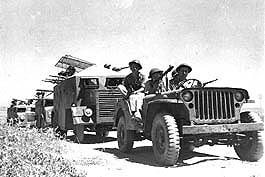
A custom-built Israeli armored car from the War of Independence


Training new Israeli forces during the cease-fire period, 1948.

When fighting resumed on October 15, the Arab armies, far from home and resupply, found themselves facing a resurgent Israeli Defense force, and were driven back, even beyond the borders of the UN's original partition plan. Military historians would later marvel at the folly of the Egyptian army's decision to attack each settlement along the coast one at a time, instead of bypassing the smaller settlements and heading straight for Tel Aviv. It could be claimed that the perseverance of the defenders of Kfar Darom saved the country.
The Israeli Counteratack

Meanwhile over Arab radio, the usual incendiary broadcasts commenced. Some villagers were told to leave their towns to make way for the invading Arab legions, which would then hand over the houses and farms of Tel Aviv and Jerusalem after the conquest of Israel. But broadcasting tales of grievous offences and massacres by the Jews, intended to fire up the Arab population living within Israel, backfired, instilling terror in the hearts of the simple villagers. Later, when Arab radio broadcast false claims that Israeli soldiers were raping the women in villages they captured, some villagers began fleeing. Preserving family honor has always been a far higher priority than military valor within Arab culture.

Israel after independence in 1949, significantly larger than the UN Partition plan of 1947.


The Arab villagers fled to the Gaza strip, now under Egyptian control, while the Jews fled Arab areas to areas under Israeli control. After independence, the villagers of Kfar Darom re-established their moshav (agricultural collective) near the ancient Philistine city of Ashdod. Their rebuilt moshav, today called Bnei Darom, is home to some of my cousins (see previous posts and photos from Moshav Benei Darom here and here.)


Today Bnei Darom makes pickles, olives, eggs, chicken, you name it.

Thursday, March 15, 2007

Gaza History 1: From the Romans through Israeli Independence

On the fringes of the tribes of Shimon (Simeon) and Yehudah (Judah,) it seems that the position of Gaza's Jewish community has always been tenuous.
While the Torah and Tanach provide the imperative to settle this area, the hostile forces living there often made settlement impossible. Jewish communities were often destroyed and exiled. The first recorded exile was conducted by the Romans in 61 CE as part of their greater program of killing all Jews living in the Land of Israel and enslaving any survivors. Later, the Byzantines, Crusaders, Ottoman Turks, British, and the modern Egyptians also took a hand in exiling the Jewish community of Gaza, a community which, like a desert weed, always seemed to rise anew after the passing storm. After the anti-Jewish riots of 1936, the indigenous Jewish population if Gaza City fled, never to return. In 1946, during a rush of settlement building prior to the Israeli declaration of Independence, the religious agricultural settlement of Kfar Darom (village of the south,) named after a Talmudic-era Jewish village of the same name, was founded in the dune fields outside of Gaza City. Foreseeing the coming Arab-Israeli conflict, the United Nations decided to partition the tiny sliver of land into two equal parts, one part for the Jews, and the other for an Arab state.

Upon Israel's declaration of Independence in 1948, the armies of the surrounding Arab states, armed, equipped and led by the British Empire, crossed over the nascent state's borders in an attempt to smash Israel in the cradle.

Israel declared independence.

Areas which Israel actually controlled at independence.

From the south, Egyptian forces moved from one Jewish settlement to the next, thoroughly destroying each one on their march up the coast to Tel Aviv.


A cool painting of Israeli and British Spitfires in a dogfight.

On May 15, 1948, the Egyptian Army surrounded Kfar Darom, the tiny Jewish settlement in Gaza. In what would later become part of Israeli military legend akin to America's experience in Wake Island, the settlement of Kfar Darom, with its fed dozen wounded, exhausted farmers, held off the entire Egyptian army for several months.

A relief convoy tries to get to Kfar Darom. Only one convoy actually got through, but it exacerbated the problem, as so many were wounded on the way that they stretched the settlement's resources even further.

Israel at its worst, during the Arab invasion.


To be continued...