Sunday, February 18, 2007

The Mount of Olives

The green area above is some of the last open land in the old city. It was acquired by Ateret Cohanim recently and is slated to become a large apartment complex after archaeological salvage operatons are completed.


The relations between Jews and their Arab neighbors are complicated. Every Jew living here is aware of what happened in the times of Haj Amin al Husseini. And memorials mark the sites of recent attacks. There are over two hundred surveillance cameras throughout the Muslim quarter, a private security service, and guardposts at strategic locations. The entrances to Jewish homes are protected with special security doors, designed to be able to hold back five men with a battering ram for at least ten minutes.
“Thank God,” Daniel tells me, “we’ve only had to use them once.”
Over two hundred security cameras, peering down alleyways and peeking over rooftops, all feed into a central control room where security personnel monitor and record all activity. If a pregnant mother or elderly person has their hands full and doesn’t feel capable of defending themselves, an armed guard can be dispatched to escort them through the streets.


Security cameras are everywhere.

But on the street level, Daniel, himself a Jewish resident of the Muslim Quarter, is met with smiles and waves. One man even comes up and shakes his hand.
“I send plenty of his business to his store.”
“Do you carry protection?” I ask him.
“My protection is God in heaven. But I also carry a gun. Living in the Muslim Quarter is a different type of settlement. In Shechem (Elon Moreh,) they built a town on a hilltop outside of the actual city itself. In Hebron, they carved out a Jewish enclave within the city and control who comes in and out. Here in the old city, we live side by side with the Arabs. Despite what others say about peace and coexistence in Tel Aviv, we are the only Jews in Israel who shop in Arab stores, meet our Arab neighbors, and know them by their first names.”
And the building continues further afield as well.


Racing through Arab East Jerusalem, outside of the Old City. Whereas East Jerusalem Arabs are free to stroll through Jewish West Jerusalem, Jews driving through East Jerusalem (outside of the Old City) are occasionally stoned, and nobody gets out of the car.


Deep in East Jerusalem, adjascent to the Mount of Olives, Ateret Cohanim has reclaimed a few urban acres, once a Jewish-owned wheat field a century ago, and constructed skyrise apartment blocks. Adjascent the new development, the Israeli Police Station, itself being relocated to the controversial E-1 region, is being sold to the group to be used for further housing.


A map, obtained from Palestinian Authority advocacy groups, showing the locations of the new neighborhoods, and properties acquired. Forgive the anti-Israel lingo; anti-Israel groups always do a better job of recording the locations of each and every new building than the settlers themselves.
The Jewish cemetary on the mount of olives. It is considered the holiest place in Judaism to be buried. Today, it is surrounded by Arab neighborhoods and it is considered dangerous to visit the gravesites on one's own.
Daniel points in the direction of the cemetary on the Mount of Olives, which is across the street. The empty lot behind him has, at long last, crossed the last legal obstacles and is now cleared for new construction. The buildings to the left are existing Jewish homes, built during "phase A" of the operation.

A photo of the existing Jewish building (that's the blast-proof garage door to the right) and the rest of Arab Ras Al Amud.

To be continued…

Friday, February 16, 2007

A Life Stuff Post

Ateret Cohanim posts will continue next week, and I'll bring some additional posts on the City of David, and maybe even some archaeology!


Meanwhile, onward with everyday life! Telecommuting can be a drag when you're working in an uncomfortable office. I had been using a folding picnic table for work, sitting at a chair I found next to the dumpster.
Before: Jumbled wires, no drawers, a total mess.
So I went to Israeli Office Max (prounounced Ofeees Meks) to buy a desk. One thing I'll never get used to is the bargaining mentality. Everybody wants to get a great deal, and nobody, but nobody, want's to be a frier (sucker.) As for me, no matter what kind of deal I get, I always walk out feeling like a frier, knowing that a real Israeli could have done better. So it's always a relief to walk into a store modelled after the good 'ol no-stress USA, where prices are marked and listed for every item.
I glanced at one desk marked at five hundred shekels. Hmmm.... well, the price is a bit high, but that's the price. I started walking away when one of the red-shirted Office Max clerks ran up to me.
"Five hundred too much? How much? How much?"
"Uh, four hundred."
"Okay!"
I got a great deal, but felt like a frier. Office Max tricked me into haggling!
Anyway, the desk came, I finished building it, and now I've got a spiffy desk, and a nice, clean work area, no wires or mess.
After: A place for everything and everything in its place.
Aaaaaah.
A few days later, I saw someone from one of my failed shidduchim walking past. What struck me is that she's, you know, walking. Like, on the street, in public. I had always figured that the girls who turn me down for second dates spend the rest of their miserable lives sleeping on the floor in sackcloth and ashes, mourning their terrible mistake at having let a guy like me get away.
And now, I'm off to Modi'in, to stay with a friend from yeshivah for Shabbat.
Lots more coming up next week... shidduchim, learning, tours, work, you name it.
Shabbat shalom!

Wednesday, February 14, 2007

One House at a Time

Continued from Yesterday
For Ateret Cohanim, despite their extensive experience, there is no standard method for purchasing property; each and every apartment carries its own story. Daniel, our guide, and Ateret Cohanim spokesman, tells me about the use of an exception to the absentee tenant law, the ordinance which allowed people to stay in the homes which they taken after expelling the Jewish owners.

Looking south at the Jewish and Muslim Quarters
“The absentee tenant could only pass from one generation to the next. It can never be sold or given away. If the next resident of the apartment is not a direct descendant of the previous one, then they are no longer protected by the absentee tenant law and therefore, if the legal owner can produce an authentic deed, he can reclaim his property.”
A corridor between the Christian and Muslim Quarters

Receiving word through an informant that, in a certain house, the resident was dying and her son wasn’t moving in, Ateret Cohanim began establishing a legal case. Placing cameras outside the entrances and exits of the home, they sought to prove that the woman’s son, the only legally qualified to inheritor the tenant status, was not, in fact, living on the premises. After two months, nature took its course, and it was time to go to court. The owner was surprised to find his status being challenged.

“What did the judge say when he saw the film?” I ask.
“He never saw the film. The son produced an electricity bill, in his name, delivered to the address, as proof that he was, in fact, the resident.” The Ateret Cohanim lawyer took a look at it, and it was, in fact valid. Then, he directed the judge’s attention to the actual useage, and pointed out that, over the last six months, virtually zero electricity had actually been used, which proved beyond a reasonable doubt that nobody was actually living in the structure. The judge agreed, and allowed the owner to retake possession of his home.

Later, walking in the direction of the Temple Mount, we hear the story of the photographer’s home.
“It started as a simple phone conversation. A group of dignitaries had their pictures taken by a photographer, who gave them his phone number.”Later, an organizer of the event tried to call the man to get his photographs. The phone rang a couple of times, but the voice on the other end wasn’t that of the photographer.
“Salaam Alakum?”

”Shalom, we’re trying to get the photographs you took.”
"What photographs? What do you want?"
“The photos you took yesterday?”
“What are you talking about? What do you want?”
The conversation continued for several minutes. Finally, in exasperation, the man on the other end of the phone figuratively threw up his hands.
“What are you talking about? What do you want?”
In equal frustration, the event organizer threw out a random exclamation, “I want to buy your house!”
“Really? You are Jew or Arab?”
”Jew.”
”Meet me at CafĂ© Rashid tonight.”
And it continued from there. As it turned out, he had dialed the wrong number, and instead of contacting the photographer, he had been speaking with a property owner living in the old city next to the Temple Mount eager to sell his home. Ateret Cohanim took care of the details, finding buyers and putting the former owner into their equivalent of the “witness protection program” for those who risk execution for selling to Jews.


From the top of the Photographer's house, one can see panoramas of the old city that most Jews never have the chance to view.


Sha'ar Shchem, Hebrew: The Shechem Gate (the road leaving this gate lead to the city of Shechem.) Also known as the Damascus Gate, for similar reasons.


Looking over at the Temple Mount, with the Mount of Olives in the background.


Yours truly, on the rooftop of the Photographer's House.

Moving through the Christian Quarter, Daniel points to a building size of a large apartment block. Ateret Cohanim doesn't usually buy in the Christian or Armenian Quarters. “Jewish. It was supposed to be purchased by the Palestinian Authority and used as a government office. Can you imagine? A terrorist headquarters, just a five minute walk from [Jerusalem’s main pedestrian thoroughfare] Jaffa Street!?” But Ateret Cohanim secretly outbid the Palestinian Authority, and one day Arafat’s subordinates woke up to find a bunch of Jews living in the property.

Of course, the international community was outraged, and the Israeli government immediately buckled to international pressure, removing the Jews who had moved in, despite the legality of the purchase. After the storm blew over, and world attention moved elsewhere, the Israeli government reached a compromise.

In the Chrisitan Quarter. The building past the fountain, to the left, was to be a major center for the Palestinian Authority. Imgagine: A Hamas base five minutes walk from the number 6 bus, which I ride twice a day.
“We were allowed to put twenty guards in to protect the property. So we found ten male guards and ten female guards. And they just so happened to be married to each other. Now, thank God, every couple has seven or eight children.”
It's nice to see a friendly flag.

To be continued….

Tuesday, February 13, 2007

Ateret Cohanim

Measuring only about a thousand meters in length and width, the old city of Jerusalem is unquestionably the most disputed square kilometer on the face of the planet. On top of the temple mount stands the Al Aksa mosque, Al Aksa being Arabic for “The Farthest,” since it was the farthest mosque from Mecca, at the time of Mohammed on the the most distant colony of the expanding Islamic Empire. The mosque itself is built over the ruins of a destroyed Byzantine chruch, the church having been erected over the ruins of the Jewish Holy Temple, the single holiest site in the world and spiritual center of world Judaism.

A Breslov Yeshivah in the Old City, Moslem (formerly Jewish) Quarter


After Israel captured the Old City in 1967, the Jewish Quarter was rebuilt on the ruins of the old, and Jewish families began returning to the area. However, of the 19,000 Jews who were expelled from the Old City prior to Israeli independence in 1948, there was only room for 4,000 to move back in. The remainder of the homes had not been destroyed but rather occupied by Arabs.

But deep in what was once the Jewish Quarter, now the Muslim Quarter, one synagogue out of what used to be eighty in the Old City had survived the onslaught. After the reunification of the city, the son of one of the former worshippers at the synagogue came wandering through the area talking to locals, trying to find the site where his father had prayed. Finally, one man took him by the arm and let him up a flight of stairs, to his house. Breaking through the wall, he revealed the synagogue, intact, complete with the original books and chairs, exactly as it had been left when the Jews fled the riots in 1934. “More than I protected it,” the caretaker said, “it has protected me.”

A rebuilt Synagogue


In 1978, Rabbi Shlomo Aviner opened the Ateret Cohanim (Crown of the Priests) Yeshivah on the site. Aside from full-time torah study, slowly at first, they began re-purchasing properties in the modern-day Muslim Quarter, in what used to be the Jewish Quarter.

Rabbi Aviner, Head of the Ateret Cohanim Yeshivah (he lives in Beit El.)

For a Jew to purchase property in the old city of Jerusalem is not as simple as buying a condo in Miami. The religious apartheid system in effect in most Muslim countries today prohibits the sale of property to a Jew on pain of death. Jerusalem being under at least nominal Israeli sovereignty, this edict can not be enforced by the courts, so it is usually taken care of by either family members preserving family honor, upset neighbors, or special hit-squads dispatched by the Palestinian Authority. Over the years, the real estate agents of Ateret Cohanim worked out an effective system for purchasing homes. First, an Arab middleman, usually a Christian with connections and ears, hears through the grape vine about someone who wants to sell his home for an exorbitant fee. The middleman then informs Ateret Cohanim, for a fee of course. Ateret Cohanim then sets up a front company, sometimes two or three, to purchase the home. The next step is to collect enough money from overseas donors to purchase the property. The Arab selling his home also has to be protected from his coreligionists, so overseas lawyers have to find him a job and get him a visa in a foreign country. The transaction itself happens very quickly, often overnight, and before protests and riots can stop it, another home is reclaimed.

Arches in the Moslem Quarter, which used to be the Jewish Quarter. Daniel Luria is our wide-eyed tourguide.


It’s not a steady business, and homes can only be purchased once someone expresses an interest in selling and is willing to take the risk in exchange for the profit.


Entrance to a Breslov Yeshivah, complete with Islamic, and some Jewish Graffiti.


Walking through the Muslim Quarter, I remember the last time I was here in 2000. It was immediately before the second “Al-Aksa Intifadah,” named for the Mosque about 400 meters away, erupted in this very spot. At that time I felt very alone wandering through here. Very few Jews dared to walk through the Muslim Quarter.


Memorial for one of the early residents, in the days when it was far more dangerous for Jews in this neighborhood.


Today, Jews can walk freely through the Moslem Quarter


But in 2000, real estate projects were broken from off Ateret Cohanim into a separate entity known as the Jerusalem Capital Development Fund. Since then, operations have accelerated, and so far over a thousand Jews have moved into the area. Numerically, it's a drop in the bucket compared to what used to be here, but it's a start.

Playground. Unfortunately, it's still too dangerous to let children wander freely through the city, and playgrounds must be built on rooftops, under guard, like this one.

Monday, February 12, 2007

The Old City

Well, there’s plenty more to write about Beit El; the continued building, the yeshivas, the opening of the Arutz Sheva radio station, but I’m getting a bit tired of the subject, which probably means you’re getting a bit tired of reading it. So I’m going to take a little breather and write about something different, and return to Beit El later. Yes, it messes up the order of things. As they say, “There’s no before and after in Torah,” i.e., while most of the Torah, Prophets, etc., was written in sequential order, it’s not a history book and events frequently occur out of chronological order. So to, “There’s no before or after in Planet Israel,” and I’ve been meaning to write about a tour I took with Ateret Cohanim, spearheading the gradual re-Judaization of the Old City of Jerusalem. So, without further ado, I bring you…

A map of the old city at present
The Old City


Rebuilding of the old city walls of Jerusalem in 1540, Turkish sultan Suleiman the Great turned the ancient city of Jerusalem into an island of life in the desert. For the first time in centuries, the Bedouin raiders who made settled life in the empty expanses of the Land of Israel unlivable could be kept at bay. Under lock and key at night, Jerusalem’s streets were quiet and safe. The city had already hosted congregation of Jewish stalwarts over the years, including such rabbinic greats as Rabbi Nachman ben Maimon (the Ramban,) as well as several synagogues, but now the community began to blossom. Over the next several hundred years, the community survived the famines, wars, and occasional sectarian violence, and by 1840 a majority (19,000) of the city’s 35,000 residents were Jewish.

Muslim Quarter, circa 1930's

Life was not without its hardship. Poverty was rampant, and life under the Islamic Apartheid system meant constant danger without legal recourse. Non-Islamic religions were permitted to exist, but only when it was clear who was in charge. Open sewers drained into cesspools built immediately adjascent to the Church of the Sephelcure, holy to Christians, and the Western Wall, Judaism’s holiest site, was used as a garbage dump and public urinal.

The Dome of the Rock, circa 1930's
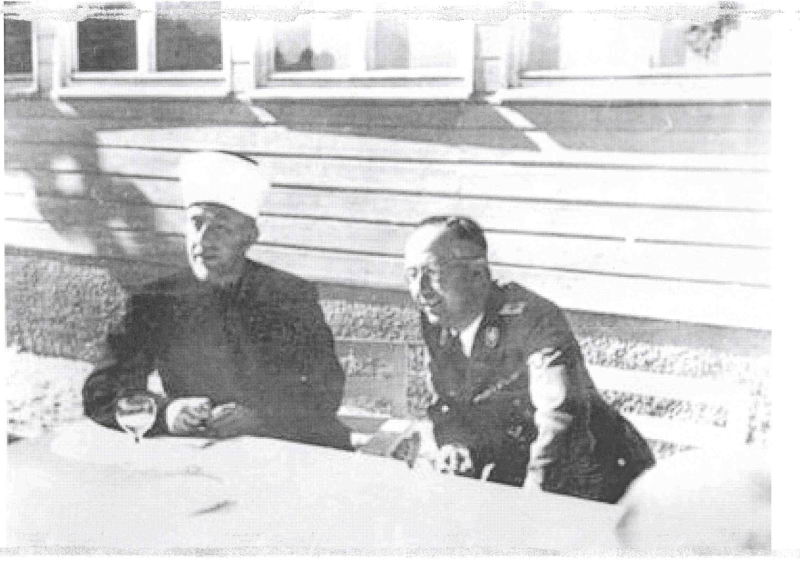
But the “coexistence,” such as it was, was to be torn apart, along with the rest of the land, with the rise of the Jewish independence movement. Haj Amin Al Husseini, Grand Mufti (Muslim spiritual leader,) viewed the rise of Zionism as a threat his dreams of a united Syria including modern day Syria, Israel, Jordan, and Lebanon (the concept of Arab Palestine not yet existent.)

Haj Amin Al-Husseini, the Grand Mufti of Jerusalem

Fearing increased Jewish immigration, Husseini doctored tourist postcards of the Dome of the Rock to look as if it had been set ablaze, and then spread the photographs with a rumor that the Jews had started the fire. In the resulting riots, hundreds were killed, both in Jerusalem and across the countryside as enraged mobs pillaged and destroyed the Jewish quarter of Judaism’s holiest city, Jerusalem, and second holiest city, Hebron. After waves of riots, continuing year after year, the Jewish community within the walled city of Jerusalem had been completely expelled by 1948.

A meeting of the minds: Husseini with Hitler

Husseini visits Heinrich Himmler at Auschwitz

As a condition of the newly independent Israel’s armistice agreement with Jordan, Jews were to be allowed access to the Western Wall while the Kingdom of Jordan would maintain actual sovereignty. Of course, the terms were not honored, and Jordanian soldiers stood on the old city walls, shooting any Jew who drifted too close, and often taking pot shots into private houses in the Valley of Hinnom below.

The situation persisted for 19 years. In 1967, with the recapture of Jerusalem in the Six Day War, Israel found a section of the Jewish quarter of the old city still empty and in rubble, as the Jewish Quarter of Hebron is to this day.

The state initiated a massive rebuilding project, lasting 15 years, and eventually much of the Jewish Quarter was restored to its original beauty.

Entrance to the Cardo, in the Jewish Quarter. Because the Jewish Quarter was so recently rebuilt, much of the stonework and masonry appears cleaner and newer than the rest of the city.

Much as the Jews of Eastern Europe who survived the holocaust returned to their homes only to find Polish families living in them, so too thousands of those whose homes were not in the areas dynamited by the Jordanian Legion found that their old homes now had “tenants,” families who had moved in after the riots of 1967. The Israeli government, eager to demonstrate a non-belligerent policy of ruling the newly unified city, granted these tenants “squatters rights” and did not permit their eviction.

Walking through the Cardo. Nice stuff at tourist prices.

An archway leading from the Armenian to the Christian Quarter

Walking through the Christian Quarter. The closed shops are victims of the Second Intifada, which permanently destroyed much of Jerusalem's tourist industry.


And that’s where Ateret Cohaim comes in. To be continued…

Sunday, February 11, 2007

The First Civilians in Beit El

For a decade, from 1967 to 1977, Beit El remained an army base, only ten miles north of the nation’s capital, Jerusalem, but seemingly a thousand years in the past. After 20 years of Jordanian rule, the surrounding Arab villages, populated by simple farmers, still went about their daily lives without the assistance of running water or electricity.
“I remember,” Baruch, my Shabbat host tells me, “when we used to come out at night, the whole landscape was dark.” It’s easy to understand why the Arabs chose to build their villages on the sites of ancient Jewish villages. Living in conditions not too different from those of mellinea ago, the decision of where to found a new settlement was likely similar to that made by the first Jewish settlers mellinia ago. Without the benefit of pumps or pipelines, the villages had to be built close to natural sources of water, springs and streams, as well as on defensible hilltops.


Beit El Bet today
Meanwhile, in the army base, conditions weren’t much better. The old Jordanian barracks were declared unfit, so the army set to work building new barracks. Then one day in 1977, shortly after the election of Israel’s first conservative Prime Minister Menachem Begin, the soldiers woke up to find a group of twelve young couples living in the abandoned barracks, studying Torah. Begin had ridden a pro-settlement tide into power, but was also eager to shed the image of “fanatic” he had earned in his younger days while the fighting the British occupation in the Jewish underground. Israel’s American backers wanted the Jews out. Despite a decade of failed peace plans and stonewalling by Israel’s neighbors, the international community was convinced that the Arabs would eventually recognize Israel in exchange for a withdrawal. Between the pressure from the conservatives in his own government to push ahead with the settlement drive versus the international outrage at Jews living in Beit El, Begin was in a jam. Like all politicians, he took the path of least resistance, deciding to let the settlers’ idealism die a natural death. In the middle of nowhere, with no electricity, no running water, in substandard buildings and the sub-freezing temperatures, the settlers would start to miss the warm, comfortable apartments in Jerusalem. They would never last the winter.
Army trailer/barracks

The settlers, meanwhile, set about patching up holes and sealing cracks in the windows. When springtime rolled around they were still there, learning in their little yeshivah. Rabbi Zalman Baruch Melamed, the head of the Yeshivha, could be seen every morning hauling water containers up the hill from the spring below. The small group had survived, the army got used to them, and the politicians had moved on to other matters. Now with a longer-term presence, and with growing families, it was time to build a real yeshivah and housing. They petitioned the army, but were denied. After all, this was a military base, no place for rabbis. Finally, the yeshivah students worked out a deal with the army. They would enlist, be given weapons, and guard the base. The local commander was ecstatic at the idea. This would free up his own soldiers from monotonous guard duty to take a more active role in policing the region.
An ancient wine press

Now taking turns guarding the base through the long nights, the settlers petitioned the base commander to build four bathrooms. Of course, every religious Jew needs to wash his hands and say the blessing after relieving himself. Since it is forbidden to say a blessing in an unclean place, like the bathroom, most restrooms in Israel have a small entry hall where one can fulfill the mitzvah in cleaner conditions, and these bathrooms would be no exception. Approval for construction came down the chain of command a few weeks later, but the settlement leadership had bigger plans. This was one of the first projects carried out by Yaakov Katz, nicknamed Katzele, and it was to be no ordinary bathroom. Negotiating with contractors, he finally found a foreman willing to work his crews around the clock in staggered eight-hour shifts. Waiting until the base commander was away for a few days, they broke ground, and the cement mixers and work crews charged ahead at a furious pace. When the commander returned, his jaw dropped. There were four bathrooms, all right. It just so happened that the entry hall was about 150 feet by 150 feet, large enough to double as a study hall and beit midrash.

The yeshivah today. Obviously, a lot has been added since that first building.

Friday, February 09, 2007

The Siyum/Shabbat is Coming!

Well, I was planning on posting more from Beit El, but it will have to wait until after Shabbat. Coming up soon: The building of modern Beit El, plus a trip to the Arutz Sheva studio. Then, I've got a huge backlog of other places I've been recently to blog.

My original plan for Shabbat was to head down to Moshav Bnei Darom, to visit my friend Yigal. He's been moving towards greater observance, so I'm trying to help him out. Unfortunately, my cousins there got sick, so Yigal is now trying to make it up to visit me here in Jerusalem for shabbat instead.

Anyway, yesterday my Tanach class finished reading Sefer Yehoshua (The Book of Joshua,) which we started in October.


Inside Sefer Yehoshua


The sun stops overhead, and the moon stops over the Valley of Ayalon. Aaaah... the fond memories of Sefer Yehoshua.

When one finishes the in-depth study of a book in its entirety, it's traditional to have a siyum (literally "completion",) to throw a little mini-party.


I could show more pictures, but they're just of people eating, nothing too spectacular.


Anyway, Shabbat is approaching quite fast now. Stay tuned next week for more posts from Eretz Yisrael, and Shabbat Shalom!

Wednesday, February 07, 2007

Beit El in History: The Maccabees Through the Six Day War


An armored patrol passes the Tomb of the Sheikh


My hands still clasp the top rung of the ladder. Cold wind whips by, hauling storm clouds towards Beit El from over the Mediterranean to the east. Under the approaching tempest I can almost see the coastal plateau.

Looking down from the tower, people still planting trees.


On a clear day, the shining waters of the Mediterranean can be seen, broken by the jagged spires of Tel Aviv, in the tribal territory of Dan. Closer, behind the approaching curtain of rain, is the Modi’in area, foothills of the tribal region of Binyamin (the area of the tribe of Benjamin,) where I stand. The region today is filled with bustling new cities, towns, farms and settlements. Tens of thousands of Jews have moved to the region since the rebirth of Jewish life began there after 1967 CE. But 2,143 years ago, in 3597 (136 BCE,) it was the site of an upheaval that would shake the world.
The northern kingdom of Israel, which had lapsed into idolatry, had been destroyed and exiled, the overwhelming majority of its ten tribes dispersed and lost forever, and shortly thereafter the southern kingdom of Judea was also exiled. But the southerners, who had remained faithful to the God of Israel, survived and returned to rebuild the second temple. Living under foreign occupation, after the conquest of Alexander the Great in 3534 (199 BCE,) the people had begun to follow the pagan and idolatrous practices of the surrounding peoples. One day, the governors of the ruling Seleucid Kingdom came to Modi’in, home of the high priest Mattityahu, and ordered the Jews to make sacrifices to the Greek gods, an act which every Jew is required to surrender his life rather than commit. Mattityahu, the Cohen Gadol (High Priest,) refused, but another, more assimilated Jew, moved to make a sacrifice. Mattityahu, enraged at the desecration of God’s name, immediately killed him, overpowered the soldiers, killed the Seleucid governors, and declared, “Let he who is zelaous for God, follow me!”
Taking the name Maccabi, an acronym for “Mi Camocha Be’elim Y’h” (Who is like you Hashem,) Mattityahu and the band of rebels ran for the hills. They came to the town of Gofna, hiding in the caves, here to plan and execute their rebellion, which successfully restored Jewish sovereignty to the holy land and repurified the temple. The festival on which Jews worldwide celebrate the victory is Chanukkah.


Map of the Hasmonean Kingdom


But where is Gofna? Well, the Cohanim, on the run from the Seleucids, wouldn’t be able to trust just anyone. Large swathes of the people had become assimilated and would be as likely to help their Seleucid overlords as their brother Jews. No, they would have to have sought shelter with someone they could trust. Blood relatives.

Turning now to the northwest, there is a modest Arab settlement built on a hill. Recent archaeological excavations indicate that the burial caves in the hill are predominantly Cohanim, high priests. Likewise, biblical passages refer to this village as a Cohanic village. Arabic tends to replace the “G” sound with a “J” sound (they call the ancient Jewish city of Ganim as Jenin.) The name of the Arab settlement is Jifna, which matches Gofna, and it seems quite reasonable to assume that these two towns are one and the same.


A shaft of light shines on Jifna, ancient Gofna


Now, fast forward 2,103 years, past the destruction of the second temple, past the pain and exile of Jewish life in Europe and Araby, through the rebirth of Jewish sovereignty in 5708 (1948 CE) up to the year 5727 (1967.) The sixties.

The sixties are remembered by most Americans as a tempestuous time. Political upheavals, civil rights, women’s lib, Vietnam; a decade of strife and upheaval. Mention the sixties to most Israelis who were alive at the time, and their minds immediately shoot to six short days, from the 26th of the Jewish month of Iyar (the 5th of June) to the 3rd of the Jewish month of Sivan (the llth of June,) 1967 CE.

After months of life under siege, and preparation for war, it was time. The armies of twenty two Arab states had crossed thousands of miles of desert to encamp on Israel’s borders. Outnumbered more than three to one, already legally at war for months due to the Arab siege, with Egyptian dictator Gamal Abdul Nasser screaming bombastic speeches promising the end of the Jewish state, and with dwindling supplies, it was time to strike before Israel had lost all strength to fight back.

But in Israel, on the morning of June 5th, nobody knew that the war had started. Military censors maintained strict control of all broadcasts to prevent the enemy from piecing together what was happening.

The Jordanians, who had a military base at Beit El and controlled nearby Ramallah, saw the first wave of Israeli fighter planes returning from bombing the Egyptian Air Force. Nasser assured Jordanian King Hussein that the blips on his radar screen were actually Egyptian bombers heading for Tel Aviv. Swept up in the excitement of the attack, Hussein ordered his artillery to begin firing into Israeli cities on all fronts. The shells came crashing through the roofs of hospitals, schools, and homes.

Radio Ramallah was ordered to begin patriotic broadcasts. Now, there is a tendancy in the Arab world to confuse speech with action, words with accomplishment. Americans experienced a similar surprise at the beginning of the Iraq war, when the split screens on the news showed, on the left side, Iraqi spokesman “Baghdad Bob” making wild pronouncements of mass American casualties and failures, while on the right side American tanks and air power cut through the feared Iraqi Republican Guard like a knife through warm butter. Similarly, the announcers at Radio Ramallah became carried away with their fantasies of pillage, rape, and genocide. “We are slaughtering their children! Blood is running in the streets! We have captured Lydda! We have captured Jaffa! We have captured Haifa!”


Foreground: Modern Beit El. Background: Ramallah

As the news embargo continued in Israel, the only available station was Radio Ramallah. Many Israelis, themselves refugees from centuries of horrifying violence in the surrounding Arab countries, heard the news and were reduced to tears. The dream of two mellinea was dying in front of their eyes!

The broadcasts continued for days, “Our officers are sitting in the Cafes of Tel Aviv! We have massacred thousands! We are…”
Suddenly the broadcast went dead. Silence. With a crackle, the radio came back to life.
“This is a sergant with the Israeli Defence Forces,” the broadcast resumed in Arabic, “we have captured Ramallah! We have captured Jenin! Hebron is ours! Our armies have surrounded Jericho! The Arab armies are destroyed in the field!”
And later would come the famous broadcast, replayed over the radio every Jerusalem day since, “Har Habayit Beyadeinu!” The temple mount is in our hands!


The mighty had been defeated, the evil vanquished. In six days Israel had quadrupled in size. Among the new areas captured was Beit El, then a Jordanian army base. After the smoke had cleared, Israel began moving men and material out to the base, making it an Israeli stronghold.

Army storage area


Firing ranges


Cease fire! Changing the targets