My stolen car woes turned into a windfall this week! The thieves who stole my car over a month ago had crashed it into a ditch, so it was left with a flat tire and a broken passenger-side window. The insurance company declared it a total and offered me a whopping $3,000 settlement, which is especially nice considering that the blue book value of the car was around $800. I then went to the impound lot where the car was left for dead, covered in plastic and a bit banged up. I paid the $83 salvage value for the wreck, swapped out the spare, started her up, and took her to get new tires, repaired the broken body panels, and replaced the broken window. The long and the short of it is that, after repairs and replacing the tefillin, I came out about ahead by $2K. ANd never mind teh $700 that the insurance company paid to put me in a Cadillac for a month. I took my profit, bought myself a nice shabbes jacket, and put the rest towards my student loans. Gam zu letovah!
In aliyah news, I finally sent out my application to Nefesh B’Nefesh. They called me back with some questions on it, so I know that they’ve got it and are working on it. I have also completed my Hebrew school teaching stint, which was exhausting, time consuming, and very rewarding.
Anyway, I wrote an editorial for the J! (local Jewish paper) which was rejected, or at least I never heard back from them. I don't want it to go completely unread, so I'm attaching it to the bottom of this email.
Writing is a difficult balance because my goal is to swing peoples' opinions, so I want to post in more left-leaning publications, but at the same time, I have to keep my edge. I used works like "Palestinian," even though when you use that word you are automatically swallowing the big lie of this generation. Since most left-leaning people are firm believers in the lie, I had to use it to keep my bearings. I probably shouldn't have used the label "liberal chauvanist" either. If I had been a better writer, I would have been able to make readers reach that conclusion on their own without using a label.
Here goes:
America can Learn from Hamas' Victory
I'll never forget the day I abandoned the left. It was over a decade ago, when the peace process was in full swing, negotiations moved at a fever pitch, and "peace in the middle east" seemed to be just over the horizon. The internet was finally transforming itself from an electronic plaything to a useful tool, and for the first time I could read the daily news from Israel, delivered directly to my desktop. Like most American Jews, I had been raised on the liberal values of tolerance, dialogue, and the need for the powerful to accommodate the weak. The re-writing of the Arab-Israeli conflict as the Israeli-Palestinian conflict made it appear to me that the solution to the was for Israel to try to make life more open and prosperous for the Palestinians, who would then reciprocate by restraining the violent elements in their society. If only Israel would destroy Jewish settlements, help the Palestinians build better roads and schools, and finally surrender control to an independent Palestinian state, then the basis for the conflict would be solved. Or so I thought.
A friend of mine then emailed me a link to Memri.org, a non-profit organization which records, translates, and distributes media broadcast from the Arab world. On this website, I found a video translation of a program called "Children's Club." It had all the look of an Arabic version of the "Howdy Doody" show, with an audience of happy singing children led by an adult host with puppets and toys. Except, instead of singing "It's Howdy Doody Time," the young boy picked from the audience sang, "When I wander into Jerusalem, I will become a suicide bomber." The chorus, ranging in age from kindergarten to fourth grade, responded with a rendition of the old favorite, "Jihad! Holy war to the end against the Zionist enemy."
After my initial shock wore off, I reached some obvious conclusions. First, we will not see peace in my lifetime. When children are bombarded messages to kill and destroy before they even utter their first word, that's what they will do when they grow up.
But in the back of my mind another, more frightening thought began to emerge. It is impossible for me, as a westerner, to empathize with Arab culture. When a western country fights a war on the home front, their first priority is to protect the children. During the blitzkrieg on London, children were sent to the north of England to live with relatives. In the prelude to the Six Day War, many Israelis flew their children to relatives in the United States. But when the Arabs go to war, they strap bombs on their children and march them to the front lines. I painfully concluded that I had been a liberal chauvinist, assuming that the Arabs wanted the same things as I did out of life; the freedom to act and think for one's self and a better life for the next generation.
At the time, I was immersed in the morally relativistic mindset of a university campus, which dictated that I never cast value judgments on other cultures. Therefore, in the conflict between Israelis and Palestinians, I was to believe that there was no "right" or "wrong" side. Israel and Palestine were mirror images of each other, both justifying their actions through victimization, both unwilling to surrender when strong, like two brothers squabbling over an inheritance.
After seeing the Palestinian children's video, my chauvinistic ego shattered, I began to open my eyes see the differences. In Israel, leaders like Shimon Peres and Yossi Beilin felt great pride in waving little Palestinian flags for the television, proving their enlightenment. Yet no Arab leaders or citizens, not a single one, was ever seen flying an Israeli flag. Israelis and American liberals loved to discuss Palestinian rights and grievances. But for an Arab leader to discuss Jewish rights was inconceivable. The concept of empathy, the first step towards true peace, seems incomprehensible to them. Palestinian Arab culture and Western civilization are not mirror images but polar opposites.
The election of Hamas has sent the remaining liberal chauvinists into a tizzy. It has left the European Union scrambling to find a way to continue financing the Palestinian Authority without admitting that they are financing terror. The Bush administration is befuddled, declaring that they will never recognize Hamas in one sentence, and then praising Palestinian democracy in the next. America has much to learn from Israel's bitter experience. When dealing with a conflict based not on grievances and borders but vast cultural differences, negotiating away territory or trying to teach our values and system of government will not soothe our enemy's anger. The election of Hamas was a dry run for what America has waiting in Iraq The only solution for America is the one that Israel has reached after exhausting all other options, to fight back hard when attacked and to build a wall. We must put a respectful distance between ourselves and Arab culture, and wait for them to develop on their own.
Friday, February 10, 2006


Monday, January 23, 2006
Gam Zu Letovah
A minus: 6 months, 3 weeks
Since the Rabbi is out of town, I've been teaching a class of second graders in religious school at Chabad for the past several weeks, in addition to the basic Hebrew class I teach for adults. Every week, I teach the children a new mitzvah beginning with the next Hebrew letter. We started with "Ahavat Yisrael," to love one's fellow Jew, followed by "Bal Taschit," not wasting. This week we learned the letter gimmel, so I taught, "Gam Zu Letovah," the concept that even seemingly inexplicably bad things sometimes happen for a good reason. I decided to give the class the following personal example:
"Two weeks ago, my car was stolen," I pronounced.
I was immediately interrupted by Justin, "How much was it worth?"
"A thousand dollars," I replied.
"That's nothing! You must have had a pretty trashy car."
"Justin, the next mitzvah we're going to learn is Derech Eretz," I replied, "proper behavior, so watch your mouth."
"Anyway, my car was stolen, and I thought I was having a really bad day. When I got to work, I called my insurance company, and they told me that I could only have $25 per day to rent something, so I was going to have to get a really little car. But when I went to the rental car company, they said they were out of little cars, so they offered me a medium sized car instead for the same price, and I said OK. Then, they said they were out of medium sized cars, so they offered me a pickup truck for the same price, which was fine with me. Then they realized they were out of pickup trucks too, so they offered me a van. I accepted, and again, they were out of Vans. The only car they had left was a 2006 Cadillac, so now I get to drive the Cadillac, and the insurance company is paying for it!"
I love it when I can bring in personal examples from my life. The rest of the story is that the CRX turned up stripped, with my stereo and tefillin stolen and a flat tire, so it's now in the Insurance Company's lot being assessed. Meanwhile, Rabbi Resnik in Pleasanton received a donation of an old Ford Probe, so if all else fails, I'll still have something to drive. Gam zu letovah.
I've become very involved with the local Chabad shul (synagogue,) not just teaching classes but also been helping set up the synagogue, buying sodas, and doing general schlepping. I have a sort of quid-pro-quo with the Rabbi. It feels a bit improper taking money from a shul, so I generally refuse payment for teaching classes or buying food. The Rabbi has a constant supply of meat coming in from Los Angeles because his brother is a Kosher butcher, so when I finish teaching a class, I just walk into the back and grab a steak or some frozen pizza. Also, when I need a car, I can always borrow one of his beaters, and I can always go over to his home if I need a place for Shabbes, so, it works out quite well for both of us.
Career wise, I'm progressing quite well. Because of my three years of service with my company, and the Professional Engineering license I will hopefully receive if I pass the PE exam, I've been given a window office. It seems to be quite a big deal, as people are constantly coming in and shaking my hand, offering congratulations. There is also an unquantifiable feeling I have been getting from my coworkers, the way they ask me for snap decisions based on my engineering judgment, send emails to my boss specifically asking that Ephraim be assigned to work on their project, and assign me difficult problems with little oversight. I think it's called "respect," but it's quite a new feeling for me. Too bad I only have six more months to enjoy it.
In the mean time I'm finishing my application for Nefesh B'Nefesh. I've completed my financial affidavit, written my essay, filled out all my forms, dotted my i's and crossed my t's. Now I'm just waiting for Rabbi Resnik to finish my final letter of recommendation and for my passport photos to be developed and I'll be ready to send it out.
Attached:
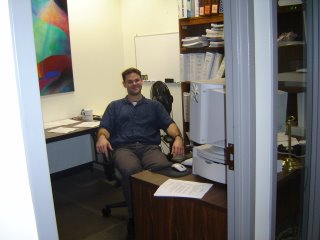
Picture of my old office.
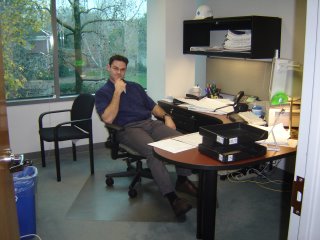
Picture of my new office.
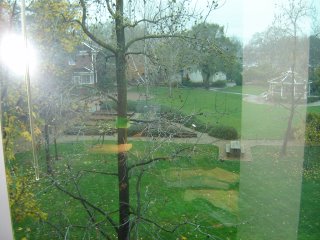
Picture of the view from my office of the Shadelands Museum (one of the few origingal buildings from the previous century that remains standing in Walnut Creek.)
Since the Rabbi is out of town, I've been teaching a class of second graders in religious school at Chabad for the past several weeks, in addition to the basic Hebrew class I teach for adults. Every week, I teach the children a new mitzvah beginning with the next Hebrew letter. We started with "Ahavat Yisrael," to love one's fellow Jew, followed by "Bal Taschit," not wasting. This week we learned the letter gimmel, so I taught, "Gam Zu Letovah," the concept that even seemingly inexplicably bad things sometimes happen for a good reason. I decided to give the class the following personal example:
"Two weeks ago, my car was stolen," I pronounced.
I was immediately interrupted by Justin, "How much was it worth?"
"A thousand dollars," I replied.
"That's nothing! You must have had a pretty trashy car."
"Justin, the next mitzvah we're going to learn is Derech Eretz," I replied, "proper behavior, so watch your mouth."
"Anyway, my car was stolen, and I thought I was having a really bad day. When I got to work, I called my insurance company, and they told me that I could only have $25 per day to rent something, so I was going to have to get a really little car. But when I went to the rental car company, they said they were out of little cars, so they offered me a medium sized car instead for the same price, and I said OK. Then, they said they were out of medium sized cars, so they offered me a pickup truck for the same price, which was fine with me. Then they realized they were out of pickup trucks too, so they offered me a van. I accepted, and again, they were out of Vans. The only car they had left was a 2006 Cadillac, so now I get to drive the Cadillac, and the insurance company is paying for it!"
I love it when I can bring in personal examples from my life. The rest of the story is that the CRX turned up stripped, with my stereo and tefillin stolen and a flat tire, so it's now in the Insurance Company's lot being assessed. Meanwhile, Rabbi Resnik in Pleasanton received a donation of an old Ford Probe, so if all else fails, I'll still have something to drive. Gam zu letovah.
I've become very involved with the local Chabad shul (synagogue,) not just teaching classes but also been helping set up the synagogue, buying sodas, and doing general schlepping. I have a sort of quid-pro-quo with the Rabbi. It feels a bit improper taking money from a shul, so I generally refuse payment for teaching classes or buying food. The Rabbi has a constant supply of meat coming in from Los Angeles because his brother is a Kosher butcher, so when I finish teaching a class, I just walk into the back and grab a steak or some frozen pizza. Also, when I need a car, I can always borrow one of his beaters, and I can always go over to his home if I need a place for Shabbes, so, it works out quite well for both of us.
Career wise, I'm progressing quite well. Because of my three years of service with my company, and the Professional Engineering license I will hopefully receive if I pass the PE exam, I've been given a window office. It seems to be quite a big deal, as people are constantly coming in and shaking my hand, offering congratulations. There is also an unquantifiable feeling I have been getting from my coworkers, the way they ask me for snap decisions based on my engineering judgment, send emails to my boss specifically asking that Ephraim be assigned to work on their project, and assign me difficult problems with little oversight. I think it's called "respect," but it's quite a new feeling for me. Too bad I only have six more months to enjoy it.
In the mean time I'm finishing my application for Nefesh B'Nefesh. I've completed my financial affidavit, written my essay, filled out all my forms, dotted my i's and crossed my t's. Now I'm just waiting for Rabbi Resnik to finish my final letter of recommendation and for my passport photos to be developed and I'll be ready to send it out.
Attached:
Picture of my old office.

Picture of my new office.
Picture of the view from my office of the Shadelands Museum (one of the few origingal buildings from the previous century that remains standing in Walnut Creek.)
Friday, January 20, 2006
The Car Saga Continues
My stolen car finally turned up. What was left of it, at least, minus tefillin ($450,) stereo ($400,) spare pair of glasses ($275,) and mp3 player ($50.) The passenger side window was bashed and it has two flat tires but the rest of it looks in OK condition. Right now it's being towed to Fremont (30 minutes south of here) to be inspected by the insurance assesors.
In the mean time, my insurance company provided me with $25/day to get a rental. I reserved the only car I could afford with that, a compact, but when I showed up to pick it up, they had run out.
"Would you take an upgrade to a mid-size?" they asked.
"Sure!"
After clicking on the keyboard with furrowed brow, the rental car representative replied, "well, I'm sorry but we don't have any mid-size. Can I upgrade you to a full-size?"
"Sure."
More clicking, more consternation, "I'm sorry, no full sizes, can we upgrade you further?"
"Uh... OK."
This went on for some time. I was upgraded to a pickup truck, then a van. After I had accepted the van, one of the drivers pulled up in a Cadillac.
"I'm sorry sir, but all we have available is this Cadillac. Will that be a problem?"
"Uh... no, I think I can live with that."
So now I'm waiting to hear back from the insurance company. Someone recently donated an old Ford Probe Rabbi Resnik in Pleasanton which he offered me, but last night he informed me that his wife backed into it pulling out of the driveway, and it's questionable whether the driver's side door will open. It's still driveable though, so that might be my emergency backup if nothing else works.
Meanwhile, I'm crusing the streets of Walnut Creek like the Mac Daddy in my Caddy.
In the mean time, my insurance company provided me with $25/day to get a rental. I reserved the only car I could afford with that, a compact, but when I showed up to pick it up, they had run out.
"Would you take an upgrade to a mid-size?" they asked.
"Sure!"
After clicking on the keyboard with furrowed brow, the rental car representative replied, "well, I'm sorry but we don't have any mid-size. Can I upgrade you to a full-size?"
"Sure."
More clicking, more consternation, "I'm sorry, no full sizes, can we upgrade you further?"
"Uh... OK."
This went on for some time. I was upgraded to a pickup truck, then a van. After I had accepted the van, one of the drivers pulled up in a Cadillac.
"I'm sorry sir, but all we have available is this Cadillac. Will that be a problem?"
"Uh... no, I think I can live with that."
So now I'm waiting to hear back from the insurance company. Someone recently donated an old Ford Probe Rabbi Resnik in Pleasanton which he offered me, but last night he informed me that his wife backed into it pulling out of the driveway, and it's questionable whether the driver's side door will open. It's still driveable though, so that might be my emergency backup if nothing else works.
Meanwhile, I'm crusing the streets of Walnut Creek like the Mac Daddy in my Caddy.
Monday, January 09, 2006
An Exceptionally Bad Monday
It all started when I woke up late. Instead of going to shul (synagogue) in the morning, I decided to daven (pray) at home to save some time. Since I usually go to shul, I kept my tefillin (little prayer boxes) in my car. Imagine my surprise to discover, while going out to my parking space to get my tefillin, that not only was my tefillin missing (cost: $450), so was the entire car! Quickly going through the checklist… no, I didn’t park it somewhere else last night… no, it couldn’t have been towed… I realized that it had been stolen. I called the police and filled out a report, but there wasn’t much they could do. Now my poor ’88 CRX, the Rust Rocket, is out there being violated by some wicked thief, and my tefillin is probably in a dumpster somewhere, God forbid.
My next step would be to ask the Rabbi for another beater car. California tax law states that anyone can donate their old car to a non-profit organization, like our shul, and receive a full deduction for the value. The front yard of our shul displays a whole fleet of beaters; rusty Datsuns, a Ford Aerostar that makes a bang-bang sound, an MGM with a transmission that can’t reverse, and the like. Today was a warm, sunny day, so I decided to hop on my bike and ride to shul and see if any keys were lying around. Upon arriving I discovered that the office was locked. I suddenly remembered that the Rabbi left last night for a month-long vacation to Israel. Now, I can do without the car, but the real problem is that I’m supposed to substitute teach in the Hebrew school for the next four weekends, and all of the teaching material is locked in the office. I started looking at the door for hinges, thinking that perhaps I could chisel out the hinge-pins and open the door that way. No dice. Finally, I was just getting frustrated enough to consider kicking the door down when I decided that I should collect myself and daven shacharit (morning prayers) before it got too late. Of course, I didn’t have any tefillin, but after searching far and wide I found an extra set we have hidden for people who don’t have to use. Of course, my luck today being what it is, it’s for right handed people and I’m a leftie. After about fifteen minutes of effort, I managed to reverse the knot on the tefillin so that it’s now appropriate for a leftie. Being late for work, still boiling mad, I race through the Shema and Amidah prayers, skipping everything else, and start to take off the tefillin. While I’m taking off the tefillin, I stop and think that, perhaps this is not the best day to be rushing through my davening, considering everything else that’s happened, so I put it back on, rewind to the very beginning, collect myself, and daven the entire Shacharit from beginning to end nice and slowly.
Feeling much calmer now, figuring things can only go up from here, I hopped on my bike and began the ride to work. About halfway there, I noticed that it was becoming harder and harder to pedal. Finally, I was passing by the exact same spot on the trail where I severely sprained my ankle three months ago when I lost control of the bike! I realized that the tire had sprung a leak. I managed to recover and not do any permanent damage to myself, but from then on I had to walk my bike along, hobbling on my lame ankle. I pushed my bike along the trail and finally made it back to work, sweating profusely and smelling like a men’s locker room. I came into the lobby and clicked on the elevator button. *DING!* The doors slid open and there stands Craig, the building maintenance man. “What do you think you’re DOING! There are no bikes allowed here! You know better than that! Take that thing outside immediately!”
I dragged my bike outside and find somewhere to lock it up, hauled myself upstairs, went to my office, and shut the door. It’s now almost noon and I needed to find something to eat. But before I could, the phone rang. When construction managers call you in the middle of construction, it’s seldom to complement you on the quality of your work. Turns out they found some serious oversights in a job I designed that’s now already in construction. Time for a conference call… and on and on it goes.
From then on, though, it’s been good news. Somebody at work offered to give me a ride tomorrow, but I hassled my insurance company, and, while they didn’t volunteer the information, it turns out I can get a rental car on their nickel until the claim is processed. I then managed to track down somebody else with the shul’s office key, so I retrieved my teaching material. I won’t have to go in front of the kiddies on Sunday looking like a fool. Lastly, I talked with another local rabbi, and it sounds like one of his neighbors might be making donating a beater some time soon. When you step back and look at it, these are all, thank God, replaceable objects. The only thing that’s really upsetting to me is the tefillin.
Anyway, tomorrow is a partial fast day, so I’ve got to get to sleep to wake up before sunrise and eat. Tzum Kal (easy fast) to all those who are fasting!
My next step would be to ask the Rabbi for another beater car. California tax law states that anyone can donate their old car to a non-profit organization, like our shul, and receive a full deduction for the value. The front yard of our shul displays a whole fleet of beaters; rusty Datsuns, a Ford Aerostar that makes a bang-bang sound, an MGM with a transmission that can’t reverse, and the like. Today was a warm, sunny day, so I decided to hop on my bike and ride to shul and see if any keys were lying around. Upon arriving I discovered that the office was locked. I suddenly remembered that the Rabbi left last night for a month-long vacation to Israel. Now, I can do without the car, but the real problem is that I’m supposed to substitute teach in the Hebrew school for the next four weekends, and all of the teaching material is locked in the office. I started looking at the door for hinges, thinking that perhaps I could chisel out the hinge-pins and open the door that way. No dice. Finally, I was just getting frustrated enough to consider kicking the door down when I decided that I should collect myself and daven shacharit (morning prayers) before it got too late. Of course, I didn’t have any tefillin, but after searching far and wide I found an extra set we have hidden for people who don’t have to use. Of course, my luck today being what it is, it’s for right handed people and I’m a leftie. After about fifteen minutes of effort, I managed to reverse the knot on the tefillin so that it’s now appropriate for a leftie. Being late for work, still boiling mad, I race through the Shema and Amidah prayers, skipping everything else, and start to take off the tefillin. While I’m taking off the tefillin, I stop and think that, perhaps this is not the best day to be rushing through my davening, considering everything else that’s happened, so I put it back on, rewind to the very beginning, collect myself, and daven the entire Shacharit from beginning to end nice and slowly.
Feeling much calmer now, figuring things can only go up from here, I hopped on my bike and began the ride to work. About halfway there, I noticed that it was becoming harder and harder to pedal. Finally, I was passing by the exact same spot on the trail where I severely sprained my ankle three months ago when I lost control of the bike! I realized that the tire had sprung a leak. I managed to recover and not do any permanent damage to myself, but from then on I had to walk my bike along, hobbling on my lame ankle. I pushed my bike along the trail and finally made it back to work, sweating profusely and smelling like a men’s locker room. I came into the lobby and clicked on the elevator button. *DING!* The doors slid open and there stands Craig, the building maintenance man. “What do you think you’re DOING! There are no bikes allowed here! You know better than that! Take that thing outside immediately!”
I dragged my bike outside and find somewhere to lock it up, hauled myself upstairs, went to my office, and shut the door. It’s now almost noon and I needed to find something to eat. But before I could, the phone rang. When construction managers call you in the middle of construction, it’s seldom to complement you on the quality of your work. Turns out they found some serious oversights in a job I designed that’s now already in construction. Time for a conference call… and on and on it goes.
From then on, though, it’s been good news. Somebody at work offered to give me a ride tomorrow, but I hassled my insurance company, and, while they didn’t volunteer the information, it turns out I can get a rental car on their nickel until the claim is processed. I then managed to track down somebody else with the shul’s office key, so I retrieved my teaching material. I won’t have to go in front of the kiddies on Sunday looking like a fool. Lastly, I talked with another local rabbi, and it sounds like one of his neighbors might be making donating a beater some time soon. When you step back and look at it, these are all, thank God, replaceable objects. The only thing that’s really upsetting to me is the tefillin.
Anyway, tomorrow is a partial fast day, so I’ve got to get to sleep to wake up before sunrise and eat. Tzum Kal (easy fast) to all those who are fasting!
Wednesday, January 04, 2006
Sharon
As I’m writing this, Israel’s Prime Minister Ariel Sharon is suffering from a serious stroke. Doctors are trying to save his life while he’s under general anesthetic, but when they say words like, “cerebral hemorrhage,” “paralysis,” and, “pray for a miracle,” I don’t think you can expect much. Regardless of one’s opinion of his actions over the last year as Prime Minister, we can always remember that he was the man of the hour in 1956, defeating the Egyptians at Mitla pass, again in 1973, when he saved Israel by encircling the invading Egyptian third army, again in 1982, when he expelled the PLO from Lebanon, again in the 90’s when he build up a permanent Jewish presence in Judea and Samaria. While his political actions may have seemed to be foolhardy or despicable at times, it’s important to remember that, unlike other politicians of his generation, he always put Jewish interests first, never cared about his image, and never expressed pity or understanding for the Israel’s sworn enemies. Unlike his contemporaries, he still considered himself a Jew first, Israeli second. Sharon came from a generation that worked miracles, a generation that gathered in millions of disbursed Jews from around the world, greened deserts, drained swamps, and built a country. He leaves behind the dregs of Post-Zionism, names like Netanyahu, Peres, Olmert, and Beilin. Whether or not the recovery we’re all praying for comes to pass, his political life is probably over. All I can say is farewell to the last of the secular Zionists.
Wednesday, December 07, 2005
Nefesh B’Nefesh
A-Minus: 8 Months, 1 Week
You may have noticed that I have adjusted my aliyah target date. Instead of June 1st, at this point it makes more sense for me to aim for August 15th, which will give me a little bit of time after the PE exam to prepare myself, and the Ulpan I want to take doesn't begin until September anyway.
The biggest aliyah news so far is that the Sochnut (Jewish Agency) has approved my Tik Aliyah (application for Israeli citizenship.) Now, once I am ready to go, all I have to do is visit the Israeli consulate and have my passport stamped with an aliyah visa, which will entitle me to citizenship upon landing in Israel.
The next step is to begin the application process with Nefesh B’Nefesh (“Soul to Soul” in Hebrew,) an organization dedicated to helping Canadians and Americans make aliyah by, “removing the financial, professional, and logistical obstacles that are preventing many ‘would-be’ Olim from fulfilling their dream.” Nefesh B’Nefesh was founded by Rabbi Yehoshua Fass the day before the 9/11 attacks on the United States after his Israeli cousin was killed in a terrorist attack in Israel. He decided to honor his cousin’s memory by helping North Americans move to Israel as a response to those who would drive us out. He co-founded the organization with philanthropist Tony Gelbhart, and since then they have been steadily boosting the numbers of olim one year at a time.
The record number of immigrants from North America was 8,122 in 1971, part of a wave of immigrants inspired by Israel’s victory in the 1967 Six Day War. Since then, numbers have steadily dropped off until, even during the prosperity and quiet of 1999, only 1,697 North Americans decided to make aliyah.
Nefesh B’ Nefesh charters flights full of olim with El Al (Israel’s national airline,) bringing in immigrants by the planeload. The first flight was in 2002, only a couple of months after I had to leave Israel. That year Nefesh B’Nefesh assisted about 200 immigrants. The numbers have steadily increased until this year, 2005, saw six planeloads with 2,300 immigrants, and 10 planeloads are expected for 2006. The eventual goal is to break the all-time record of 1971 and beyond.
If the old saying that Zionism is one Jew sending a second Jew to Israel on a third Jew’s money, then Nefesh B’Nefesh is Zionism par excellence. Right now, my main concern is completing my application for financial aid. I have to gather together all of my financial records and have my accountant fill in a financial affidavit. Then I’ll write an essay explaining my plans and dreams for aliyah, hopefully inspiring them enough to help me out with my student loans. Nefesh B’Nefesh is also involved with helping immigrants work their way through the Israeli bureaucracy, find work, and generally get settled in life.
While I’m busy with aliyah business, the rest of life seems to be moving apace. I unfortunately sprained my ankle about two months ago while jogging. It was a class 2 inversion sprain, which means that there was incredible swelling, bruising, and I was stuck at home on crutches for several days. After a couple of weeks, I was able to use the exercise bike, and after a month, I was able to use the elliptical machine at the gym. Unfortunately, I still can’t run without serious pain, which makes it difficult to cross the street when the little “Walk” symbol changes to a “Don’t Walk”. I was hoping to be able to run again by January 1st, but it’s looking less and less likely.
I also had my first business trip a week ago. The company actually seems convinced that I’m some sort of HVAC (Heating, Ventilation, and Air Conditioning) guru, so they flew me up to Seattle and put me up in a hotel for a couple of days to help them with a project they’re doing up there. I managed to extend the trip through the weekend, so I had a chance to visit my friends, my Dad and Sister, and I met Ira and Terry, a couple of wonderful long-lost cousins who live near Seattle.
It was a fun trip, and great for the ego that the company thinks it’s worth $600 to fly me up to Seattle for my expertise. Now it’s back to the grind here in Walnut Creek, working 10 hours per day, 6 days per week as usual, trying to get out of debt and save up as much as possible.
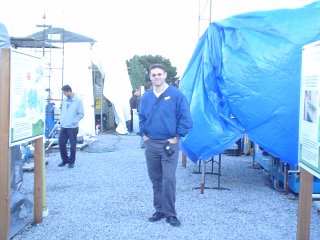
Attached are some photos I took at a desalination pilot plant I visited earlier today.
You may have noticed that I have adjusted my aliyah target date. Instead of June 1st, at this point it makes more sense for me to aim for August 15th, which will give me a little bit of time after the PE exam to prepare myself, and the Ulpan I want to take doesn't begin until September anyway.
The biggest aliyah news so far is that the Sochnut (Jewish Agency) has approved my Tik Aliyah (application for Israeli citizenship.) Now, once I am ready to go, all I have to do is visit the Israeli consulate and have my passport stamped with an aliyah visa, which will entitle me to citizenship upon landing in Israel.
The next step is to begin the application process with Nefesh B’Nefesh (“Soul to Soul” in Hebrew,) an organization dedicated to helping Canadians and Americans make aliyah by, “removing the financial, professional, and logistical obstacles that are preventing many ‘would-be’ Olim from fulfilling their dream.” Nefesh B’Nefesh was founded by Rabbi Yehoshua Fass the day before the 9/11 attacks on the United States after his Israeli cousin was killed in a terrorist attack in Israel. He decided to honor his cousin’s memory by helping North Americans move to Israel as a response to those who would drive us out. He co-founded the organization with philanthropist Tony Gelbhart, and since then they have been steadily boosting the numbers of olim one year at a time.
The record number of immigrants from North America was 8,122 in 1971, part of a wave of immigrants inspired by Israel’s victory in the 1967 Six Day War. Since then, numbers have steadily dropped off until, even during the prosperity and quiet of 1999, only 1,697 North Americans decided to make aliyah.
Nefesh B’ Nefesh charters flights full of olim with El Al (Israel’s national airline,) bringing in immigrants by the planeload. The first flight was in 2002, only a couple of months after I had to leave Israel. That year Nefesh B’Nefesh assisted about 200 immigrants. The numbers have steadily increased until this year, 2005, saw six planeloads with 2,300 immigrants, and 10 planeloads are expected for 2006. The eventual goal is to break the all-time record of 1971 and beyond.
If the old saying that Zionism is one Jew sending a second Jew to Israel on a third Jew’s money, then Nefesh B’Nefesh is Zionism par excellence. Right now, my main concern is completing my application for financial aid. I have to gather together all of my financial records and have my accountant fill in a financial affidavit. Then I’ll write an essay explaining my plans and dreams for aliyah, hopefully inspiring them enough to help me out with my student loans. Nefesh B’Nefesh is also involved with helping immigrants work their way through the Israeli bureaucracy, find work, and generally get settled in life.
While I’m busy with aliyah business, the rest of life seems to be moving apace. I unfortunately sprained my ankle about two months ago while jogging. It was a class 2 inversion sprain, which means that there was incredible swelling, bruising, and I was stuck at home on crutches for several days. After a couple of weeks, I was able to use the exercise bike, and after a month, I was able to use the elliptical machine at the gym. Unfortunately, I still can’t run without serious pain, which makes it difficult to cross the street when the little “Walk” symbol changes to a “Don’t Walk”. I was hoping to be able to run again by January 1st, but it’s looking less and less likely.
I also had my first business trip a week ago. The company actually seems convinced that I’m some sort of HVAC (Heating, Ventilation, and Air Conditioning) guru, so they flew me up to Seattle and put me up in a hotel for a couple of days to help them with a project they’re doing up there. I managed to extend the trip through the weekend, so I had a chance to visit my friends, my Dad and Sister, and I met Ira and Terry, a couple of wonderful long-lost cousins who live near Seattle.
It was a fun trip, and great for the ego that the company thinks it’s worth $600 to fly me up to Seattle for my expertise. Now it’s back to the grind here in Walnut Creek, working 10 hours per day, 6 days per week as usual, trying to get out of debt and save up as much as possible.
Attached are some photos I took at a desalination pilot plant I visited earlier today.

Thursday, October 06, 2005
Happy Birthday to the World and Me
The world turned 5,766 yesterday, and I turned 27 today. I want to wish everybody a happy Rosh Hashanah! If I have offended anybody over the past year I would like to here and now apologize (without necessarily admitting malice, wrongdoing, or negligence.)
I have been receiving the yearly parade of phone calls for my birthday, and in wishing her a happy Rosh Hashanah, my 16 year old skeptic sister bluntly pointed out the fact that the world is not 5,766 but, in fact, approximately 4.7 billion years old, and hence that going to Rosh Hashanah services is a waste of time. I'm so proud of her! She has matured from being childishly obnoxious to intellectually obnoxious. My natural response was, "Shut up."
But she raised an excellent question: how can a person on the one hand function in the western world, with its dependence on fact, impartial judgment, and critical thought, yet at the same time be a religious Jew and believe in the Torah as the revealed word of God, straight from Mount Sinai? It's especially difficult for me, being an engineer, a profession requiring measurement, calculation, and a cold analysis of whether a solution to a particular problem is, in fact viable.
The easiest way to deal with such questions is to simply ignore the elephant sitting in your living room. For the religious, this means that anything contradicting the literal Torah view must be shut out, including books, movies, and news reports. Why is there fossilized evidence that creatures existed eons before the biblical 5,766 years of creation? How can we see light traveling from stars which are more than 5,766 light years away? None of this is a problem if you live in a Torah bubble.
Similarly, a secular person can to dismiss substantive arguments that the Torah is true as religious superstition. Why does the surrounding culture always react with great violence and hostility to Jews when they attempt to assimilate, contrary to the experience of all other exiled peoples? Why do the Jewish people, the weakest and smallest, survive when all the great and powerful nations of the earth have vanished, contrary to every rational argument? If you can brush off such questions as exceptions and quirks without a second thought, then you're out of the intellectual woods.
There are some who, in desperation, try to split this argument into two issues. "Science explains how the world works, and Torah explains why." In other words, don't try to mix the two, you're only asking for trouble. I've tried each of these methods and none of them work. The little unasked questions don't go away, they gestate and feed on my subconscious, growing into major doubts.
The next step is to try to reconcile the two ideas. There is an idea that the world was created in-situ. When God created the world, he created trees full-grown. Thus, if you were to cut down a tree on the sixth day of creation and count the number of rings, the tree would seem to be 70 years old when really it was only 3 days old. Likewise fossils were created already buried in the earth, and starlight was created already on its way here, such that it would appear to the scientific observer that the world is four billion years old when it is really only 5,766. All evidence contrary to divine creation is simply a divine test of faith.
Likewise, there is the scientific theory, called "intelligent design," postulating that the world was created through a natural process, but that this process was constantly guided by God's hand.
I have never been a big fan of either of these theories, since I don't see anywhere else that God tries to "fool" us with evidence to contradicts his words. "I have set before you life and death, the blessing and the curse; therefore choose life, that you may live…" (Deut 30:19.) No tricks or demands that you live with your head in the sand, just the expectation that you live properly and the Torah, the teaching, of how to do so.
My own belief is that the two systems are part of one system, they simply haven't been reconciled yet. The physics world is experiencing a similar problem. Einstein's theory of relativity today explains how the world of the very large, galaxies, stars, light, and gravity, operates. Quantum physics explains how the world of the very small, the atoms, electrons, neutrons, and protons, operates. However, when one applies the laws of relativity to the very small, they do describe what is seen in a laboratory. And quantum physics, while beautifully explaining the world of the very small, doesn't bear any resemblance to reality on the very large scale. Still, there is no doubt that they do both, in fact, explain the same universe, and the search is on to find the "Grand Unified Theory" to unite them.
We know from physics that time is not necessarily a static quantity. Relativity tells us, and it has been scientifically observed, that what a person traveling at close to the speed of light experiences as a day may take years or centuries to a stationary observer. Likewise, one of the four Talmudic explanations of the Chanukah miracle is that, although outsiders observed the Chanukah menorah to burn for eight days, time inside the Beit Hamikdash where the menorah was burning was actually only one day, stretched out so that an outside observer would observe eight days.
There are aspects of the observable universe that science explains and aspects that only the Torah can explain, and sometimes pretending to know the answers is more destructive than admitting, "I don't know." The physicists argue over quantum mechanics and Einstein's relativity, but meanwhile we continue to enjoy televisions, computers, microwave ovens, and all the inventions that require both of these seemingly contradictory theories to function. Likewise, I have no doubt that with the coming of the Moshiach, we'll finally have our "Grand Unified Theory" of Torah and science. Until then, I'll keep using my microwave and keep going to minyan on Rosh Hashanah.
I have been receiving the yearly parade of phone calls for my birthday, and in wishing her a happy Rosh Hashanah, my 16 year old skeptic sister bluntly pointed out the fact that the world is not 5,766 but, in fact, approximately 4.7 billion years old, and hence that going to Rosh Hashanah services is a waste of time. I'm so proud of her! She has matured from being childishly obnoxious to intellectually obnoxious. My natural response was, "Shut up."
But she raised an excellent question: how can a person on the one hand function in the western world, with its dependence on fact, impartial judgment, and critical thought, yet at the same time be a religious Jew and believe in the Torah as the revealed word of God, straight from Mount Sinai? It's especially difficult for me, being an engineer, a profession requiring measurement, calculation, and a cold analysis of whether a solution to a particular problem is, in fact viable.
The easiest way to deal with such questions is to simply ignore the elephant sitting in your living room. For the religious, this means that anything contradicting the literal Torah view must be shut out, including books, movies, and news reports. Why is there fossilized evidence that creatures existed eons before the biblical 5,766 years of creation? How can we see light traveling from stars which are more than 5,766 light years away? None of this is a problem if you live in a Torah bubble.
Similarly, a secular person can to dismiss substantive arguments that the Torah is true as religious superstition. Why does the surrounding culture always react with great violence and hostility to Jews when they attempt to assimilate, contrary to the experience of all other exiled peoples? Why do the Jewish people, the weakest and smallest, survive when all the great and powerful nations of the earth have vanished, contrary to every rational argument? If you can brush off such questions as exceptions and quirks without a second thought, then you're out of the intellectual woods.
There are some who, in desperation, try to split this argument into two issues. "Science explains how the world works, and Torah explains why." In other words, don't try to mix the two, you're only asking for trouble. I've tried each of these methods and none of them work. The little unasked questions don't go away, they gestate and feed on my subconscious, growing into major doubts.
The next step is to try to reconcile the two ideas. There is an idea that the world was created in-situ. When God created the world, he created trees full-grown. Thus, if you were to cut down a tree on the sixth day of creation and count the number of rings, the tree would seem to be 70 years old when really it was only 3 days old. Likewise fossils were created already buried in the earth, and starlight was created already on its way here, such that it would appear to the scientific observer that the world is four billion years old when it is really only 5,766. All evidence contrary to divine creation is simply a divine test of faith.
Likewise, there is the scientific theory, called "intelligent design," postulating that the world was created through a natural process, but that this process was constantly guided by God's hand.
I have never been a big fan of either of these theories, since I don't see anywhere else that God tries to "fool" us with evidence to contradicts his words. "I have set before you life and death, the blessing and the curse; therefore choose life, that you may live…" (Deut 30:19.) No tricks or demands that you live with your head in the sand, just the expectation that you live properly and the Torah, the teaching, of how to do so.
My own belief is that the two systems are part of one system, they simply haven't been reconciled yet. The physics world is experiencing a similar problem. Einstein's theory of relativity today explains how the world of the very large, galaxies, stars, light, and gravity, operates. Quantum physics explains how the world of the very small, the atoms, electrons, neutrons, and protons, operates. However, when one applies the laws of relativity to the very small, they do describe what is seen in a laboratory. And quantum physics, while beautifully explaining the world of the very small, doesn't bear any resemblance to reality on the very large scale. Still, there is no doubt that they do both, in fact, explain the same universe, and the search is on to find the "Grand Unified Theory" to unite them.
We know from physics that time is not necessarily a static quantity. Relativity tells us, and it has been scientifically observed, that what a person traveling at close to the speed of light experiences as a day may take years or centuries to a stationary observer. Likewise, one of the four Talmudic explanations of the Chanukah miracle is that, although outsiders observed the Chanukah menorah to burn for eight days, time inside the Beit Hamikdash where the menorah was burning was actually only one day, stretched out so that an outside observer would observe eight days.
There are aspects of the observable universe that science explains and aspects that only the Torah can explain, and sometimes pretending to know the answers is more destructive than admitting, "I don't know." The physicists argue over quantum mechanics and Einstein's relativity, but meanwhile we continue to enjoy televisions, computers, microwave ovens, and all the inventions that require both of these seemingly contradictory theories to function. Likewise, I have no doubt that with the coming of the Moshiach, we'll finally have our "Grand Unified Theory" of Torah and science. Until then, I'll keep using my microwave and keep going to minyan on Rosh Hashanah.
Wednesday, September 14, 2005
Moving Right Along
A-Minus: 8 Months 2 Weeks 2 Days
The Sochnut, Hebrew for “Jewish Agency,” began in Israel’s pre-state days facilitating Jewish Immigration to Palestine and representing the Jewish People when negotiating with the United Nations and national governments. When Israel declared independence in 1948, most of the duties of the Sochnut were taken over by the Israeli government. Today the Sochnut acts as a semi-autonomous arm of the government, responsible for immigration, Zionist education, and Israel’s relations with Jews around the world. The Sochnut sends shlichim (messengers) to cities with a significant Jewish population in order to encourage and facilitate aliyah.
A few hours ago I made the first phone call to the Sochnut at the Israeli Consulate in San Francisco to open my Tik Aliyah (immigration file.) After repeated phone calls I finally got a hold of my shaliach, whose name is Shiri and seems quite friendly. She briefly interviewed me and we discussed my plans, which met with her approval. I already have all of my personal paperwork together (new passport and proof of Jewishness,) and she mailed me some additional paperwork to fill out. Once I have crossed all my t’s and dotted my i’s, I’ll have to make a trip out to San Francisco to meet with her for a face to face interview and to check my paperwork.
Meanwhile, my Hebrew has been suffering over the last few months. I’ve been so busy at work that it has been difficult to find time to study. Also, I took a 4th of July vacation down to Southern California to visit friends when my briefcase with all of my study materials and palm pilot was either lost, misplaced, or stolen by gnomes. I had an Israeli friend at Chabad who was correcting my grammar exercises, but then he stopped coming so there’s nobody to help with my written exercises. Also, my good next-door neighbors who were helping me learn and feeding me every night have moved away to Toronto, so now I don’t have anybody to eat or read with.
Helping my neighbors pack all of their junk and garbage for the move to Toronto made me realize how much junk and garbage I also own, and it made me wonder how I’m going to get it all to Israel. One of the Zchuyot Oleh, the special rights granted to new immigrants, is the right to bring over a container full of possessions without paying Israel’s draconian import taxes. Once I started looking into it, however, I discovered that a container will cost at least $6,000 after everything is said and done. I don’t think that all of my possessions combined are worth that much, not to mention that I’ll have nowhere to put them once I arrive, so I think it’s better just to sell everything I can, especially the large stuff. I have already photographed almost everything I own and am working on a website to launch an internet garage sale, probably after I finish the PE exam in April.
I do have some small stuff that I don’t want to just have to throw away, so I’ve begun transferring it to store with my family up north. I just took a good week and a half vacation up there, and managed to transfer about 100 lbs worth of valuable but unnecessary items. I will keep bringing my possessions north incrementally until my final departure. Then, once I live in Israel, I will incrementally bring stuff over with me in my luggage as I shuttle back and forth for visits. This process is a bit tedious, but if it saves me $6,000, it will have been worth it.
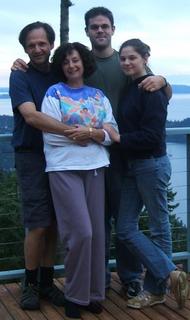
As I mentioned, I got to visit my family up north. It really is great to see my family, and makes me realize I don’t see them nearly enough. Pictures are attached.
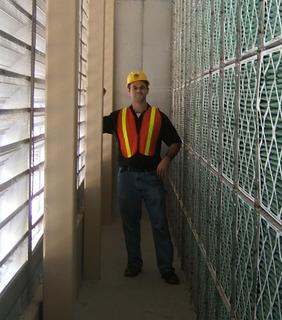
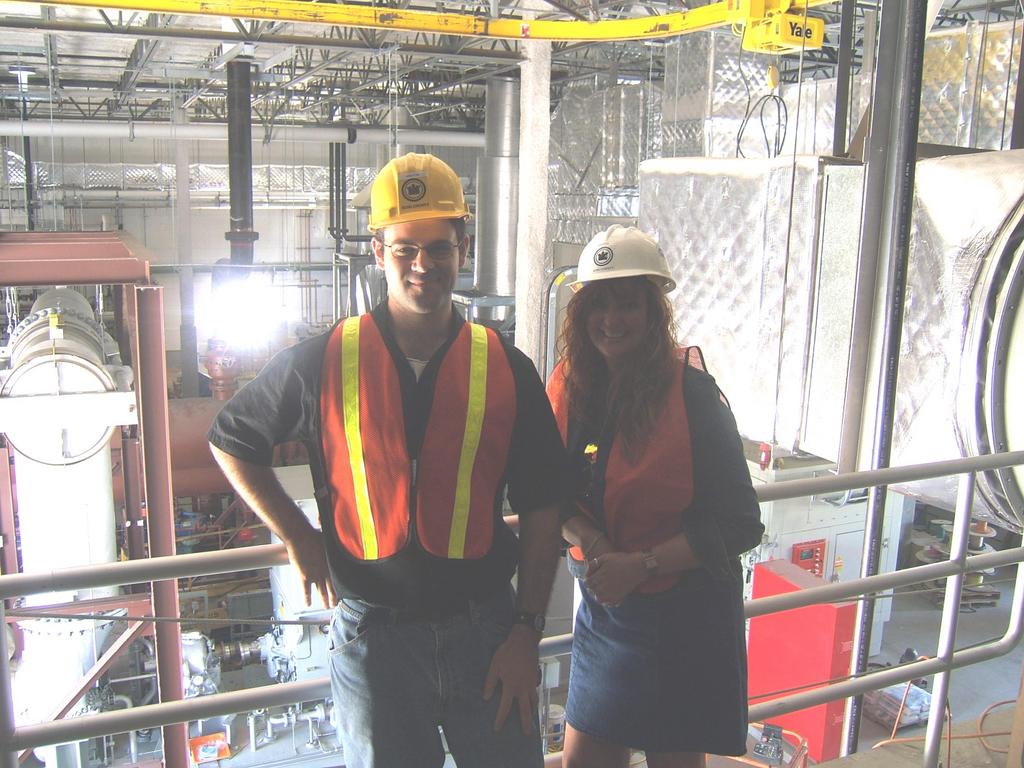
I also got to visit the King County Cogeneration Plant in Seattle, which was the first project I ever worked on as an engineer, starting way back in October 2002. I designed everything in that building from the 6 MegaWatt Gas Generators to the mop sink and hose spigots, so it’s very exciting to see the project nearing completion. Pictures of me in my macho hard hat are attached.
 It was refreshing to take time off to focus on things other than money, career, and aliyah. It reminds me how much I’m looking forward to being finished with this part of my life.
The Sochnut, Hebrew for “Jewish Agency,” began in Israel’s pre-state days facilitating Jewish Immigration to Palestine and representing the Jewish People when negotiating with the United Nations and national governments. When Israel declared independence in 1948, most of the duties of the Sochnut were taken over by the Israeli government. Today the Sochnut acts as a semi-autonomous arm of the government, responsible for immigration, Zionist education, and Israel’s relations with Jews around the world. The Sochnut sends shlichim (messengers) to cities with a significant Jewish population in order to encourage and facilitate aliyah.
A few hours ago I made the first phone call to the Sochnut at the Israeli Consulate in San Francisco to open my Tik Aliyah (immigration file.) After repeated phone calls I finally got a hold of my shaliach, whose name is Shiri and seems quite friendly. She briefly interviewed me and we discussed my plans, which met with her approval. I already have all of my personal paperwork together (new passport and proof of Jewishness,) and she mailed me some additional paperwork to fill out. Once I have crossed all my t’s and dotted my i’s, I’ll have to make a trip out to San Francisco to meet with her for a face to face interview and to check my paperwork.
Meanwhile, my Hebrew has been suffering over the last few months. I’ve been so busy at work that it has been difficult to find time to study. Also, I took a 4th of July vacation down to Southern California to visit friends when my briefcase with all of my study materials and palm pilot was either lost, misplaced, or stolen by gnomes. I had an Israeli friend at Chabad who was correcting my grammar exercises, but then he stopped coming so there’s nobody to help with my written exercises. Also, my good next-door neighbors who were helping me learn and feeding me every night have moved away to Toronto, so now I don’t have anybody to eat or read with.
Helping my neighbors pack all of their junk and garbage for the move to Toronto made me realize how much junk and garbage I also own, and it made me wonder how I’m going to get it all to Israel. One of the Zchuyot Oleh, the special rights granted to new immigrants, is the right to bring over a container full of possessions without paying Israel’s draconian import taxes. Once I started looking into it, however, I discovered that a container will cost at least $6,000 after everything is said and done. I don’t think that all of my possessions combined are worth that much, not to mention that I’ll have nowhere to put them once I arrive, so I think it’s better just to sell everything I can, especially the large stuff. I have already photographed almost everything I own and am working on a website to launch an internet garage sale, probably after I finish the PE exam in April.
I do have some small stuff that I don’t want to just have to throw away, so I’ve begun transferring it to store with my family up north. I just took a good week and a half vacation up there, and managed to transfer about 100 lbs worth of valuable but unnecessary items. I will keep bringing my possessions north incrementally until my final departure. Then, once I live in Israel, I will incrementally bring stuff over with me in my luggage as I shuttle back and forth for visits. This process is a bit tedious, but if it saves me $6,000, it will have been worth it.
As I mentioned, I got to visit my family up north. It really is great to see my family, and makes me realize I don’t see them nearly enough. Pictures are attached.
I also got to visit the King County Cogeneration Plant in Seattle, which was the first project I ever worked on as an engineer, starting way back in October 2002. I designed everything in that building from the 6 MegaWatt Gas Generators to the mop sink and hose spigots, so it’s very exciting to see the project nearing completion. Pictures of me in my macho hard hat are attached.

 It was refreshing to take time off to focus on things other than money, career, and aliyah. It reminds me how much I’m looking forward to being finished with this part of my life.
Tuesday, July 26, 2005
Progress & eLationships
A-minus: 10 months, 3 days
I’ve got 10 months to my Aliyah target date, so it’s time to stop daydreaming and start the process. The first step was to get a new passport since I lost my old one. Next, I’m going to open a “Tik Aliyah” (Aliyah folder) with the Israeli consulate.
To become an Israeli citizen, the Israeli “Law of Return” requires that the prospective immigrant prove his Jewishness. The Jewish definition of “Who is a Jew” states that one must either have a Jewish mother or have converted to Judaism. However, the founding fathers of Israel decided that in order to fulfill Israel’s mission as a Jewish refuge, anyone who would have been persecuted as a Jew is entitled to Israeli citizenship. Since the Nazis decreed that anyone who had one Jewish grandparent was Jewish enough to kill, the Israeli government adopted this definition. To obtain Israeli citizenship, one needs to present the Israeli consulate with two letters from prominent community members or a certificate of conversion as proof of Jewishness. I’m now in the process of preparing my paperwork.
Interestingly, post-war Germany also decided to open its borders to Jews in order to rebuild its local Jewish population, so anyone who has a Jewish mother can also immigrate to Germany. This results in the strange situation where the Jewish State uses the Nazi definition of “Who is a Jew”, and the descendants of the Nazis use the Jewish definition.
In the mean time I’ve been corresponding with a few potential Shidduchim (matches) via internet and telephone. I refer to these electronic relationships as eLationships. For those who don’t know, in the Frum (Orthodox Jewish) world, dating for marriage-minded singles works something like this:
1. Compile a list of character traits you are looking for in a prospective bride.
2. Go to local Rabbi, Rebbetzin (Rabbi’s wife) or trusted friend and tell them you’re “on the market” and what you’re looking for.
3. Someone recommends a Shidduch.
4. Give and check Shidduch’s references.
5. Initiate contact via phone or email.
6. Arrange and go on dates.
7. Get serious or split up.
Some of these steps may be skipped. For instance, if I bumped into someone I liked at shul (synagogue) and thought she was appropriate, I might start asking around about her without waiting for someone else to have the idea. Sometimes people don’t ask for references. In some very religious communities the couple meets once before getting married, although that is strongly advised against for people who grew up in western society.
So far I’ve made it up to steps 5 and 6, but no further. I’ve been involved in several eLationships recently, but I’ve been finding them extremely difficult since most of the girls I talk to live far, far away. I can have a few phone conversations, but if I want to get to know the girl, I have to buy an airline ticket and fly cross-country. The amount of money I would lose would set my Aliyah plans back by at least a month, maybe two, so it’s already a serious investment.
All these failed eLationships and financial issues sometimes trigger me to fall into the blues. Most mornings I wake up ready to go, to bring myself one more day, one more hour, one more minute closer to my goal. I can daven (pray) with kavannah (intent), and I get to work with a spring in my step. But about once every six months to a year, something happens that causes me to lose my footing. I won’t sleep all night, but in the morning I just want to lay there. I go to work but am really just an empty desk. My last episode happened around Lag B’Omer last May.
Since these “Blues Episodes” have happened a few times, I’ve been learning how to deal with and control them. The Jewish concept of Emunah is not really blind faith, but faithfulness, i.e. sticking to what you know even in times of challenge. I find that if I can just focus on the memory that, yes, there was a time when I woke up and had that powerful sense of direction, and that yes, I am still working towards a goal, even though I may be a bit confused now and it seems out of sight. I use the memory of having direction to gather enough strength to sustain the effort. Gradually, over a course of two or three weeks, I slowly regain my footing and begin again to have that burning fire in my belly of purpose and direction. I always come out of “Blues Episodes” stronger than I was when I fell in.
Well, I’ve got no blues for the time being and am making some serious progress. I put in another 10-hour workday today, I’m putting together my paperwork, and gearing up to begin the Aliyah process!
I’ve got 10 months to my Aliyah target date, so it’s time to stop daydreaming and start the process. The first step was to get a new passport since I lost my old one. Next, I’m going to open a “Tik Aliyah” (Aliyah folder) with the Israeli consulate.
To become an Israeli citizen, the Israeli “Law of Return” requires that the prospective immigrant prove his Jewishness. The Jewish definition of “Who is a Jew” states that one must either have a Jewish mother or have converted to Judaism. However, the founding fathers of Israel decided that in order to fulfill Israel’s mission as a Jewish refuge, anyone who would have been persecuted as a Jew is entitled to Israeli citizenship. Since the Nazis decreed that anyone who had one Jewish grandparent was Jewish enough to kill, the Israeli government adopted this definition. To obtain Israeli citizenship, one needs to present the Israeli consulate with two letters from prominent community members or a certificate of conversion as proof of Jewishness. I’m now in the process of preparing my paperwork.
Interestingly, post-war Germany also decided to open its borders to Jews in order to rebuild its local Jewish population, so anyone who has a Jewish mother can also immigrate to Germany. This results in the strange situation where the Jewish State uses the Nazi definition of “Who is a Jew”, and the descendants of the Nazis use the Jewish definition.
In the mean time I’ve been corresponding with a few potential Shidduchim (matches) via internet and telephone. I refer to these electronic relationships as eLationships. For those who don’t know, in the Frum (Orthodox Jewish) world, dating for marriage-minded singles works something like this:
1. Compile a list of character traits you are looking for in a prospective bride.
2. Go to local Rabbi, Rebbetzin (Rabbi’s wife) or trusted friend and tell them you’re “on the market” and what you’re looking for.
3. Someone recommends a Shidduch.
4. Give and check Shidduch’s references.
5. Initiate contact via phone or email.
6. Arrange and go on dates.
7. Get serious or split up.
Some of these steps may be skipped. For instance, if I bumped into someone I liked at shul (synagogue) and thought she was appropriate, I might start asking around about her without waiting for someone else to have the idea. Sometimes people don’t ask for references. In some very religious communities the couple meets once before getting married, although that is strongly advised against for people who grew up in western society.
So far I’ve made it up to steps 5 and 6, but no further. I’ve been involved in several eLationships recently, but I’ve been finding them extremely difficult since most of the girls I talk to live far, far away. I can have a few phone conversations, but if I want to get to know the girl, I have to buy an airline ticket and fly cross-country. The amount of money I would lose would set my Aliyah plans back by at least a month, maybe two, so it’s already a serious investment.
All these failed eLationships and financial issues sometimes trigger me to fall into the blues. Most mornings I wake up ready to go, to bring myself one more day, one more hour, one more minute closer to my goal. I can daven (pray) with kavannah (intent), and I get to work with a spring in my step. But about once every six months to a year, something happens that causes me to lose my footing. I won’t sleep all night, but in the morning I just want to lay there. I go to work but am really just an empty desk. My last episode happened around Lag B’Omer last May.
Since these “Blues Episodes” have happened a few times, I’ve been learning how to deal with and control them. The Jewish concept of Emunah is not really blind faith, but faithfulness, i.e. sticking to what you know even in times of challenge. I find that if I can just focus on the memory that, yes, there was a time when I woke up and had that powerful sense of direction, and that yes, I am still working towards a goal, even though I may be a bit confused now and it seems out of sight. I use the memory of having direction to gather enough strength to sustain the effort. Gradually, over a course of two or three weeks, I slowly regain my footing and begin again to have that burning fire in my belly of purpose and direction. I always come out of “Blues Episodes” stronger than I was when I fell in.
Well, I’ve got no blues for the time being and am making some serious progress. I put in another 10-hour workday today, I’m putting together my paperwork, and gearing up to begin the Aliyah process!
Tuesday, May 31, 2005
A-Minus: One Year
Well, this is it, I'm in the home stretch. My aliyah target date is June 1st, 2006. I realize that I may not be leaving on exactly that day, but I want to at least have my Professional Engineering License, to have my debts squared away, and to have all my possessions packed, shipped, sold, or burned by then. It feels good to be moving forward.
On the down side, my dear, precious 1992 Ford Tempo, which I've driven since I was in high school, is now in its death throes. The bearings on the AC compressor are failing, so the car makes these horrible banging and clicking sounds when I drive it. The repairs will cost significantly more than the value of the car. I've been riding my bike as much as possible, hoping beyond hope that I could stretch the car's life out for just one more year, but I don't think it's going to pull through.
Fortunately, a car was just donated to our Chabad, so the Rabbi said I can take it. The deal is that I pay for registration, the smog check, etc., and he'll let me use it for the year.
So my new car is a two-seater 1988 Honda CRX hatchback with 150,000 miles on it. I was ten years old when this baby was born. The hood ornament is missing, the front left end is slightly crunched from some sort of collision, the sunroof looks a bit leaky, the air conditioning and power steering are long gone, the upholstery is shredded, and the body has numerous metastasizing colonies of blood rust. That aside, the old girl really runs smoothly and handles like a missile. I have dubbed her the "Rust Rocket."
The main disadvantage is that it's a manual transmission, and I only know how to drive an automatic. Not to worry! My buddy Art from Chabad has been taking me on lessons after work and on weekends. So far I've managed to go from a standstill to a start without screeching a total of four times out of roughly two hundred attempts. Usually we practice until either we can smell the clutch burning or Art starts experiencing whiplash. I'm only hoping I can get the hang of it before my Tempo breathes its last.
At work, we've hired a new Mechanical Engineer whom I interviewed a few months ago, and I am now in charge of training him. Boy, talk about starting from scratch. This young whipper-snapper came out of school and knows a lot of theoretical engineering stuff, but he's really pretty much a baby when it comes to practical applications and construction. I was never like that, was I? Still, he asks lots of questions and clearly knows that he doesn't know anything, which is a very good sign.
Otherwise things are okay. Life can sometimes get lonely here in Walnut Creek, as there aren't any girls of my age and religious persuasion around. I also haven't been studying Hebrew as much as I should lately, as I have been feeling a bit burned out on it. Still, I've got some good friends to go riding and hiking with. I'm also keeping in shape, working hard, learning a lot, and counting down the days.
On the down side, my dear, precious 1992 Ford Tempo, which I've driven since I was in high school, is now in its death throes. The bearings on the AC compressor are failing, so the car makes these horrible banging and clicking sounds when I drive it. The repairs will cost significantly more than the value of the car. I've been riding my bike as much as possible, hoping beyond hope that I could stretch the car's life out for just one more year, but I don't think it's going to pull through.
Fortunately, a car was just donated to our Chabad, so the Rabbi said I can take it. The deal is that I pay for registration, the smog check, etc., and he'll let me use it for the year.
So my new car is a two-seater 1988 Honda CRX hatchback with 150,000 miles on it. I was ten years old when this baby was born. The hood ornament is missing, the front left end is slightly crunched from some sort of collision, the sunroof looks a bit leaky, the air conditioning and power steering are long gone, the upholstery is shredded, and the body has numerous metastasizing colonies of blood rust. That aside, the old girl really runs smoothly and handles like a missile. I have dubbed her the "Rust Rocket."
The main disadvantage is that it's a manual transmission, and I only know how to drive an automatic. Not to worry! My buddy Art from Chabad has been taking me on lessons after work and on weekends. So far I've managed to go from a standstill to a start without screeching a total of four times out of roughly two hundred attempts. Usually we practice until either we can smell the clutch burning or Art starts experiencing whiplash. I'm only hoping I can get the hang of it before my Tempo breathes its last.
At work, we've hired a new Mechanical Engineer whom I interviewed a few months ago, and I am now in charge of training him. Boy, talk about starting from scratch. This young whipper-snapper came out of school and knows a lot of theoretical engineering stuff, but he's really pretty much a baby when it comes to practical applications and construction. I was never like that, was I? Still, he asks lots of questions and clearly knows that he doesn't know anything, which is a very good sign.
Otherwise things are okay. Life can sometimes get lonely here in Walnut Creek, as there aren't any girls of my age and religious persuasion around. I also haven't been studying Hebrew as much as I should lately, as I have been feeling a bit burned out on it. Still, I've got some good friends to go riding and hiking with. I'm also keeping in shape, working hard, learning a lot, and counting down the days.
Friday, March 25, 2005
A Freilecha Purim!
In shul this morning the Rabbi was passing out miniature bottles of vodka, so it must be PURIM TIME! Happy Purim to everyone!
Things have been moving along nicely here in Walnut Creek. First off, I found out that I passed the EIT exam. What a load off my shoulders! A few weeks later, I got a 3.88% raise, which felt even better. It would appear that Environmental Engineers (Environmental is the latest euphemism for sewage treatment) are in great demand these days. About 15% of the engineers at my company have left over the last two months, recruited mostly by our clients, the local municipalities. I think passing the EIT exam demonstrated my seriousness about advancement to my bosses, and they want to keep me, hence the raise.
When I was studying for the EIT exam, I would usually go to the library for two or three hours every night and spend all day Sunday studying at the coffee shop. I think that the brain is like a muscle, and once you start pushing it, you build up your strength. In order to better understand this process, I invented a new engineering unit. I figure that one fully-functional brain operating at full capacity for a standard hour is one "brain-hour." By long hours of studying, I increased my daily brain-hour capacity by about 40% from 8 hours per day to 11 hours per day. Once I finished the exam, I suddenly found that I had leisure time, something unknown in Israel, and I didn't know what to do with myself. I would finish work, come home, and just vegetate on video games or movies. Like a well-honed endurance runner suddenly sidelined, I found myself going crazy, so I decided to do something about it.
There are many hobbies that I've wanted to do. I've always been embarrassed about being a mechanical engineer and not being able to fix my car, so I could enroll in auto mechanic's courses at the local community college. I also wanted to improve my Hebrew, grow a vegetable garden, and maybe even learn an instrument. Well, I think that one of the reasons that the KBH (Kadosh Baruch Hu, a.k.a. God) sent me out here was to learn about focus. I really have to focus myself to get out of debt and stay on track. So I eliminated three and decided that the most important thing by far is to improve my Hebrew. I figure if I can learn Hebrew well enough, then I'll be able to get a better job after Aliyah, so I can hire someone else to fix my car and I'll be able to haggle with the mechanic better. I will also be able to afford vegetables instead of growing them, and I could buy a nice stereo instead of learning piano.
Thanks to friends in Israel I have some Ulpan (intensive Hebrew) workbooks, so I started with those. I've been going to the library for two hours every night, slowly working through the problems. I have several Israeli expatriate friends from Chabad and one in particular has spent many hours helping me. I fill out about five pages of grammar and vocabulary exercises per night and then fax them to him. He usually returns them, corrected, the next day at morning davening. He's been an amazing help.
Also, I really hit the jackpot when an older friend of mine, Meshullam got married. His wife moved into town and is a total Chabad-style Yiddishe Mame, who happens to have lived in Israel for twenty years. I have been going over to their house every night of the week for a sumptuous and highly kosher meal. After the meal, I have to earn my keep by reading from a Hebrew book of stories about the Lubavitcher Rebbe. I usually read for an hour or more, with her gently correcting and translating the parts I don't understand. It's a fantastic arrangement, and it's a relief to interact with non-engineers from time to time.
Things have been moving along nicely here in Walnut Creek. First off, I found out that I passed the EIT exam. What a load off my shoulders! A few weeks later, I got a 3.88% raise, which felt even better. It would appear that Environmental Engineers (Environmental is the latest euphemism for sewage treatment) are in great demand these days. About 15% of the engineers at my company have left over the last two months, recruited mostly by our clients, the local municipalities. I think passing the EIT exam demonstrated my seriousness about advancement to my bosses, and they want to keep me, hence the raise.
When I was studying for the EIT exam, I would usually go to the library for two or three hours every night and spend all day Sunday studying at the coffee shop. I think that the brain is like a muscle, and once you start pushing it, you build up your strength. In order to better understand this process, I invented a new engineering unit. I figure that one fully-functional brain operating at full capacity for a standard hour is one "brain-hour." By long hours of studying, I increased my daily brain-hour capacity by about 40% from 8 hours per day to 11 hours per day. Once I finished the exam, I suddenly found that I had leisure time, something unknown in Israel, and I didn't know what to do with myself. I would finish work, come home, and just vegetate on video games or movies. Like a well-honed endurance runner suddenly sidelined, I found myself going crazy, so I decided to do something about it.
There are many hobbies that I've wanted to do. I've always been embarrassed about being a mechanical engineer and not being able to fix my car, so I could enroll in auto mechanic's courses at the local community college. I also wanted to improve my Hebrew, grow a vegetable garden, and maybe even learn an instrument. Well, I think that one of the reasons that the KBH (Kadosh Baruch Hu, a.k.a. God) sent me out here was to learn about focus. I really have to focus myself to get out of debt and stay on track. So I eliminated three and decided that the most important thing by far is to improve my Hebrew. I figure if I can learn Hebrew well enough, then I'll be able to get a better job after Aliyah, so I can hire someone else to fix my car and I'll be able to haggle with the mechanic better. I will also be able to afford vegetables instead of growing them, and I could buy a nice stereo instead of learning piano.
Thanks to friends in Israel I have some Ulpan (intensive Hebrew) workbooks, so I started with those. I've been going to the library for two hours every night, slowly working through the problems. I have several Israeli expatriate friends from Chabad and one in particular has spent many hours helping me. I fill out about five pages of grammar and vocabulary exercises per night and then fax them to him. He usually returns them, corrected, the next day at morning davening. He's been an amazing help.
Also, I really hit the jackpot when an older friend of mine, Meshullam got married. His wife moved into town and is a total Chabad-style Yiddishe Mame, who happens to have lived in Israel for twenty years. I have been going over to their house every night of the week for a sumptuous and highly kosher meal. After the meal, I have to earn my keep by reading from a Hebrew book of stories about the Lubavitcher Rebbe. I usually read for an hour or more, with her gently correcting and translating the parts I don't understand. It's a fantastic arrangement, and it's a relief to interact with non-engineers from time to time.
Thursday, January 13, 2005
Halfway There
I'll start with the good news. My recent collision and the resulting damage to my 12-year-old Tempo caused $1,629.83 worth of damage to the car, which, after some haggling, my insurance company agreed to pay. I then made a near 100% repair with two wood screws and some rubbing compound, costing a total of $0.15, and promptly paid the balance to my student loans, which brings me to my next positive development.
Last year on January 1st, I made a vow to myself that within one year I would finish paying off my parents' portion of my student loans, an amount of $20,000 which we had agreed before my going to college that I was to pay myself. Today, I can proudly announce that, thank God, I reached my goal with 19 hours to spare. Now all I have left is the $20,000 that is in my name. I had decided to finish with my parents' portion first since, if God forbid I get fired or laid off, at least all of the debt would be in my own name, so the government can't go after my family. For the first time in my life I am completely financially independent, as all of my debt is in my own name.
I can now project that I should be able to finish with the second $20,000 by the end of this secular year, January 1st, 2006. I plan on taking the PE exam in April, 2006. This gives me some time to save up a bit extra, and I can at long last set myself a target date for aliyah: June, 2006.
Having a target date changes my outlook on life. I feel like I've been running up a mountain this whole time, and now that I'm halfway, I've come over the crest and am on my way back down. It's just as grueling and just as far as the way I've come, but now I know the terrain and I can finally see the finish line. I know I can make it.
Last year on January 1st, I made a vow to myself that within one year I would finish paying off my parents' portion of my student loans, an amount of $20,000 which we had agreed before my going to college that I was to pay myself. Today, I can proudly announce that, thank God, I reached my goal with 19 hours to spare. Now all I have left is the $20,000 that is in my name. I had decided to finish with my parents' portion first since, if God forbid I get fired or laid off, at least all of the debt would be in my own name, so the government can't go after my family. For the first time in my life I am completely financially independent, as all of my debt is in my own name.
I can now project that I should be able to finish with the second $20,000 by the end of this secular year, January 1st, 2006. I plan on taking the PE exam in April, 2006. This gives me some time to save up a bit extra, and I can at long last set myself a target date for aliyah: June, 2006.
Having a target date changes my outlook on life. I feel like I've been running up a mountain this whole time, and now that I'm halfway, I've come over the crest and am on my way back down. It's just as grueling and just as far as the way I've come, but now I know the terrain and I can finally see the finish line. I know I can make it.
Wednesday, November 10, 2004
Explosions, Collisions, Exams
Well, it's been quite a week or two.As some may know, I have been working hard towards getting my P.E. (Professional Engineer) license. This license allows the engineer to legally sign on drawings confirming that a design is correct, testify in a court of law, and show that he or she is generally capable of making competent engineering design decisions where human lives, health, or property is at risk. In order to get a P.E. license, one must first pass the E.I.T. (Engineer In Training) exam, accumulate three years of industry experience, and then pass the P.E. exam.
I've been studying for almost six months for the E.I.T. I have also been working long overtime hours (about 60 hours per week) until recently. Fortunately, the design project I've been working on so hard finally went out to the client. I suddenly found myself on a normal working schedule on October 1st, so I decided to really put the pedal to the metal studying. For a solid month (minus, of course, Sukkot) I was studying for three hours per day on weekdays and all day Sunday.
Two Fridays ago, I left work early to try to get in some studying before Shabbes started. There I was sitting at the intersection minding my own business when I heard some popping noises and looked in my rearview mirror to see flying glass and pieces of car. Before I could think, I was rear-ended and my car was thrown into a busy intersection. My car still ran, and I managed to pull to the side of the road with pieces of my car falling off. I really consider myself fortunate, since the person to the left of me had her car totaled and was hauled off in an ambulance, and the person to the left of her and to the right of me were both smashed up in the accident, but I walked away with only rear damage but a running car.
My car managed to limp home. On the way I was consoled upon hearing that Arafat died. I made a temporary repair by duct taping my bumper back onto my car, which has held up very well even in the rain. My insurance broker keeps calling me with tips to weasel money out of the insurance company.
The E.I.T. exam is always given on Saturday, but I received an exemption for religious reasons, which the exam proctor referred to as a "social handicap" and I was allowed to take it a different day. The exam covers everything you learn as an undergraduate, including calculus, thermodynamics, statics, dynamics, electric circuitry, fluid mechanics, physics, chemistry, and computer programming. The test is eight hours long, broken up into a four hour morning section on general engineering and four hour discipline-specific afternoon section, in my case mechanical engineering. I feel pretty good about the morning section, but I’m not so sure about the afternoon section. It was a tough exam, and the effort of studying, taking time off from work, and actually taking the exam was so exhausting that I really don’t want to have to take it again. On my way home, I heard that, his recent death notwithstanding, Arafat was awake and eating cornflakes. A bad omen.
So I came home to the election, which leads me to a confession… I was so wrapped up in my studies that I missed the registration deadline. For the last week I’ve been sulking about my failure as an American. Thank heavens, the Prez-EE-dent was re-elected without my help. Unfortunately, Bush lost California, and all because of me. Still, it was quite a relief. I could say more on why I think it was right for Jews to vote Republican in this election, but then I might never be able to stop. To top off the good news, it was announced that Arafat died again. Two hours later, Arafat issued his congratulations for President Bush’s victory.
So, for the last week, I’ve been working overtime making up the hours I missed for taking the E.I.T. exam. Last night I had finally finished working off the hours, and it was to be the first time I came straight home at 5 P.M. since July. I thought that I was through the woods, but…
…three miles away from where I was working, about 200 feet behind my apartment, the utility company has been digging a pipeline to divert a local creek under the road for flood control. Construction workers managed to expose a pipeline carrying jet fuel from the refinery in Martinez down to the San Jose Airport. For whatever reason, they happened to be doing some welding work in the same trench. The contractor then decided to use a backhoe to drop sections of pipe into the trench instead of the standard and safer procedure of lowering pipe sections by crane. You can see where this is headed.
At around 2 P.M., the resulting explosion shook all of Walnut Creek, sending a ball of flaming jet fuel careening into the sky. At my work, ambulances and fire trucks raced by, but there was little they could do at that point. The blast killed three workers instantly. Two more workers are still missing (i.e. completely vaporized.) Because the fuel pipeline was under pressure, fuel shot out at high velocity and acted as a giant blowtorch, incinerating a house across the street and causing fires at three apartment buildings. One square mile of Walnut Creek, including my apartment, were evacuated completely. Firefighters put out the blaze but it kept shooting back up until late last night, when the rain mercifully started falling. Upon further investigation, I found out that the design was done by Carollo Engineers (my company.) This is the worst tragedy that our company has ever been involved in and the first where someone died. I was able to go home at 9 P.M. to find my apartment still in one piece, but the whole neighborhood stank from the fire. I checked the news before going to bed. It looks like the Arabs have finally confessed that, no, Yassir Arafat is not dead, and he will be buried in Ramallah on Friday.
Well, other than the road carnage, 60 hour weeks, tectonic political shifts, grueling exams, and catastrophic explosions of jet fuel, it’s been a quiet week here in Walnut Creek.
I've been studying for almost six months for the E.I.T. I have also been working long overtime hours (about 60 hours per week) until recently. Fortunately, the design project I've been working on so hard finally went out to the client. I suddenly found myself on a normal working schedule on October 1st, so I decided to really put the pedal to the metal studying. For a solid month (minus, of course, Sukkot) I was studying for three hours per day on weekdays and all day Sunday.
Two Fridays ago, I left work early to try to get in some studying before Shabbes started. There I was sitting at the intersection minding my own business when I heard some popping noises and looked in my rearview mirror to see flying glass and pieces of car. Before I could think, I was rear-ended and my car was thrown into a busy intersection. My car still ran, and I managed to pull to the side of the road with pieces of my car falling off. I really consider myself fortunate, since the person to the left of me had her car totaled and was hauled off in an ambulance, and the person to the left of her and to the right of me were both smashed up in the accident, but I walked away with only rear damage but a running car.
My car managed to limp home. On the way I was consoled upon hearing that Arafat died. I made a temporary repair by duct taping my bumper back onto my car, which has held up very well even in the rain. My insurance broker keeps calling me with tips to weasel money out of the insurance company.
The E.I.T. exam is always given on Saturday, but I received an exemption for religious reasons, which the exam proctor referred to as a "social handicap" and I was allowed to take it a different day. The exam covers everything you learn as an undergraduate, including calculus, thermodynamics, statics, dynamics, electric circuitry, fluid mechanics, physics, chemistry, and computer programming. The test is eight hours long, broken up into a four hour morning section on general engineering and four hour discipline-specific afternoon section, in my case mechanical engineering. I feel pretty good about the morning section, but I’m not so sure about the afternoon section. It was a tough exam, and the effort of studying, taking time off from work, and actually taking the exam was so exhausting that I really don’t want to have to take it again. On my way home, I heard that, his recent death notwithstanding, Arafat was awake and eating cornflakes. A bad omen.
So I came home to the election, which leads me to a confession… I was so wrapped up in my studies that I missed the registration deadline. For the last week I’ve been sulking about my failure as an American. Thank heavens, the Prez-EE-dent was re-elected without my help. Unfortunately, Bush lost California, and all because of me. Still, it was quite a relief. I could say more on why I think it was right for Jews to vote Republican in this election, but then I might never be able to stop. To top off the good news, it was announced that Arafat died again. Two hours later, Arafat issued his congratulations for President Bush’s victory.
So, for the last week, I’ve been working overtime making up the hours I missed for taking the E.I.T. exam. Last night I had finally finished working off the hours, and it was to be the first time I came straight home at 5 P.M. since July. I thought that I was through the woods, but…
…three miles away from where I was working, about 200 feet behind my apartment, the utility company has been digging a pipeline to divert a local creek under the road for flood control. Construction workers managed to expose a pipeline carrying jet fuel from the refinery in Martinez down to the San Jose Airport. For whatever reason, they happened to be doing some welding work in the same trench. The contractor then decided to use a backhoe to drop sections of pipe into the trench instead of the standard and safer procedure of lowering pipe sections by crane. You can see where this is headed.
At around 2 P.M., the resulting explosion shook all of Walnut Creek, sending a ball of flaming jet fuel careening into the sky. At my work, ambulances and fire trucks raced by, but there was little they could do at that point. The blast killed three workers instantly. Two more workers are still missing (i.e. completely vaporized.) Because the fuel pipeline was under pressure, fuel shot out at high velocity and acted as a giant blowtorch, incinerating a house across the street and causing fires at three apartment buildings. One square mile of Walnut Creek, including my apartment, were evacuated completely. Firefighters put out the blaze but it kept shooting back up until late last night, when the rain mercifully started falling. Upon further investigation, I found out that the design was done by Carollo Engineers (my company.) This is the worst tragedy that our company has ever been involved in and the first where someone died. I was able to go home at 9 P.M. to find my apartment still in one piece, but the whole neighborhood stank from the fire. I checked the news before going to bed. It looks like the Arabs have finally confessed that, no, Yassir Arafat is not dead, and he will be buried in Ramallah on Friday.
Well, other than the road carnage, 60 hour weeks, tectonic political shifts, grueling exams, and catastrophic explosions of jet fuel, it’s been a quiet week here in Walnut Creek.
Thursday, September 02, 2004
Shanah Tovah!
Well, I haven't been very communicative lately, so I thought I'd just write to say hi.
Things here have been okay but not great. On January first of this year, I still hadn't paid off a dime's worth of debt, which is the whole reason I had to re-enter diaspora living. Various expenses, my car repeatedly breaking down, dental work, old credit card debt, and other problems had taken up all the money I was hoping to put towards my school debt. I had always assumed that my experiences with poverty in Israel, lving for weeks at a time on a bag of potatoes and ketchup packets from Burger King and "securing" my toilet paper from the university would have taught me to be careful with my money, and I was careful, but somehow living on my own in California has just been incredibly expensive. So on Rosh Hashanah last year, I resolved to start clamping down. I cut way way back on luxury expenses and started watching every penny. I like to challenge myself with a game called "streak", where I go as many days as possible without spending any money at all. My current record is six days. Also, my weight loss program really cut back on grocery bills (yes, I'm still maintaining my weight loss of 50 lbs.) Since January every spare cent I have has gone towards the loans.
I can't say that it's been a picnick though. Walnut Creek can be a very lonely place, as it's very hard to find religious girls around here. I've looked on all of the Frum dating websites, and there are some really nice girls out there on the east coast, but they're all too far away and, because of my clamp-down on expenses it's been very difficult to travel. The more local types seem to be more on the liberal end of things, as in, "My name is Sarah and I want to have a family but I also want to be a full-time trauma surgeon," which wouldn't work for what I want in a family. I've been in contact with shidduch potentials in Israel via email, but it's so expensive that I can't afford to meet them in person, and it gradually fizzles, which is harder than having never started communicating in the first place. About a month ago, I became very depressed, to the point that I couldn't eat or sleep for three days (it was right around Tisha B'Av.) Fortunately, I have some good friends here who helped me through it, and I'm feeling a lot happier now. I've always despised depression, assuming it a form of self-pity, but when it hits you it hits hard.
I find that I'm happiest when I feel that I'm making progress towards my goal of Aliyah. The Tanya (the founding mystical text of Chabad Lubavitch) says that if one is depressed the best course of action is to make ones self busy with mitzvot, and work is a mitzvah (six days of the week you shall work and on the seventh day don't do any work at all,) so I decided to throw myself into my work. The main project I've been working on over the last year is due on Erev Rosh Hashanah (September 15th), so there's tons of work to do to get it out the door. I've been working an average of ten hours per day, six days a week. After work, I like to come home, lay down on my bed, and listen to a lesson or two on Aish Hatorah audio (www.aishaudio.com) In the last five weeks I've ammassed over 100 hours of comp time, which I will eventually cash out and put toward my loans.
The good news is that I've been rewarded for my hard work with my very own office. Yes, I am no longer cubicled. I can even close the door and talk over the speaker phone with clients and vendors, or just sit at my desk and look important. Ever since they put me in the office, people stopped treating me like a trainee and started regarding me as an real life engineer. I am now managing construction of the power plant I designed for Seattle last year, meeting with clients, and coordinating our designs with subcontractors. Sometimes, people even ask me questions! The down side is that I'm now held responsible for every mistake I make. It's frustrating when someone comes back to me with a mistake I made in a design I completed a year ago that wasn't noticed until construction, and which is glaringly obvious to me now.
Well, there's lots of other stuff going on here. I have a potential roommate, so I could be moving soon. I have to study for the EIT exam which I'm taking in November. And, of course, the holidays are coming up in just two weeks!
Things here have been okay but not great. On January first of this year, I still hadn't paid off a dime's worth of debt, which is the whole reason I had to re-enter diaspora living. Various expenses, my car repeatedly breaking down, dental work, old credit card debt, and other problems had taken up all the money I was hoping to put towards my school debt. I had always assumed that my experiences with poverty in Israel, lving for weeks at a time on a bag of potatoes and ketchup packets from Burger King and "securing" my toilet paper from the university would have taught me to be careful with my money, and I was careful, but somehow living on my own in California has just been incredibly expensive. So on Rosh Hashanah last year, I resolved to start clamping down. I cut way way back on luxury expenses and started watching every penny. I like to challenge myself with a game called "streak", where I go as many days as possible without spending any money at all. My current record is six days. Also, my weight loss program really cut back on grocery bills (yes, I'm still maintaining my weight loss of 50 lbs.) Since January every spare cent I have has gone towards the loans.
I can't say that it's been a picnick though. Walnut Creek can be a very lonely place, as it's very hard to find religious girls around here. I've looked on all of the Frum dating websites, and there are some really nice girls out there on the east coast, but they're all too far away and, because of my clamp-down on expenses it's been very difficult to travel. The more local types seem to be more on the liberal end of things, as in, "My name is Sarah and I want to have a family but I also want to be a full-time trauma surgeon," which wouldn't work for what I want in a family. I've been in contact with shidduch potentials in Israel via email, but it's so expensive that I can't afford to meet them in person, and it gradually fizzles, which is harder than having never started communicating in the first place. About a month ago, I became very depressed, to the point that I couldn't eat or sleep for three days (it was right around Tisha B'Av.) Fortunately, I have some good friends here who helped me through it, and I'm feeling a lot happier now. I've always despised depression, assuming it a form of self-pity, but when it hits you it hits hard.
I find that I'm happiest when I feel that I'm making progress towards my goal of Aliyah. The Tanya (the founding mystical text of Chabad Lubavitch) says that if one is depressed the best course of action is to make ones self busy with mitzvot, and work is a mitzvah (six days of the week you shall work and on the seventh day don't do any work at all,) so I decided to throw myself into my work. The main project I've been working on over the last year is due on Erev Rosh Hashanah (September 15th), so there's tons of work to do to get it out the door. I've been working an average of ten hours per day, six days a week. After work, I like to come home, lay down on my bed, and listen to a lesson or two on Aish Hatorah audio (www.aishaudio.com) In the last five weeks I've ammassed over 100 hours of comp time, which I will eventually cash out and put toward my loans.
The good news is that I've been rewarded for my hard work with my very own office. Yes, I am no longer cubicled. I can even close the door and talk over the speaker phone with clients and vendors, or just sit at my desk and look important. Ever since they put me in the office, people stopped treating me like a trainee and started regarding me as an real life engineer. I am now managing construction of the power plant I designed for Seattle last year, meeting with clients, and coordinating our designs with subcontractors. Sometimes, people even ask me questions! The down side is that I'm now held responsible for every mistake I make. It's frustrating when someone comes back to me with a mistake I made in a design I completed a year ago that wasn't noticed until construction, and which is glaringly obvious to me now.
Well, there's lots of other stuff going on here. I have a potential roommate, so I could be moving soon. I have to study for the EIT exam which I'm taking in November. And, of course, the holidays are coming up in just two weeks!
Friday, April 30, 2004
Published - Enough Holocaust Museums
I was published in JWeekly, the San Francisco Bay Area's Jewish weekly magazine. The following editorial appears in this weekend's edition:
Enough Holocaust museums
A quick Google search will reveal no less than 26 Holocaust museums in the United States alone. Scan the headlines and you can’t miss it: a new Holocaust museum recently opened in Hungary; the groundbreaking for a Holocaust museum in Skopje, Macedonia is scheduled to begin soon. In these times, when intermarriage is skyrocketing and assimilation is following close behind, is it really appropriate to pour million after million into museums?
If the goal of these museums is to foster the memory of the Holocaust, they are failing. Polls consistently show a worldwide decrease in Holocaust awareness. The Italian newspaper Corriere della Sera reported that 35 percent of Europeans think the Jews should "stop playing the victim" and 15 percent think that the Holocaust was exaggerated. The German newspaper Die Zeit found that 65 percent of German teenagers do not even know what the word "holocaust" means. Even in America, 22 percent polled by the U.S. Holocaust Memorial Museum thought it was possible the Holocaust never took place.
Holocaust museums are equally ineffective at fostering Jewish identity. For Jewish children in the public school system, a field trip to the Holocaust museum may be the only contact with the Jewish world they have growing up. Barbed wire sculptures and photographs of emaciated corpses send a clear message to these children: "Stay away!" It sometimes seems that Yiddishkeit (Jewish feeling or content) has been replaced by Holocaustkeit.
So how can we make the memory of the Holocaust permanent, strengthen Jewish identity and boldly proclaim, "Never Again!"? Our history shows and the statistics prove that the only way to strengthen Jewish identity and prevent assimilation is through education. There are Jews walking around today, descended from survivors, who have never heard of Passover, never seen Israel,and never said the Sh’ma.
This "silent Holocaust" is made worse by the fact that it alienates the younger generation from exactly those whom it is supposed to remember. The Yiddishkeit of the six million seems foreign and strange to the Jew who has never learned. Education, outreach and personal involvement are the only way to bridge this gap, make the Holocaust more real, and ensure that there will be a next generation to remember the survivors.
A Holocaust museum can be an important memorial to the fallen, but in a generation facing the existential threats of Jewish ignorance and assimilation, we have to ask ourselves where we can most effectively direct our energy. The next time you walk into a Holocaust museum, look around and think what could have been done with all that energy and money. When you are given the guided tour of the exhibits, instead imagine that the tour guide is a Jewish-school instructor teaching about the holidays. When you are in the auditorium watching movies of bodies being piled up like cordwood, imagine that the room is a classroom full of eager students learning the aleph-bet. Try to imagine yourself as one of the victims of the gas chambers looking down on us today and ask yourself what you would rather see: a thriving Jewish school, or an expensive tomb.
Enough Holocaust museums
A quick Google search will reveal no less than 26 Holocaust museums in the United States alone. Scan the headlines and you can’t miss it: a new Holocaust museum recently opened in Hungary; the groundbreaking for a Holocaust museum in Skopje, Macedonia is scheduled to begin soon. In these times, when intermarriage is skyrocketing and assimilation is following close behind, is it really appropriate to pour million after million into museums?
If the goal of these museums is to foster the memory of the Holocaust, they are failing. Polls consistently show a worldwide decrease in Holocaust awareness. The Italian newspaper Corriere della Sera reported that 35 percent of Europeans think the Jews should "stop playing the victim" and 15 percent think that the Holocaust was exaggerated. The German newspaper Die Zeit found that 65 percent of German teenagers do not even know what the word "holocaust" means. Even in America, 22 percent polled by the U.S. Holocaust Memorial Museum thought it was possible the Holocaust never took place.
Holocaust museums are equally ineffective at fostering Jewish identity. For Jewish children in the public school system, a field trip to the Holocaust museum may be the only contact with the Jewish world they have growing up. Barbed wire sculptures and photographs of emaciated corpses send a clear message to these children: "Stay away!" It sometimes seems that Yiddishkeit (Jewish feeling or content) has been replaced by Holocaustkeit.
So how can we make the memory of the Holocaust permanent, strengthen Jewish identity and boldly proclaim, "Never Again!"? Our history shows and the statistics prove that the only way to strengthen Jewish identity and prevent assimilation is through education. There are Jews walking around today, descended from survivors, who have never heard of Passover, never seen Israel,and never said the Sh’ma.
This "silent Holocaust" is made worse by the fact that it alienates the younger generation from exactly those whom it is supposed to remember. The Yiddishkeit of the six million seems foreign and strange to the Jew who has never learned. Education, outreach and personal involvement are the only way to bridge this gap, make the Holocaust more real, and ensure that there will be a next generation to remember the survivors.
A Holocaust museum can be an important memorial to the fallen, but in a generation facing the existential threats of Jewish ignorance and assimilation, we have to ask ourselves where we can most effectively direct our energy. The next time you walk into a Holocaust museum, look around and think what could have been done with all that energy and money. When you are given the guided tour of the exhibits, instead imagine that the tour guide is a Jewish-school instructor teaching about the holidays. When you are in the auditorium watching movies of bodies being piled up like cordwood, imagine that the room is a classroom full of eager students learning the aleph-bet. Try to imagine yourself as one of the victims of the gas chambers looking down on us today and ask yourself what you would rather see: a thriving Jewish school, or an expensive tomb.
Friday, May 09, 2003
Women of the Wall
Dear friends and family,
Disclaimer: This email contains material which may be somewhat upsetting to those of my friends and family who are Reform and Conservative. Please read what I say carefully, and note that I am making a legal and logical argument, and nowhere do I state that a Reform or Conservative Jew is not a Jew, or that I am somehow "better" for being Orthodox.
A couple of weeks ago I read a piece in Findlaw disparaging the ruling by the Israeli Supreme Court to disallow a group known as "Women of the Wall" from praying at the Western Wall in Jerusalem, the holiest site to which Jews have access. The piece is written by a lawyer named Sheryl Colb (http://writ.news.findlaw.com/colb/), who is a Professor at Rutgers Law School in Newark. Upon seeing the piece, I felt the need to respond, which began a short-lived dialogue.
Before I begin, for those who don't know, the Women of the Wall is a group of non-Orthodox women who pray at the Western Wall every Rosh Chodesh (the first day of each Jewish month) wearing the traditional masculine garments of Tefillin and Talit, praying and singing very loudly, praying as a minyan (quorum,) and reading from the Torah, all of which are the traditional role of men and not women in an Orthodox synagogue.
While this may all sound very technical, it is important to understand that when women pray in this manner, it makes it impossible for the men to pray according to halachah (Jewish Law.) Legal arguments aside, the real fight here is by the non-Orthodox movements for recognition, not by the Israeli state, which already recognizes their religion as Jewish, but by Orthodox Jews who do not. The goal is to make a media spectacle which will attract attention and bring down scorn upon we obstinate Orthodox Jews who refuse to modify our beliefs and practices to make room for the "moral flavor of the month." It is important to make clear that while Orthodox Jews do not believe that the religion that the women are practicing is true to Torah, we still believe that they are Jews and are commanded to love them as sisters regardless of our disagreements.
To get their perspective, go to http://www.womenofthewall.org/ . Two interesting observations on their web page: while the English section is very thorough and well done, and has been up for three and a half years, the Hebrew section still says "Under Construction," indicating that this movement is not integral to Israeli society, in which something like 0.1% of Jews are Reform and Conservative, but imposed by English-speaking American Jews, in which the Refom and Conservative movements attract the majority of Jews. Also, it is noteworthy that while they claim to be acting within Halachah, glaringly absent from the section on their website labeled "Halachah" is any Halachic justification or backing for their actions.
Please bear with me, as the exchange was quite long. If you fall asleep while reading, I won't blame you.
The original article written by Sheryl Colb is as follows:
The Israeli Supreme Court Denies Women The Right to Pray at the Western Wall:A Misguided Decision Parallels the U.S. "Fighting Words" Doctrine
Wednesday, Apr. 23, 2003
Earlier this month, the Israeli Supreme Court, in a 5-4 decision, refused to permit women to pray out loud at the Western Wall ("the Wall") in Jerusalem. Known in Hebrew as the "Kotel Ha'Maaravi," the Wall is all that remains of the second Jewish Temple destroyed by the Romans almost 2000 years ago. It is one of the holiest sites in existence for Jews around the world.
The plaintiffs in the case called themselves the "Women of the Wall." They asked the Israeli Court to recognize their right to pray out loud at the Kotel, after they had repeatedly encountered physical and verbal abuse from the Ultra-Orthodox each time they tried to do so on their own.The women had hoped and expected the Court to agree that they, as a matter of equality, should be able to assemble and pray just like men have done for as long as the Wall has stood. Besides formalizing the legal equality of women, such a ruling could help fortify the resolve of police who must invariably come to the women's aid and repel acts of aggression.
On April 6, the women's hopes were dashed. The Israeli High Court concluded that because of the violence that plaintiffs' religious practice provokes on the part of Ultra-Orthodox spectators, the Women of the Wall would have to conduct their services elsewhere. In the estimation of the Court, female assembly and vocal prayer at the Wall could endanger public order and lead to rioting by Ultra-Orthodox Jews.
Fighting Words: An American Counterpart to the Israeli Concern
American Law has an analogue to the Israeli Court's public order concern: the "fighting words" doctrine. The First Amendment ordinarily protects people's right to speak or assemble in a public forum, without censorship by the government. Under such cases as Chaplinsky v. New Hampshire, however, an exception exists for "fighting words," defined to include "those personally abusive epithets which, when addressed to the ordinary citizen, are, as a matter of common knowledge, inherently likely to provoke violent reaction."
To assess whether particular speech qualifies as "fighting words," courts must determine when the likely response will be an assault. Words that predictably provoke immediate violence do not enjoy constitutional protection. Like the Women of the Wall, the speaker in such cases is classified as disruptive of public order.Implicit Gender Bias in the Fighting Words Doctrine
Feminist authors have argued persuasively that the fighting words doctrine focuses on the wrong party in attributing responsibility for outbreaks of violence. To attach the label "fighting words" is, at least to some extent, to mitigate the seriousness of the violence that may follow such speech, on the theory that the speaker "asked for" or provoked the aggression.
Such labeling literally "blames the victim" for violence that is directed against him. It permits the government to punish his speech in addition to (or even instead of) punishing the person who would use his fists in response to words.
On top of unfairly attributing blame, moreover, the fighting words doctrine could conceivably turn on the gender of an audience to offending speech. When a woman, for example, listens to abusive remarks, the odds are relatively slim that she will physically assault the speaker. However hurtful the words that she hears, a woman ordinarily will not lash out in physical violence, even in situations in which men predictably would.
At best, this reality suggests that the fighting words doctrine is built around a masculine conception of speakers and listeners that disregards female modes of interaction and accommodates a stereotypically male way of responding to provocation.
At worst, as some authors have suggested, the doctrine provides that a person speaking abusively to a woman may enjoy greater First Amendment protection than a person speaking abusively to a man, by virtue of the likelihood that each respective listener will respond with violence.
Another way of putting this is that, as a matter of First Amendment doctrine, the worse the listener's temper, the more limited the speaker's freedom.
Explicit Gender Bias
The gender bias implicit in the American fighting words doctrine becomes explicit and pronounced in the decision handed down by the Israeli Supreme Court. The provocative speech (and worship) in that case is the prayer of women at a holy site. It is precisely the speakers' gender that triggers violent disorder on the part of onlookers.
By taking the abusive conduct of Ultra-Orthodox Jews as inevitable and silencing the praying women to restore order, the Court effectively condones violence as a strategy for imposing one's religious dogma on others. In the particular case, it does so at the expense of equality.
A Lesson from U.S. Constitutional Law
As noted above, U.S. courts have adopted a troubling fighting words doctrine. In addition, they have in other contexts often failed to resist oppressive private behavior. Yet in the area of race relations, they have embraced a salutary policy that could be instructive for the Israeli Supreme Court.
In Palmore v. Sidoti, decided in 1984, the U.S. Supreme Court confronted a custody battle between a man and woman who had formerly been married and had a daughter together. Both parties and their child were Caucasian.
The mother in the case, Linda Palmore, had originally been awarded custody of the couple's daughter. The father - Anthony Sidoti - later sought a modification of the custody award due to changed circumstances. Since the divorce was finalized, the mother had begun cohabiting with an African-American man (whom she went on to marry), and the child's father believed that this development called for a change in his child's living situation.
The Florida courts agreed with Sidoti and held that his daughter should not have to suffer the social stigmatization that would likely accompany life in a multiracial household. It accordingly awarded custody to the girl's father.
On appeal, the United States Supreme Court reversed the decision of the Florida courts. It held that the Equal Protection Clause of the Fourteenth Amendment prohibits the government from making custody decisions on the basis of race, even if the government's motive is to protect innocent people from exposure to the racial prejudice of society. The Court's decision wisely refused to allow bigots to dictate the structure of society.
The Israeli Supreme Court should have ruled likewise. The fact that some Ultra-Orthodox Jews may become violent and abusive in response to women praying out loud at the Wall is shameful and should be addressed as the hate crime that it is. As the U.S. Court said in Palmore, "[p]rivate biases may be outside the reach of the law, but the law cannot, directly or indirectly, give them effect." The decision against the Women of the Wall did exactly that: it gave effect to the wishes of the Ultra Orthodox, as expressed through violence.
The Larger Implications of the Ruling for Israeli Policy
The Israeli government should be especially sensitive to the perversity of the argument that prevailed in this case. Terrorists regularly visit death and injury on the people of Israel. They do so, they claim, in response to what they describe as Israel's provocative behavior - including settlement of the West Bank.Rather than alter its settlement policy, however, Israel has chosen to react to suicide bombings by indicating that it will not bow to terrorists, even if it might - in the absence of the violence - have begun the process of dismantling the settlements.
Whatever one thinks of Israeli settlements, the value of standing up to terrorists and resisting such extortion is clear. For both practical and moral reasons, Israel must not be perceived as conducting its decision-making at the point of a Palestinian gun.
Women of the Wall: Their Right to Worship
A group of Jewish women has sought to worship at a holy place at which men have worshipped for centuries. The women wish to pray and sing aloud - as the men do - despite the religious opposition of Ultra-Orthodox Jews who contend that the sound of a woman's voice is too sexually alluring to be heard by men.Onlookers - apparently inflamed with desire - have repeatedly set upon the "provocative" women by spitting, shoving, and hurling stones and other heavy objects, causing injuries that have, on occasion, required hospitalization. The Israeli Supreme Court attributes this "public disorder" to the peaceful prayers of the women rather than to the illegal and disgraceful behavior of their assailants.
One could justifiably characterize this decision as representing one step along to road to appeasing terrorists. It is a grave mistake that ought to be recognized as such and overruled.
Ephraim Aryeh's Response of 4/25/03
Dear Ms. Colb,I read your article on the Israeli Supreme Court case in FindLaw, and had a few problems with it. I couldn't figure out how to post this to the message board so I decided to email it to you directly.
First off, I'm not a lawyer.
I agree with your argument that the ruling that the presence of non-Orthodox women praying provokes the Orthodox men and women around them to violence is "blaming the victim," and the court should not have barred the "Women of the Wall" for that particular reason. However, as an Orthodox Jew, I would object to the presence of the women's prayer group not for that reason but because it is imposing a separate religion. The religion to which the women adhere, which calls itself Conservative Judaism, has been in existence for approximately 150 years. The religion to which the Orthodox men and women adhere, which calls itself Traditional or Orthodox Judaism, has been in existence for about 4,000 years. The Temple Mount, and later the Western Wall, has been a holy place for Orthodox Jews for nearly that entire time. Essentially, what the "Women of the Wall" amounts to is the imposition of a foreign religion upon Orthodox Jews in our holiest place. A parallel situation would be if a group of Muslims called itself "Muslims of the Church" and walked into a Catholic Church screaming "Alla Hu Achbar!" on Sunday mornings. Like the women of the wall, the Muslims could fairly make the claim that they were not interfering with the worship of Catholics because the Catholics were free to continue worshipping in their own way. However, realistically there is no way that the Catholics could be expected to reasonably tolerate such a disturbance in their holiest of places.
One could, of course argue, that the "Women of the Wall" are not trying to impose their religion on the Orthodox Jews but pray in their own way, and any offence is unintentional. However, the fact is that the Israeli Supreme Court offered "Women of the Wall" a separate location on the Western Wall to pray in their own way. This section of the wall, unearthed recently, is, in fact, closer to the original location of the Jewish Temple and therefore considered even holier than the current location where the Orthodox Jews pray. Their outright rejection of this solution indicates that their intent is not the practice of their religion but the imposition of their religion on Orthodox Jews.
As a side note, I also object to the following quote, "Terrorists regularly visit death and injury on the people of Israel. They do so, they claim, in response to what they describe as Israel's provocative behavior - including settlement of the West Bank. Rather than alter its settlement policy, however, Israel has chosen to react to suicide bombings by indicating that it will not bow to terrorists, even if it might - in the absence of the violence - have begun the process of dismantling the settlements."
This comment is somewhat disingenuous. While certain English-speaking pundits and European intellectuals use this argument, the terrorists do not. Virtually every terrorist group, from Hamas to Yassir Arafat's Fatach faction, do not claim that they conduct their attacks because of Jewish settlements but because of the existence of a Jewish state.
I would appreciate your input on these comments.
Sheryl Colb's Response of 4/25/03
Dear Mr. Aryeh:
Thank you for your thoughtful e-mail. I think you make a number of interesting points. The notion that the women in this case are practicing a different religion altogether puts the case of the Orthodox in a very different light, and I appreciate you're clarifying the issues in this way. Ultimately, though, I am not sure that I agree with the characterization. The analogy between "Muslims of the Church" and "Women of the Wall" strikes me as flawed, in part because the "Women of the Wall" group includes Orthodox Jews as well as Conservative and Reform Jews. Perhaps the Orthodox among them are modern Orthodox, however, and therefore, by your lights, not that different from Conservative. Still, I don't think the belief that women should be able to worship out loud is really enough of a departure from traditional Judaism to make the women's practice of Judaism an entirely different religion (just as a Sephardic Jew's eating peanuts on Passover does not convert the Sephardic Jew into an adherent of another religion from the Ashkenazim, or, to take a closer analogy, an Orthodox rabbi who shakes hands with women is not distinct enough from an Orthodox rabbi who refuses to shake hands (on the grounds that to do so would be "negiyah") to be a leader of different religion. The reason the women wish to worship at the Wall is not, I think, a desire to force a different religion on the Orthodox (as, for example, I would suggest about "Jews for Jesus"). Instead, women -- like men -- are drawn to the traditional association of that Wall with the Jewish religion. My suspicion, for example, is that even though the newly unearthed part of the Wall may be holier in some respects, as you suggest, the Orthodox men who currently pray at the Wall would probably be displeased if they were told by the Israeli Supreme Court that from now on, only women will be permitted to pray at the Kotel but that men (and only men) can pray at the alternative, holier portion of the wall. The women's not being satisfied with the alternative, in other words, is not necessarily proof that they just want to impose a religion on the Orthodox. Neither men nor women would wish to have their worship relegated to an "alternative" forum, even if that location may be "objectively" just as good as or better than the desired one. On the separate question of what gives rise to terrorism, you are right about what various terrorist groups say when claiming "credit" for their murders of Jews. Nonetheless, I think that the question is actually quite complex. While leaders of terrorist groups (and many terrorists themselves) say and believe that the existence of a Jewish State is what provokes them to violence, the reality is that the settlements may contribute to the ability of terrorist groups to recruit followers (each of whom presumably does what he does for his own reasons). If that is so, as I think it is, then a cessation of settlement and progress toward dismantling them could, in fact, reduce the amount of terrorism. Nonetheless, if Israel were to change its settlement policy in an obvious reaction to bus bombings, then the result could be very destructive and the message would be to reward violence (in fact, some Israeli academics in my circle of friends have indicated that pulling out of the Sinai when Israel did was strategically a mistake for that very reason, even though every one of them believes that pulling out of the Sinai was the right thing to do). In any event, I very much appreciate your sharing your thoughts with me, and I hope I have helped clarify my views for you. SFC
Ephraim Aryeh's Response of 5/2/03
(Note: I decided to ignore Ms. Colb's non sequitur stab at the settlements and argue only the merits of the religious arguments)
Dear Ms. Colb,
I have been thinking about the email you sent me and wanted to reply.
First, the supposition that the difference between Conservative/Reform (which I will call "Heterodox" for the sake of argument) and Orthodox is the same as the difference between Sephardi and Ashkenazi does not accurately reflect the basis of the disagreement. The specific example of a Sephardi eating peanuts on Passover while the Ashkenazi does not, is, like all differences between Sephardim and Ashkenazim, a matter of specific interpretation of an ordinance which is universally accepted among Orthodox Jews. Specifically, an Orthodox Jew is forbidden from eating leaven on Passover. In the world of Ashkenazi Jewry, there was a danger of peanuts being carried in the same sack as leaven, and therefore a ruling was made that Peanuts must be treated as leaven lest one inadvertently ingest leaven while enjoying a peanut. In the Sephardi world, leaven was not typically carried in the same sack with Peanuts, and therefore the Sephardi Rabbis ruled that there is no need to avoid peanuts. If the Torah is considered as the Jewish Constitution, then the Ashkenazi and Sephardi rabbis may be thought of as the state legislature and supreme court. While Florida and California may pass different laws and rulings relating to the local implementation of their laws, the United States Constitution will always be the basis of that law.
The thirteen principles of faith, as laid out by Maimonides in the 10th century, have been accepted as the litmus test by Judaism (for the last 200 years, Orthodox Judaism) to determine whether a religion or system of beliefs which claims to be Jewish has drifted far enough that it will be considered a different religion. Heterodox Judaism is in violation of many of these principles, more, in fact, than Christianity. For example, the ninth principle, "…that this Torah will not be changed, and that there will never be another given by G-d," clearly tells us that, for an Orthodox Jew, Torah is immutable. However, a Conservative Rabbi may pass a ruling that one may drive to his temple on the Sabbath, in spite of the fact that this will inevitably lead to the lighting of a fire on the Sabbath, which is expressly forbidden by Torah. An Orthodox Rabbi simply doesn’t have the power to make such a ruling. Because they are operating from the same set of basic principles, the Ashkenazi recognizes the Sephardi who eats peanuts on Passover as legitimate, even though he would never do so himself, and the Sephardi recognizes Ashkenazi leniencies likewise, but neither would dream of recognizing the Heterodox Rabbi’s rulings. Due to the vast chasm in both basic belief and practice which separates Heterodox from Orthodox Judaism, it is difficult to see what grounds there are to say that the two are of the same religion.Indeed a similar situation exists in the Christian world. Mormons will continuously affirm that they are Christians, and indeed they do share many of the same beliefs, but Christian theologians would never agree that Mormons are Christians.
As to the argument that some of the Women of the Wall are modern Orthodox, well, it seems beside the point. While they may claim to be of the Orthodox persuasion, their actions are clearly in violation of the beliefs and norms of Orthodox Judaism. To use the "Muslims of the Church" argument, it would be as if some of the Catholics decided to join in with the Muslims. This would not necessarily imply that the Muslims were practicing Catholicism.
As to the final argument, that the Western Wall holds a special place in the hearts of the Women of the Wall because of its traditional association with the Jewish religion, one can only take their word for it. And yes, the Orthodox men and women would be quite put out if they were asked to move from the Kotel to an alternate location, but it really comes down to a question of who was there first. Because prayers have been carried out at this location by Orthodox Jews for virtually all of recorded history, they take precedence over Heterodox Judaism. And because Heterodox and Orthodox forms of prayer are mutually exclusive and can’t be done in the same place, the Orthodox Jews have priority. Likewise, there are many Orthodox Jews who would much prefer to pray on the Temple Mount itself because if its traditional association with the Jewish religion, but because that location is currently in use by Muslims, the Israeli Supreme Court has determined that, for the Orthodox Jews, it’s just too bad.
Sheryl Colb's Response of 5/8/03
Dear Mr. Aryeh:
I have enjoyed our exchanges, but unfortunately, time is such that I cannot continue it indefinitely, even though it has been very interesting. I leave you the last word if you want it, but I do want to say a few things in parting.
Our discussion began with your suggestion that Women of the Wall represents a different religion from Orthodox Judaism, and the women's unwillingness to go to an alternative forum is evidence of their bad faith. I responded that the Orthodox men would almost certainly reject the suggestion that *they* go to an alternative forum (even if the forum were just as "holy" as the Western Wall, by many accounts). My point was not that the women should be able to go to the Western Wall and the Orthodox should go elsewhere. I was simply addressing your claim about bad faith by indicating that all Jews, including Women of the Wall, have reason to want to pray at the Western Wall, and that their wish to do so is therefore not proof of a desire to impose their vision of Judaism upon others, but is simply a product of the Wall's status as an important traditional place for Jewish worship. Just as Orthodox would not want to go elsewhere, so the Women of the Wall do not want to go elsewhere, and neither should have to.
Everyone, in other words, can be acting in good faith and nonetheless wish to pray at the Western Wall. If the Women of the Wall were to insist, however, that the Orthodox should be excluded from praying at the Wall, because their prayers and their modes of behavior offend the women and construct women's status in a manner that is profoundly wrong, I would think that such insistence should not be accepted as a basis for excluding the Orthodox. Jews of all different stripes come to the Wall for different reasons, and none should be excluded just because their approach is inconsistent with another's. If they work together, for example, the Ultra-Orthodox can come to an understanding through which particular times will be available to people who prefer not to pray in the presence of women praying aloud or ultra-Orthodox. For you to suggest that the Women of the Wall should not be allowed to pray out loud at what they (and their detractors) view as a holy place for Jews, because their views of Judaism are "heterodox" or otherwise presumptively inferior to that of the Orthodox, shows a lack of humility that all Jews, and indeed all human beings, ought to have in this world of uncertainty.
No one can know exactly what God wants from Jews (or from non-Jews). Everyone religious does his or her best to understand the commandments in a light that coheres with deep impulses about good and evil. Many, perhaps most, Hasidim, for example, believe that the Torah forbids the existence of Israel as a State until the Moshiach comes. For them, the very power of an Israeli Supreme Court or an Israeli prime minister who can make decisions about settlements or anything else is as good as treif. If you think that all Orthodox are united on the important things about halacha, you are thus very much mistaken. Finally, on the matter of who was at the Wall first, I would be very cautious about relying on an argument like that, when Jews have been shunned and worse by outsiders precisely because we weren't there first.
Though I could say more, other responsibilities call, and I know that whatever I say, you will believe what you believe, and I will believe what I believe. I nonetheless hope that our exchange will prove enlightening as we encounter people unlike ourselves in the future. SFC--End of email
Ephraim Aryeh's Final Response 5/8/03
Clearly, Professor Colb did not want me to respond, so I am forced to reply on my own. Her statement, "I leave you the last word if you want it, but I do want to say a few things in parting," seems to be something of an oxymoron, but I’ll leave it be.The most interesting observation one could make of Professor Colb’s response is that she really doesn’t address the legal or logical arguments I was making. Indeed, from reading her final email, it is not even clear if she read my email of 5/2/03. When she begins railing against my supposed superiority complex, which is a stereotype she seems to have about Orthodox Jews in general and is applying to me in this case, one can’t help but laugh.To go point by point:"Our discussion began with your suggestion that Women of the Wall represents a different religion from Orthodox Judaism, and the women's unwillingness to go to an alternative forum is evidence of their bad faith."
I believe that I conceded the point in my second email of 5/2 that we don’t know whether their motivation for wanting to pray at the more crowded section of the Western Wall is political or religious. "We can only take their word for it," were the words I used.
The legal argument I made was that I can not pray as an Orthodox Jew at the Western Wall in the presence of a Heterodox minyan without violating my own religion, which commands me not to listen to a quorum of lovely young women singing while I’m praying lest I be distracted from talking to my creator and start thinking about Women. Orthodox Judaism makes the honest distinction that men are the weaker gender when it comes to impulse control, concentration, and sexual restraint. For me to pray in the presence of such a minyan is to violate my religion. Whether intentional or unintentional, the actions of Women of the Wall constitute religious coercion, forcing me to either become a non-Orthodox Jew myself or no longer visit the wall. Professor Colb did not address this point.
"For you to suggest that the Women of the Wall should not be allowed to pray out loud at what they (and their detractors) view as a holy place for Jews, because their views of Judaism are "heterodox" or otherwise presumptively inferior to that of the Orthodox, shows a lack of humility that all Jews, and indeed all human beings, ought to have in this world of uncertainty."
The term "Heterodox" does not presume inferiority. The term "Orthodox" is a label which was assigned to people who had always thought of themselves simply as "Jews" by the Reform in the early days of their movement. The term "Ortho" meaning one, "dox" meaning way. It is defined as "Adhering to the accepted or traditional and established faith, especially in religion," by Webster’s dictionary. Therefore "Heterodox" seems appropriate, "Hetero" meaning different or, more specifically, differentiated (like heterogeneous,) since within Reform and Conservative there is no unifying moral code. A careful reread of my emails will show that I was not arguing the merits of one belief system against another (which I would be happy to do,) and I was not stating that one group is somehow superior to another.
"If you think that all Orthodox are united on the important things about halacha, you are thus very much mistaken."
No argument there. Orthodox Judaism is probably the most pluralistic religion in the world. There are Jews who say Tachanun (the prayer of mourning) on Israeli Independence Day, which they see as a disaster, and there are those who say Hallel (the prayer of thanksgiving and praise) on the same day, for what they see as a miracle. Yet all abide by the thirteen principles of faith and regard each other’s beliefs as Jewish. Professor Colb did not address this issue which I brought up in my email of 5/2.
"Finally, on the matter of who was at the Wall first, I would be very cautious about relying on an argument like that, when Jews have been shunned and worse by outsiders precisely because we weren't there first."
The Women of the Wall are still allowed to pray at the Western Wall. This is the unassailable right of every Jew. Provided, of course, that they pray in the traditional manner. At issue is not the right of the individual but the right of the movement. Suppose Jews for Jesus decided to erect a giant cross at the Western Wall. Technically, they are all Jewish, they simply believe that Jesus is the Moshiach. Therefore, by Reform standards, they are just as Jewish as Reform. Would this not be considered religious coercion? Would any court which values tolerance allow such a thing?
To close, I want to make it clear that I do not dislike "Heterodox" Jews. Indeed, I still feel a very strong closeness with all of my Jewish brothers and sisters. I simply do not believe that they have the right to force their religion upon me.
Shabbat Shalom,
Ephraim
Disclaimer: This email contains material which may be somewhat upsetting to those of my friends and family who are Reform and Conservative. Please read what I say carefully, and note that I am making a legal and logical argument, and nowhere do I state that a Reform or Conservative Jew is not a Jew, or that I am somehow "better" for being Orthodox.
A couple of weeks ago I read a piece in Findlaw disparaging the ruling by the Israeli Supreme Court to disallow a group known as "Women of the Wall" from praying at the Western Wall in Jerusalem, the holiest site to which Jews have access. The piece is written by a lawyer named Sheryl Colb (http://writ.news.findlaw.com/colb/), who is a Professor at Rutgers Law School in Newark. Upon seeing the piece, I felt the need to respond, which began a short-lived dialogue.
Before I begin, for those who don't know, the Women of the Wall is a group of non-Orthodox women who pray at the Western Wall every Rosh Chodesh (the first day of each Jewish month) wearing the traditional masculine garments of Tefillin and Talit, praying and singing very loudly, praying as a minyan (quorum,) and reading from the Torah, all of which are the traditional role of men and not women in an Orthodox synagogue.
While this may all sound very technical, it is important to understand that when women pray in this manner, it makes it impossible for the men to pray according to halachah (Jewish Law.) Legal arguments aside, the real fight here is by the non-Orthodox movements for recognition, not by the Israeli state, which already recognizes their religion as Jewish, but by Orthodox Jews who do not. The goal is to make a media spectacle which will attract attention and bring down scorn upon we obstinate Orthodox Jews who refuse to modify our beliefs and practices to make room for the "moral flavor of the month." It is important to make clear that while Orthodox Jews do not believe that the religion that the women are practicing is true to Torah, we still believe that they are Jews and are commanded to love them as sisters regardless of our disagreements.
To get their perspective, go to http://www.womenofthewall.org/ . Two interesting observations on their web page: while the English section is very thorough and well done, and has been up for three and a half years, the Hebrew section still says "Under Construction," indicating that this movement is not integral to Israeli society, in which something like 0.1% of Jews are Reform and Conservative, but imposed by English-speaking American Jews, in which the Refom and Conservative movements attract the majority of Jews. Also, it is noteworthy that while they claim to be acting within Halachah, glaringly absent from the section on their website labeled "Halachah" is any Halachic justification or backing for their actions.
Please bear with me, as the exchange was quite long. If you fall asleep while reading, I won't blame you.
The original article written by Sheryl Colb is as follows:
The Israeli Supreme Court Denies Women The Right to Pray at the Western Wall:A Misguided Decision Parallels the U.S. "Fighting Words" Doctrine
Wednesday, Apr. 23, 2003
Earlier this month, the Israeli Supreme Court, in a 5-4 decision, refused to permit women to pray out loud at the Western Wall ("the Wall") in Jerusalem. Known in Hebrew as the "Kotel Ha'Maaravi," the Wall is all that remains of the second Jewish Temple destroyed by the Romans almost 2000 years ago. It is one of the holiest sites in existence for Jews around the world.
The plaintiffs in the case called themselves the "Women of the Wall." They asked the Israeli Court to recognize their right to pray out loud at the Kotel, after they had repeatedly encountered physical and verbal abuse from the Ultra-Orthodox each time they tried to do so on their own.The women had hoped and expected the Court to agree that they, as a matter of equality, should be able to assemble and pray just like men have done for as long as the Wall has stood. Besides formalizing the legal equality of women, such a ruling could help fortify the resolve of police who must invariably come to the women's aid and repel acts of aggression.
On April 6, the women's hopes were dashed. The Israeli High Court concluded that because of the violence that plaintiffs' religious practice provokes on the part of Ultra-Orthodox spectators, the Women of the Wall would have to conduct their services elsewhere. In the estimation of the Court, female assembly and vocal prayer at the Wall could endanger public order and lead to rioting by Ultra-Orthodox Jews.
Fighting Words: An American Counterpart to the Israeli Concern
American Law has an analogue to the Israeli Court's public order concern: the "fighting words" doctrine. The First Amendment ordinarily protects people's right to speak or assemble in a public forum, without censorship by the government. Under such cases as Chaplinsky v. New Hampshire, however, an exception exists for "fighting words," defined to include "those personally abusive epithets which, when addressed to the ordinary citizen, are, as a matter of common knowledge, inherently likely to provoke violent reaction."
To assess whether particular speech qualifies as "fighting words," courts must determine when the likely response will be an assault. Words that predictably provoke immediate violence do not enjoy constitutional protection. Like the Women of the Wall, the speaker in such cases is classified as disruptive of public order.Implicit Gender Bias in the Fighting Words Doctrine
Feminist authors have argued persuasively that the fighting words doctrine focuses on the wrong party in attributing responsibility for outbreaks of violence. To attach the label "fighting words" is, at least to some extent, to mitigate the seriousness of the violence that may follow such speech, on the theory that the speaker "asked for" or provoked the aggression.
Such labeling literally "blames the victim" for violence that is directed against him. It permits the government to punish his speech in addition to (or even instead of) punishing the person who would use his fists in response to words.
On top of unfairly attributing blame, moreover, the fighting words doctrine could conceivably turn on the gender of an audience to offending speech. When a woman, for example, listens to abusive remarks, the odds are relatively slim that she will physically assault the speaker. However hurtful the words that she hears, a woman ordinarily will not lash out in physical violence, even in situations in which men predictably would.
At best, this reality suggests that the fighting words doctrine is built around a masculine conception of speakers and listeners that disregards female modes of interaction and accommodates a stereotypically male way of responding to provocation.
At worst, as some authors have suggested, the doctrine provides that a person speaking abusively to a woman may enjoy greater First Amendment protection than a person speaking abusively to a man, by virtue of the likelihood that each respective listener will respond with violence.
Another way of putting this is that, as a matter of First Amendment doctrine, the worse the listener's temper, the more limited the speaker's freedom.
Explicit Gender Bias
The gender bias implicit in the American fighting words doctrine becomes explicit and pronounced in the decision handed down by the Israeli Supreme Court. The provocative speech (and worship) in that case is the prayer of women at a holy site. It is precisely the speakers' gender that triggers violent disorder on the part of onlookers.
By taking the abusive conduct of Ultra-Orthodox Jews as inevitable and silencing the praying women to restore order, the Court effectively condones violence as a strategy for imposing one's religious dogma on others. In the particular case, it does so at the expense of equality.
A Lesson from U.S. Constitutional Law
As noted above, U.S. courts have adopted a troubling fighting words doctrine. In addition, they have in other contexts often failed to resist oppressive private behavior. Yet in the area of race relations, they have embraced a salutary policy that could be instructive for the Israeli Supreme Court.
In Palmore v. Sidoti, decided in 1984, the U.S. Supreme Court confronted a custody battle between a man and woman who had formerly been married and had a daughter together. Both parties and their child were Caucasian.
The mother in the case, Linda Palmore, had originally been awarded custody of the couple's daughter. The father - Anthony Sidoti - later sought a modification of the custody award due to changed circumstances. Since the divorce was finalized, the mother had begun cohabiting with an African-American man (whom she went on to marry), and the child's father believed that this development called for a change in his child's living situation.
The Florida courts agreed with Sidoti and held that his daughter should not have to suffer the social stigmatization that would likely accompany life in a multiracial household. It accordingly awarded custody to the girl's father.
On appeal, the United States Supreme Court reversed the decision of the Florida courts. It held that the Equal Protection Clause of the Fourteenth Amendment prohibits the government from making custody decisions on the basis of race, even if the government's motive is to protect innocent people from exposure to the racial prejudice of society. The Court's decision wisely refused to allow bigots to dictate the structure of society.
The Israeli Supreme Court should have ruled likewise. The fact that some Ultra-Orthodox Jews may become violent and abusive in response to women praying out loud at the Wall is shameful and should be addressed as the hate crime that it is. As the U.S. Court said in Palmore, "[p]rivate biases may be outside the reach of the law, but the law cannot, directly or indirectly, give them effect." The decision against the Women of the Wall did exactly that: it gave effect to the wishes of the Ultra Orthodox, as expressed through violence.
The Larger Implications of the Ruling for Israeli Policy
The Israeli government should be especially sensitive to the perversity of the argument that prevailed in this case. Terrorists regularly visit death and injury on the people of Israel. They do so, they claim, in response to what they describe as Israel's provocative behavior - including settlement of the West Bank.Rather than alter its settlement policy, however, Israel has chosen to react to suicide bombings by indicating that it will not bow to terrorists, even if it might - in the absence of the violence - have begun the process of dismantling the settlements.
Whatever one thinks of Israeli settlements, the value of standing up to terrorists and resisting such extortion is clear. For both practical and moral reasons, Israel must not be perceived as conducting its decision-making at the point of a Palestinian gun.
Women of the Wall: Their Right to Worship
A group of Jewish women has sought to worship at a holy place at which men have worshipped for centuries. The women wish to pray and sing aloud - as the men do - despite the religious opposition of Ultra-Orthodox Jews who contend that the sound of a woman's voice is too sexually alluring to be heard by men.Onlookers - apparently inflamed with desire - have repeatedly set upon the "provocative" women by spitting, shoving, and hurling stones and other heavy objects, causing injuries that have, on occasion, required hospitalization. The Israeli Supreme Court attributes this "public disorder" to the peaceful prayers of the women rather than to the illegal and disgraceful behavior of their assailants.
One could justifiably characterize this decision as representing one step along to road to appeasing terrorists. It is a grave mistake that ought to be recognized as such and overruled.
Ephraim Aryeh's Response of 4/25/03
Dear Ms. Colb,I read your article on the Israeli Supreme Court case in FindLaw, and had a few problems with it. I couldn't figure out how to post this to the message board so I decided to email it to you directly.
First off, I'm not a lawyer.
I agree with your argument that the ruling that the presence of non-Orthodox women praying provokes the Orthodox men and women around them to violence is "blaming the victim," and the court should not have barred the "Women of the Wall" for that particular reason. However, as an Orthodox Jew, I would object to the presence of the women's prayer group not for that reason but because it is imposing a separate religion. The religion to which the women adhere, which calls itself Conservative Judaism, has been in existence for approximately 150 years. The religion to which the Orthodox men and women adhere, which calls itself Traditional or Orthodox Judaism, has been in existence for about 4,000 years. The Temple Mount, and later the Western Wall, has been a holy place for Orthodox Jews for nearly that entire time. Essentially, what the "Women of the Wall" amounts to is the imposition of a foreign religion upon Orthodox Jews in our holiest place. A parallel situation would be if a group of Muslims called itself "Muslims of the Church" and walked into a Catholic Church screaming "Alla Hu Achbar!" on Sunday mornings. Like the women of the wall, the Muslims could fairly make the claim that they were not interfering with the worship of Catholics because the Catholics were free to continue worshipping in their own way. However, realistically there is no way that the Catholics could be expected to reasonably tolerate such a disturbance in their holiest of places.
One could, of course argue, that the "Women of the Wall" are not trying to impose their religion on the Orthodox Jews but pray in their own way, and any offence is unintentional. However, the fact is that the Israeli Supreme Court offered "Women of the Wall" a separate location on the Western Wall to pray in their own way. This section of the wall, unearthed recently, is, in fact, closer to the original location of the Jewish Temple and therefore considered even holier than the current location where the Orthodox Jews pray. Their outright rejection of this solution indicates that their intent is not the practice of their religion but the imposition of their religion on Orthodox Jews.
As a side note, I also object to the following quote, "Terrorists regularly visit death and injury on the people of Israel. They do so, they claim, in response to what they describe as Israel's provocative behavior - including settlement of the West Bank. Rather than alter its settlement policy, however, Israel has chosen to react to suicide bombings by indicating that it will not bow to terrorists, even if it might - in the absence of the violence - have begun the process of dismantling the settlements."
This comment is somewhat disingenuous. While certain English-speaking pundits and European intellectuals use this argument, the terrorists do not. Virtually every terrorist group, from Hamas to Yassir Arafat's Fatach faction, do not claim that they conduct their attacks because of Jewish settlements but because of the existence of a Jewish state.
I would appreciate your input on these comments.
Sheryl Colb's Response of 4/25/03
Dear Mr. Aryeh:
Thank you for your thoughtful e-mail. I think you make a number of interesting points. The notion that the women in this case are practicing a different religion altogether puts the case of the Orthodox in a very different light, and I appreciate you're clarifying the issues in this way. Ultimately, though, I am not sure that I agree with the characterization. The analogy between "Muslims of the Church" and "Women of the Wall" strikes me as flawed, in part because the "Women of the Wall" group includes Orthodox Jews as well as Conservative and Reform Jews. Perhaps the Orthodox among them are modern Orthodox, however, and therefore, by your lights, not that different from Conservative. Still, I don't think the belief that women should be able to worship out loud is really enough of a departure from traditional Judaism to make the women's practice of Judaism an entirely different religion (just as a Sephardic Jew's eating peanuts on Passover does not convert the Sephardic Jew into an adherent of another religion from the Ashkenazim, or, to take a closer analogy, an Orthodox rabbi who shakes hands with women is not distinct enough from an Orthodox rabbi who refuses to shake hands (on the grounds that to do so would be "negiyah") to be a leader of different religion. The reason the women wish to worship at the Wall is not, I think, a desire to force a different religion on the Orthodox (as, for example, I would suggest about "Jews for Jesus"). Instead, women -- like men -- are drawn to the traditional association of that Wall with the Jewish religion. My suspicion, for example, is that even though the newly unearthed part of the Wall may be holier in some respects, as you suggest, the Orthodox men who currently pray at the Wall would probably be displeased if they were told by the Israeli Supreme Court that from now on, only women will be permitted to pray at the Kotel but that men (and only men) can pray at the alternative, holier portion of the wall. The women's not being satisfied with the alternative, in other words, is not necessarily proof that they just want to impose a religion on the Orthodox. Neither men nor women would wish to have their worship relegated to an "alternative" forum, even if that location may be "objectively" just as good as or better than the desired one. On the separate question of what gives rise to terrorism, you are right about what various terrorist groups say when claiming "credit" for their murders of Jews. Nonetheless, I think that the question is actually quite complex. While leaders of terrorist groups (and many terrorists themselves) say and believe that the existence of a Jewish State is what provokes them to violence, the reality is that the settlements may contribute to the ability of terrorist groups to recruit followers (each of whom presumably does what he does for his own reasons). If that is so, as I think it is, then a cessation of settlement and progress toward dismantling them could, in fact, reduce the amount of terrorism. Nonetheless, if Israel were to change its settlement policy in an obvious reaction to bus bombings, then the result could be very destructive and the message would be to reward violence (in fact, some Israeli academics in my circle of friends have indicated that pulling out of the Sinai when Israel did was strategically a mistake for that very reason, even though every one of them believes that pulling out of the Sinai was the right thing to do). In any event, I very much appreciate your sharing your thoughts with me, and I hope I have helped clarify my views for you. SFC
Ephraim Aryeh's Response of 5/2/03
(Note: I decided to ignore Ms. Colb's non sequitur stab at the settlements and argue only the merits of the religious arguments)
Dear Ms. Colb,
I have been thinking about the email you sent me and wanted to reply.
First, the supposition that the difference between Conservative/Reform (which I will call "Heterodox" for the sake of argument) and Orthodox is the same as the difference between Sephardi and Ashkenazi does not accurately reflect the basis of the disagreement. The specific example of a Sephardi eating peanuts on Passover while the Ashkenazi does not, is, like all differences between Sephardim and Ashkenazim, a matter of specific interpretation of an ordinance which is universally accepted among Orthodox Jews. Specifically, an Orthodox Jew is forbidden from eating leaven on Passover. In the world of Ashkenazi Jewry, there was a danger of peanuts being carried in the same sack as leaven, and therefore a ruling was made that Peanuts must be treated as leaven lest one inadvertently ingest leaven while enjoying a peanut. In the Sephardi world, leaven was not typically carried in the same sack with Peanuts, and therefore the Sephardi Rabbis ruled that there is no need to avoid peanuts. If the Torah is considered as the Jewish Constitution, then the Ashkenazi and Sephardi rabbis may be thought of as the state legislature and supreme court. While Florida and California may pass different laws and rulings relating to the local implementation of their laws, the United States Constitution will always be the basis of that law.
The thirteen principles of faith, as laid out by Maimonides in the 10th century, have been accepted as the litmus test by Judaism (for the last 200 years, Orthodox Judaism) to determine whether a religion or system of beliefs which claims to be Jewish has drifted far enough that it will be considered a different religion. Heterodox Judaism is in violation of many of these principles, more, in fact, than Christianity. For example, the ninth principle, "…that this Torah will not be changed, and that there will never be another given by G-d," clearly tells us that, for an Orthodox Jew, Torah is immutable. However, a Conservative Rabbi may pass a ruling that one may drive to his temple on the Sabbath, in spite of the fact that this will inevitably lead to the lighting of a fire on the Sabbath, which is expressly forbidden by Torah. An Orthodox Rabbi simply doesn’t have the power to make such a ruling. Because they are operating from the same set of basic principles, the Ashkenazi recognizes the Sephardi who eats peanuts on Passover as legitimate, even though he would never do so himself, and the Sephardi recognizes Ashkenazi leniencies likewise, but neither would dream of recognizing the Heterodox Rabbi’s rulings. Due to the vast chasm in both basic belief and practice which separates Heterodox from Orthodox Judaism, it is difficult to see what grounds there are to say that the two are of the same religion.Indeed a similar situation exists in the Christian world. Mormons will continuously affirm that they are Christians, and indeed they do share many of the same beliefs, but Christian theologians would never agree that Mormons are Christians.
As to the argument that some of the Women of the Wall are modern Orthodox, well, it seems beside the point. While they may claim to be of the Orthodox persuasion, their actions are clearly in violation of the beliefs and norms of Orthodox Judaism. To use the "Muslims of the Church" argument, it would be as if some of the Catholics decided to join in with the Muslims. This would not necessarily imply that the Muslims were practicing Catholicism.
As to the final argument, that the Western Wall holds a special place in the hearts of the Women of the Wall because of its traditional association with the Jewish religion, one can only take their word for it. And yes, the Orthodox men and women would be quite put out if they were asked to move from the Kotel to an alternate location, but it really comes down to a question of who was there first. Because prayers have been carried out at this location by Orthodox Jews for virtually all of recorded history, they take precedence over Heterodox Judaism. And because Heterodox and Orthodox forms of prayer are mutually exclusive and can’t be done in the same place, the Orthodox Jews have priority. Likewise, there are many Orthodox Jews who would much prefer to pray on the Temple Mount itself because if its traditional association with the Jewish religion, but because that location is currently in use by Muslims, the Israeli Supreme Court has determined that, for the Orthodox Jews, it’s just too bad.
Sheryl Colb's Response of 5/8/03
Dear Mr. Aryeh:
I have enjoyed our exchanges, but unfortunately, time is such that I cannot continue it indefinitely, even though it has been very interesting. I leave you the last word if you want it, but I do want to say a few things in parting.
Our discussion began with your suggestion that Women of the Wall represents a different religion from Orthodox Judaism, and the women's unwillingness to go to an alternative forum is evidence of their bad faith. I responded that the Orthodox men would almost certainly reject the suggestion that *they* go to an alternative forum (even if the forum were just as "holy" as the Western Wall, by many accounts). My point was not that the women should be able to go to the Western Wall and the Orthodox should go elsewhere. I was simply addressing your claim about bad faith by indicating that all Jews, including Women of the Wall, have reason to want to pray at the Western Wall, and that their wish to do so is therefore not proof of a desire to impose their vision of Judaism upon others, but is simply a product of the Wall's status as an important traditional place for Jewish worship. Just as Orthodox would not want to go elsewhere, so the Women of the Wall do not want to go elsewhere, and neither should have to.
Everyone, in other words, can be acting in good faith and nonetheless wish to pray at the Western Wall. If the Women of the Wall were to insist, however, that the Orthodox should be excluded from praying at the Wall, because their prayers and their modes of behavior offend the women and construct women's status in a manner that is profoundly wrong, I would think that such insistence should not be accepted as a basis for excluding the Orthodox. Jews of all different stripes come to the Wall for different reasons, and none should be excluded just because their approach is inconsistent with another's. If they work together, for example, the Ultra-Orthodox can come to an understanding through which particular times will be available to people who prefer not to pray in the presence of women praying aloud or ultra-Orthodox. For you to suggest that the Women of the Wall should not be allowed to pray out loud at what they (and their detractors) view as a holy place for Jews, because their views of Judaism are "heterodox" or otherwise presumptively inferior to that of the Orthodox, shows a lack of humility that all Jews, and indeed all human beings, ought to have in this world of uncertainty.
No one can know exactly what God wants from Jews (or from non-Jews). Everyone religious does his or her best to understand the commandments in a light that coheres with deep impulses about good and evil. Many, perhaps most, Hasidim, for example, believe that the Torah forbids the existence of Israel as a State until the Moshiach comes. For them, the very power of an Israeli Supreme Court or an Israeli prime minister who can make decisions about settlements or anything else is as good as treif. If you think that all Orthodox are united on the important things about halacha, you are thus very much mistaken. Finally, on the matter of who was at the Wall first, I would be very cautious about relying on an argument like that, when Jews have been shunned and worse by outsiders precisely because we weren't there first.
Though I could say more, other responsibilities call, and I know that whatever I say, you will believe what you believe, and I will believe what I believe. I nonetheless hope that our exchange will prove enlightening as we encounter people unlike ourselves in the future. SFC--End of email
Ephraim Aryeh's Final Response 5/8/03
Clearly, Professor Colb did not want me to respond, so I am forced to reply on my own. Her statement, "I leave you the last word if you want it, but I do want to say a few things in parting," seems to be something of an oxymoron, but I’ll leave it be.The most interesting observation one could make of Professor Colb’s response is that she really doesn’t address the legal or logical arguments I was making. Indeed, from reading her final email, it is not even clear if she read my email of 5/2/03. When she begins railing against my supposed superiority complex, which is a stereotype she seems to have about Orthodox Jews in general and is applying to me in this case, one can’t help but laugh.To go point by point:"Our discussion began with your suggestion that Women of the Wall represents a different religion from Orthodox Judaism, and the women's unwillingness to go to an alternative forum is evidence of their bad faith."
I believe that I conceded the point in my second email of 5/2 that we don’t know whether their motivation for wanting to pray at the more crowded section of the Western Wall is political or religious. "We can only take their word for it," were the words I used.
The legal argument I made was that I can not pray as an Orthodox Jew at the Western Wall in the presence of a Heterodox minyan without violating my own religion, which commands me not to listen to a quorum of lovely young women singing while I’m praying lest I be distracted from talking to my creator and start thinking about Women. Orthodox Judaism makes the honest distinction that men are the weaker gender when it comes to impulse control, concentration, and sexual restraint. For me to pray in the presence of such a minyan is to violate my religion. Whether intentional or unintentional, the actions of Women of the Wall constitute religious coercion, forcing me to either become a non-Orthodox Jew myself or no longer visit the wall. Professor Colb did not address this point.
"For you to suggest that the Women of the Wall should not be allowed to pray out loud at what they (and their detractors) view as a holy place for Jews, because their views of Judaism are "heterodox" or otherwise presumptively inferior to that of the Orthodox, shows a lack of humility that all Jews, and indeed all human beings, ought to have in this world of uncertainty."
The term "Heterodox" does not presume inferiority. The term "Orthodox" is a label which was assigned to people who had always thought of themselves simply as "Jews" by the Reform in the early days of their movement. The term "Ortho" meaning one, "dox" meaning way. It is defined as "Adhering to the accepted or traditional and established faith, especially in religion," by Webster’s dictionary. Therefore "Heterodox" seems appropriate, "Hetero" meaning different or, more specifically, differentiated (like heterogeneous,) since within Reform and Conservative there is no unifying moral code. A careful reread of my emails will show that I was not arguing the merits of one belief system against another (which I would be happy to do,) and I was not stating that one group is somehow superior to another.
"If you think that all Orthodox are united on the important things about halacha, you are thus very much mistaken."
No argument there. Orthodox Judaism is probably the most pluralistic religion in the world. There are Jews who say Tachanun (the prayer of mourning) on Israeli Independence Day, which they see as a disaster, and there are those who say Hallel (the prayer of thanksgiving and praise) on the same day, for what they see as a miracle. Yet all abide by the thirteen principles of faith and regard each other’s beliefs as Jewish. Professor Colb did not address this issue which I brought up in my email of 5/2.
"Finally, on the matter of who was at the Wall first, I would be very cautious about relying on an argument like that, when Jews have been shunned and worse by outsiders precisely because we weren't there first."
The Women of the Wall are still allowed to pray at the Western Wall. This is the unassailable right of every Jew. Provided, of course, that they pray in the traditional manner. At issue is not the right of the individual but the right of the movement. Suppose Jews for Jesus decided to erect a giant cross at the Western Wall. Technically, they are all Jewish, they simply believe that Jesus is the Moshiach. Therefore, by Reform standards, they are just as Jewish as Reform. Would this not be considered religious coercion? Would any court which values tolerance allow such a thing?
To close, I want to make it clear that I do not dislike "Heterodox" Jews. Indeed, I still feel a very strong closeness with all of my Jewish brothers and sisters. I simply do not believe that they have the right to force their religion upon me.
Shabbat Shalom,
Ephraim
Monday, July 22, 2002
Perspectives on Zionism
The current war being fought in Israel is causing deep soul-searching in every corner of the political spectrum. The fact that 54 years after the establishment of their state, the Jews are still fighting tooth and nail for their national survival is bringing many to ask if Zionism can really be considered a success.
By every physical standard, Zionism is an unparalleled success. Over the last hundred years the land of Israel has increased its capacity to support a population from a few hundred thousand to 5.3 million Jews and almost as many Arabs. Israeli universities churn out scientific achievements at a rate far greater than most other western nations. The Israeli military is a modern and fearsome fighting machine with the demonstrated ability to repeatedly vanquish a vastly numerically superior enemy. So why is there an increasing sense of despair on the streets of Tel Aviv these days?
Despite their differences, the one thing that the early Zionists had in common with each other was that they were secular. This lack of belief in a higher power convinced them that it was up to them to solve the problems facing the Jewish world by their own power. The secular Zionists interpreted the anti-Semitism which culminated in the Holocaust as proof that life in the Diaspora is untenable. Therefore, the clearest solution to the anti-Semitism and torture that the Jews of Europe were facing was to set up a state of their own. They could then stand tall and face their European neighbors as equals. The state would have a strong military to prevent raging Cossacks and boot-clicking Nazis from wiping them out. After becoming free of the chains of Europe, the Jews would be able to speak their own language, Hebrew, and pursue their own national destiny as a people.
If judged by these goals, secular Zionism is an abject failure. Israel’s right to exist is routinely denied by the Arabs, and even the Europeans frequently question it. Israelis are being booted out of European universities, Israeli sports teams are no longer welcome in Europe, and European nations frequently tax or boycott Israeli products. Israel is the Jew of the nations. For all of its tanks and planes and hydrogen bombs, Israel is still unable (or unwilling) to use its military to defend its citizens. Today’s descendants of the Nazis and Cossacks are funding terrorist attacks by siphoning European Union funds to the Palestinian Authority. “Israeli Culture” today seems to be more American culture translated into Hebrew. The cultural characteristics of America from Coca Cola to Viagra to road rage are popping up all over the Israel. The Israeli state, which was supposed to be a refuge, is probably the least secure place for a Jew to live in the world.
But by religious standards, Israel is an unparalleled success. Traditionally religious Judaism (orthodoxy) views history as moving in a specific direction. The end goal of history is to reach a state of world peace with all of the Jewish people living in the land of Israel and living their lives by the Torah. The State of Israel is viewed by most as an important step on that path. The traditional Jew does not see the end of anti-Semitism as a realistic goal. G-d uses anti-Semitism to correct the course of the Jewish people when they go too far astray. Because the world has not arrived at the final messianic age, then obviously the Jewish people do not yet merit it, and therefore Anti-Semitism must be expected. Since Orthodox Jews believe that G-d created the Universe and everything in it, then no amount of military might or financial prowess is going to make these troubles go away. Only more careful religious observance and strengthening of the bonds between Jewish brethren can mitigate anti-Semitism.
When the Secular Jew looks at America, the ultimate golden Diaspora, he sees all of the physical and financial security Jews enjoy here. He finds a tolerant atmosphere and Jews reaching unparalleled prosperity and levels of acceptance. The original goals of secular Zionism; security, equality, and cultural freedom, can be more easily attained here in America.
But to the Orthodox Jew, life in America, however sweet, is transitory. The fact that Jews have become Federal Reserve Chairmen and movie producers and Vice Presidential candidates does not change the fact that history has a goal for us, and it is not going to be fulfilled here. The accomplishments of Diaspora Jewry are impermanent, and some day we will be called upon to fold our tents, pack our bags, and catch the next flight to Jerusalem. The only indelible edifice that there will be to our ever having existed will be the effect we have on the souls of the people who live around us. This explains the planeloads of secular Israelis who are leaving Israel for America, and the planeloads of American Orthodox Jews who pass them in the air on their way to Israel.
By every physical standard, Zionism is an unparalleled success. Over the last hundred years the land of Israel has increased its capacity to support a population from a few hundred thousand to 5.3 million Jews and almost as many Arabs. Israeli universities churn out scientific achievements at a rate far greater than most other western nations. The Israeli military is a modern and fearsome fighting machine with the demonstrated ability to repeatedly vanquish a vastly numerically superior enemy. So why is there an increasing sense of despair on the streets of Tel Aviv these days?
Despite their differences, the one thing that the early Zionists had in common with each other was that they were secular. This lack of belief in a higher power convinced them that it was up to them to solve the problems facing the Jewish world by their own power. The secular Zionists interpreted the anti-Semitism which culminated in the Holocaust as proof that life in the Diaspora is untenable. Therefore, the clearest solution to the anti-Semitism and torture that the Jews of Europe were facing was to set up a state of their own. They could then stand tall and face their European neighbors as equals. The state would have a strong military to prevent raging Cossacks and boot-clicking Nazis from wiping them out. After becoming free of the chains of Europe, the Jews would be able to speak their own language, Hebrew, and pursue their own national destiny as a people.
If judged by these goals, secular Zionism is an abject failure. Israel’s right to exist is routinely denied by the Arabs, and even the Europeans frequently question it. Israelis are being booted out of European universities, Israeli sports teams are no longer welcome in Europe, and European nations frequently tax or boycott Israeli products. Israel is the Jew of the nations. For all of its tanks and planes and hydrogen bombs, Israel is still unable (or unwilling) to use its military to defend its citizens. Today’s descendants of the Nazis and Cossacks are funding terrorist attacks by siphoning European Union funds to the Palestinian Authority. “Israeli Culture” today seems to be more American culture translated into Hebrew. The cultural characteristics of America from Coca Cola to Viagra to road rage are popping up all over the Israel. The Israeli state, which was supposed to be a refuge, is probably the least secure place for a Jew to live in the world.
But by religious standards, Israel is an unparalleled success. Traditionally religious Judaism (orthodoxy) views history as moving in a specific direction. The end goal of history is to reach a state of world peace with all of the Jewish people living in the land of Israel and living their lives by the Torah. The State of Israel is viewed by most as an important step on that path. The traditional Jew does not see the end of anti-Semitism as a realistic goal. G-d uses anti-Semitism to correct the course of the Jewish people when they go too far astray. Because the world has not arrived at the final messianic age, then obviously the Jewish people do not yet merit it, and therefore Anti-Semitism must be expected. Since Orthodox Jews believe that G-d created the Universe and everything in it, then no amount of military might or financial prowess is going to make these troubles go away. Only more careful religious observance and strengthening of the bonds between Jewish brethren can mitigate anti-Semitism.
When the Secular Jew looks at America, the ultimate golden Diaspora, he sees all of the physical and financial security Jews enjoy here. He finds a tolerant atmosphere and Jews reaching unparalleled prosperity and levels of acceptance. The original goals of secular Zionism; security, equality, and cultural freedom, can be more easily attained here in America.
But to the Orthodox Jew, life in America, however sweet, is transitory. The fact that Jews have become Federal Reserve Chairmen and movie producers and Vice Presidential candidates does not change the fact that history has a goal for us, and it is not going to be fulfilled here. The accomplishments of Diaspora Jewry are impermanent, and some day we will be called upon to fold our tents, pack our bags, and catch the next flight to Jerusalem. The only indelible edifice that there will be to our ever having existed will be the effect we have on the souls of the people who live around us. This explains the planeloads of secular Israelis who are leaving Israel for America, and the planeloads of American Orthodox Jews who pass them in the air on their way to Israel.
Subscribe to:
Posts (Atom)