Wednesday, December 06, 2006

The Grave of Samuel the Prophet

Approximately four hundred years after Joshua's crossing of the Jordan river, his building the first Jewish settlement at Shechem/Elon moreh, and his subsequent conquest of the land of Israel, the Jewish people were at an elevated state, where they were prepared to annoint a king. During this critical period in Jewish history, Samuel (Shmuel in Hebrew), was the greatest prophet of his day, serving as conscience and moral scold to Saul (Sha'ul), the first King of Israel, and David, the second, and by most opinions greatest, King of Israel.

For twenty years, from 1948 until 1967, his grave was beyond reach for Jews, in the Jordanian-occupied sector of Eretz Israel. Today, free access is provided for all, and the grave is divided between a Muslim section and a Jewish section (contrast this sharing with the Palestinian Authority's destructon of Joseph's tomb in Shechem.) The city of Jerusalem has grown so greatly over the past few years that neighborhood of Ramot may soon entirely surround the tomb on a hilltop.

Arab housing, the small village of An Nabi near the tomb.

Kollel Students (the gate to the Kollel is in the background.)

Meanwhile, the Jews have built a Kollel, a yeshivah for married students, so that Torah study may contine, and to place a Jewish presence next to the site.
A small gift shop for all your Prophecy supply and Samuel the Prophet-Related needs.

The Muslims built a mosque over the grave.

Last Wednesday, I went with a group from the Yeshivah to visit the tomb as part of an explanation of a section in Tanach (the Jewish bible.)


The Muslim Area
The smaller Jewish area. Pilgrims recite Tehillim (Psalms) at Shmuel Hanavi's grave.
Inside the main building (not designated Muslim or Jewish.)


Fellow Machon Meir student Moshe. The Kollel is in the background.

Schlepping up the Minnaret for a view from the roof.

Coming soon, pictures from the top, overlooking at the actual locations where Joshua fought the battle of Giv'on.

Stay tuned...

Tuesday, December 05, 2006

Be'er Sheva

Last week's parsha (Torah Portion) begins, "Vayetzeh Ya'akov MeBe'er Sheva vayelech Haranah" (and Jacob left Be'er Sheva and went to Haran,) so, appropriately, last Shabbat, "Vayetzeh Ephraim MeYerushalayim vayelech Be'er Shevah," (and Ephraim left Jerusalem and went to Be'er Sheva). Be'er Sheva is where I studied as an environmental engineering student for a year and a half starting in 2000. I enjoyed seeing all of my friends, and had a wonderful shabbat, but the town itself was somewhat depressing. It wasn't the poverty or the heat that got to me. It's just that the place reminds me of a very difficult time in life. In some ways my time in Be'er Sheva was great and in other ways miserable for me personally. I was learning the Jewish language, making new friends, and living in Eretz Yisrael, which I loved. But I was also enrolled in a graduate program in Environmental Engineering entirely in Hebrew, which I didn't speak at the time, suffering from a seemingly endless array of sicknesses, totally broke, heavily in debt, constantly struggling and falling behind in classes, and I was working on a research project I didn't really understand as well as I should have. It was the first time I had ever set out to accomplish something big and not made it. At the same time, it laid the groundwork for my so-far-successful aliyah this time around, as I knew exactly what to expect.

Endless building continues in Be'er Sheva


A street vendor under a bridge, on David Hamelech Street.


Ben Gurion University, with a series of brand new buildings.

Still, despite my personal feelings, it's exciting to see the new development going on. A new, glitzy glass and steel building has replaced the old stucco hut that used to be the Ben Gurion University / Be'er Sheva North Train Station. Row after row of new university buildings, and new housing, have popped up around the city. It's strange, when I was away, I always considered Be'er Sheva my "home city" in Israel, where I would be going back to some day. But now, while I like to visit, I think I'm going to end up somewhere else.

Monday, December 04, 2006

Life in Israel

Balancing Yeshivah studies and work can be a tight fit. My first couple of months in Israel were pretty easy. The workload was slow, and I hadn't decided to put in some serious Yeshivah time, so the days were pretty relaxed. Too relaxed, in fact. I find that when I have twelve free hours, and only eight hours of work to do, I only actually get through six. But when I only have eight hours to work, the stress and time limit forces me to hunker down and take care of business.

Typically, I spring out of bed (well, actually, I roll out of bed) at 6:30. I make it to the 7:00 AM Minyan (morning prayers) at 7:20, and race to catch up. I daven they way I learned at Chabad, Nussach Ari. A nussach is a type or style of prayer (there is also Ashkenazi, Sephardi, Sephard, among others,) and Ari being an acronym for "Ashkenazi Rabbi Yitzchak," who composed the nusach by stitching together an Ashkenazi (European) style with Sephardi (North African/Middle Eastern) wording. I daven at the Sephardi shul, which is actually much easier for me to follow, being a nussach Ari guy, than at an Ashkenazi shul.


Davening with the Sephardim has an extra advantage, I can bump into Cousin Rafi, who also goes to the same shul. It turns out, Rafi is learning mornings at a Kollel (yeshivah for married men) only two blocks from mine, so if I can hitch a ride with him, I can shave half an hour to an hour off my morning bus commute.

There being one car between two parents and four kids in the household, every day is different, some days I have a ride and some days I don't.

Davening usually ends at about 8 AM. I go to Rafi, who is usually engrossed in some extra-credit prayers or tehillim (psalms), and make the universal sign for "drive," to which he responds with either a thumbs-up or down.

Thumbs down means a 20-minute hike up the hill to the number 8 bus stop at the top. Thumbs up means I go over to his house and forage for breakfast in the fridge while Galila prepares the kids for school and Rafi gets his cell phone and work papers together.

Yuda (Rafi's brother in law) lives a few blocks away and studies at the same Kollel, so, on ride days, we swing by and pick him up.


Some days we have to stack up the kids to fit. (Yuda in the background.)


There's often pretty severe traffic on the bridge, as it's the only access point to Jerusalem from all of Pisgat Ze'ev, as well as all the settlements north of Jerusalem, not to mention all the Arab workers who come in from Ramallah and environs.


I typically arrive at the Yeshivah between 8:45 and 9:45 AM.


The yeshivah publishes a Hebrew newsletter which is distributed to shuls all over the country. Since I'm not doing ulpan, I wanted to focus on Hebrew learning, so I grab a newsletter and sit down with my pad of paper, newsletter, and Pocket PC with Hebrew Dictionary, and start translating. As I go through the article, I form a list of new words I've encountered in the article.


From 10:30-11:30, I have a course, alternate days on Halachah (Jewish Law) or Tanach (the Jewish Bible) with a focus on the Nevi'im (prophets.) From 11:30-12:30 there's a course on Chumash (the five books of Moses.)


At this point (12:30), if I have a whole lot of work to do, I pack up and head for the bus (or Rafi, if I have a ride.) If work is slow, I stay until Mincha (afternoon prayers) at 1:15, go downstairs and wolf down lunch with my fellow students, and hit the road at 2 PM. It takes me an hour to get home by bus, 30 minutes if I have a ride.


Getting home any time between 1:15 and 3, I change and jog about 3 kilometers up a steep hill, to the archaeological gardens in Pisgat Ze'ev Merkaz (Central Pisgat Ze'ev) and 3 kilometers back down. And then, it's time to start work, which goes until 10PM, after which I blog for 30 minutes, daven Ma'ariv (afternoon prayers) on my own, and hit the hay, ready for the next day.


Me at my workstation. Does anybody have an extra office chair? (and a desk, and shelves, and...)

Thursday, November 30, 2006

Matchmaker, Matchmaker

It starts at shul. I’m just standing, enjoying some snacks laid out on the table after davening, when I feel a pair of eyes on me. She’s late-middle aged, her hair is covered (she’s married,) wearing glasses, a masticated baby rattler from her children or grandchildren trailing from her pocket. Slowly, she weaves her way across the room, husband in tow.
“Hi my name’s Michael, and this is my wife…”
“… Sarah,” she finishes for him. “We haven’t seen you here before.”
His mission on this Earth now discharged, Michael submissively bows his head and tries to drift off.
“Well, I moved into town three months ago,” I respond.
Now she’s perked up. I’m potentially single guy, and I’m local. Blood in the water!
“Where are you from what do you do?”
“Walnut Creek, California. I’m an engineer.”
And now to work the conversation towards the real question. It’s a delicate question and must be asked with tact and subtlety. It can come in the form of, Are you living alone? Or, Did you arrive with family?
“So are you single?”
The direct approach. This one’s been in Israel for a while.
“Yes.”
Her mind rushes into action. Single. Employed. Not a psychopath. Her eyes glaze over as she re-routes all available brain power to scanning her mental rolodex of single girls. At this point, I could say just about anything. I try to make conversation to fill the dead air.
“You know, the hills sure are steep here in Jerusalem. It’s tough to ride my bike.”
“Uh-huh.”
“Did I mention that I’m a world-class athelete? I took home gold in the water balloon toss in the 2003 Fall Olympics.”
“Uh-huh.”
“And in my spare time I’ve genetically modified the Holstein cow to excrete four different flavors of ice cream, one from each teat.”
“Uh-huh”
“And I’ve…”
*BING* The glaze vanishes from her eyes. Her mental search has yielded a fruit. “I think I know someone you might be interested in.”
Next comes the glowing description, followed by a strong personal recommendation.
“My husband will call you Motzei Shabbat.” (Saturday night.)
Sometimes she forgets and I don’t have her name, so the opportunity is lost.
Sometimes, she calls me back with a negative answer.
“She said she’s not interested right now.”
“She’s out of town for the next month.”
“I didn’t realize she’s married with four kids already.”
But once in a while, I get a positive lead, and a phone number. Then comes the first phone call.
Ring…
I’m praying she doesn’t pick up. Just let me leave a message. It’s sooooo much easier.
Ring… “Shalom?”
“HiIgotyournamefromafriendwould-
youliketomeetsometime?”
“Wait, who are you?”
Name! Think, now, what’s my name?
“Uh… Ephraim?”
“Oh yeah, my aunt/grandmother/dermatologist told me you’d be calling. Sure.”
Score! El-Smootheo strikes again!
Next comes the first date, stammering at each other at a coffee shop over a cup of orange juice (she’s just learned I’m caffeine intolerant.) We’ll get the ball rolling with a search for common acquaintances.
“Uh… do you know Motti, the guy at the door who checks your backpack for explosives at the Immigrant Absorption Ministry?”
“I was born here. I’ve never been to the Absorption Ministry.”
“Oh. Uh… do you know Shlomi, my barber in Pisgat Ze’ev?’
“No. And what are you doing living in Pisgat Ze’ev?”
“I had cousins there and they offered to take me in until I got settled.”
“You mean you’re still living off your family?”
“NO! It didn’t come out right.”
Hmmm… best to just take a breather and sip my orange juice for a bit. Veeeeeeery slooooooowly. Let’s see if she takes a turn.
“So what did you do in the Army?” she asks.
Uh-oh. This is the big Israeli thing that I have no experience with. And I don’t really care what she did in the Army. Actually, most religious girls go through national service, but it’s still conscription, something all Israelis go through.
“Well, so far they haven’t called.”
And that’s what it usually comes to. My dates hit a roadblock, or at least a severely congested checkpoint, because I don’t share any common experiences. I don’t know if the last four years in America have fossilized me as an outsider, if it’s personality or lack of experience, but the female Israeli mindset is very difficult to navigate.
Speaking with one of my Rabbis, I hear some sage advice, “The fact that you’re a guy and she’s a girl will give you enough work, don’t add to it the fact that you’re an American and she’s an Israeli.”
But where to find immigrants? It’s time to seek professional help. Enter the matchmakers, the shadchaniyot!
Ringing the doorbell, I’m welcomed in and shuttled off to an antechamber in the apartment.
“We’re finishing up with someone else, and we will be with you in fifteen minutes. Please, make yourself comfortable.”
The waiting room even has a magazine. Talk about professional! All that’s missing is the strip of butcher paper over the bed. I feel like I should be stripping down and changing into a gown.
The door opens, “We’re ready to see you.”
The shadchaniyot crouch poised over their forms, pens at the ready. I hand over my passport photographs and references. The questions come rapid fire:
“Name?”
“Date of birth?”
“Height?”
“Religious from birth/newly religious/convert?”
“Level of religious observance?”
“How would you describe yourself?”
Next, questions about the girl you’re looking for:
”Do you want a television in the house?”
“What age range do you prefer?”
”Do you want her to cover her hair?”
“What midot (personality traits) are you looking for?”
“Don’t be shy. If you don’t tell us exactly what you’re looking for, we won’t know.”
And now, with the questioning done, it’s time for the matchmaking minds to begin working. Most communication is done telepathically, although sometimes sentence fragments slip out.
“What to you think about…”
“…Rivkah”
“My thoughts exactly.”
“But wasn’t she involved in…”
“Yes, but that was before, now it’s…”
“No, I don’t remember if that was a problem…”
“It wasn’t…”
”Now do you think he would work with Leah…”
“… no, too Israeli..”
”But she’s over… no she’s not yet.”
”Well, I think that Illana, would, you know,…”
“…yes, of course!”
Suddenly, both heads turn towards me.
“Okay, we have a list of names that we think you would go well with. We’ll call them, to make sure they’re available, and then we’ll call you.”
An hour after entering, I step back out into the cold winter night. Still single, but hope springs eternal.

Wednesday, November 29, 2006

Hebron

Note: Because I visited on Shabbat, I was unable to take photographs. most are lifted from the web.

"I remember when they transferred control," Yitzchak tells waving at the motorized gate, "back in 1997. Arabs started coming out of Hebron and gathering outside the gate. Tens, later hundreds, standing outside the gate, weeping, begging to be let in. They were terrified of living under an terrorist government. They offered us anything, they offered to convert to Judaism. We had to send them away."

Since then, walking the mile or so from Kiryat Arba to Hebron by foot has been too dangerous, most trips being made by car. But not today. The army has deployed on major thoroughfares and street corners, making the trip safe for the thousands of visitors, and giving the city a much lighter feeling, at least for the Jews. Their uniforms may erase the distinction between secular and religious, political and apathetic, right and left, but it's written on their faces. Some tip their helmets and wish a "Shabbat Shalom" to every passing visitor, offering directions and advice. A few wear bitter expressions, a mixture of disgust at being here and incomprehension as to what would drive tens of thousands of people to come to a site like this. Most just focus on their jobs, keeping alert, watching the alleyways and rooftops, looking forward to getting home. The road we are walking on was cut straight through the rubble in the ruins of the old Jewish quarter, ducking under archways and slipping between jagged corners.
Yitzchak has left us to return to his wife and four children, so Sasha and I continue alone, through the ruins of the Jewish quarter, destroyed in the anti-Jewish pogrom of 1929.
"Here," Sasha says, pulling me over to what used to be a doorway, "you can still see the outline of a mezuzzah (Jewish doorpost scroll.)"
The rubble looks like something out of a post-World War II movie. Walls crumbling away, sprouting shrubbery. Some homes have been broken in half, revealing a diorama-like perspective inside.
"They left this area in ruins since 1929. The Arabs are afraid to move in here, afraid of the ghosts."
But it hasn't stopped them from plastering the area with the posters of suicide bombers and Hamas politicians.


Top two photos: the old Jewish Quarter, Pre-1929
Bottom Three: Ruins of the Jewish Quarter, Present

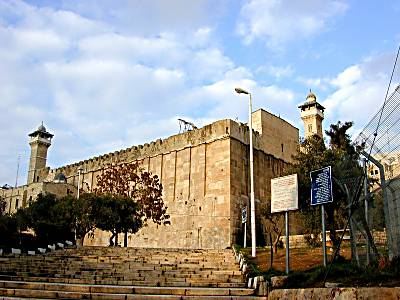
Turning the corner from the landscape of death, we are confronted with the Ma'arat Hamachpelah, the burial place of the biblical Adam and Eve, Abraham and Sarah, Isaaak and Rebecca, and Jacob and Leah, one of Judaism's holiest sites.


Maarat Hamachpelah, The Cave of the Couples
The term Machpelah is rooted in the Hebrew letters "Caf-Pay-Lamed", which means "Pair", in that four pairs of our anscestors are buried here, and also becuase there is an aboveground section where worshippers visit and a below-ground chamber where the holy ones area actually buried. I would be willing to bet that the letters "Caf-Pay-Lamed" could also be the distant, ancient root of the English word "couple." Likewise, the area is known as a Chibur, a connection point between this world and the next, which is why the city is called "Chevron" in Hebrew.


The building exhibits the column style of architecture which once typified Jerusalem over 2,000 years ago, now buried under rubble.

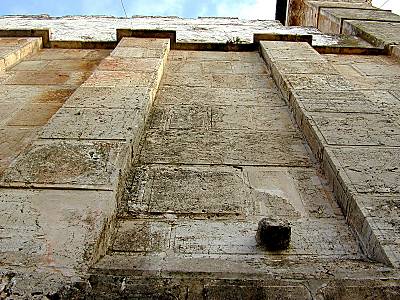
The building is one of several projects built by the Roman Proconsul Herod the Builder in the holy land. The massive stones reveal the same groove around their edges as the stones at the Kotel (western wall.)
Note the grooved edges of the massive stones.
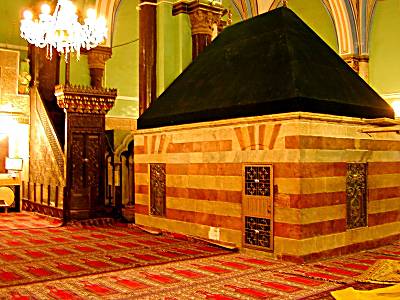
Today is one of the few days of the year when the entire cave is open to Jews, who usually do not have the opportunity to visit our forefather Yitzchak (Isaac) because his tomb is located on the Muslim side.


Kever Yitzchak, the Tomb of Isaak

After Mincha, Sasha and I head towards the Avraham Avinu (Abraham our Father) neighborhood, the section of the Jewish quarter which was rebuilt in the 1980's. We split up, he heads off to meet an artist who lives here, and I find the english tour. I know all the sights, but it's still exciting to see it all again.

There's the Avraham Avinu synagogue, demolished by the conquering Jordanian Legion in 1948 and used as an a garbage dump and animal pen until being rebuilt when Jews moved back into this area.

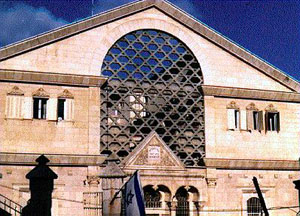
There's Beit Hadassah, a hospital built by Jewish philanthropists which served Arabs and Jews until 1929, now reclaimed.


Beit Hadassah

There's the ancient Jewish cemetary.


And there's Tel Rumeidah, where history runs deep underfoot. Underneath stand the ruins of the ancient biblical city of Hebron, where Reut and Yishai (Ruth and Jessee) are buried, where King David was crowned and ruled for ten years, Judaism's second holiest city.

Excavations under Tel Rumeidah

Tel Rumeida has the same semi-circle of Jewish trailers, but there's something new here; a four story building. When I was last here, four years ago, the building was still in the planning stages, with lawyers and activists doing everything in their power to prevent Jews from living here. But today, here it stands.


The new building in Tel Rumeidah


And so, progress is slow and painful, every brick bought with suffering, and even today a cloud hangs over the entire Jewish Quarter, it being on the short list of Jewish settlements to be demolished. But it's important to remember that despite the political and physical strife surrounding this place, this is still the same holy city it's always been. And it's all a part of the same land. The mountain range which runs through the hills of the Negev desert to the south, also runs through Hebron, as it does through Jerusalem, Shechem, Elon Moreh, and clear up through the Gallilee. To understand the connection to this place, one must take a step back and see it not through the lense of politics of war, but through history, memory, and dreams for the future.

New building in Kiryat Arba

Sasha and Me

My Host Yitzchak and Me

Getting out was just as much of a madhouse as getting in.

Monday, November 27, 2006

Pictures from Harsina

Coming soon... new housing.

Looking from Harsina towards the Arab neighborhoods of Hebron.

Housing, and future new housing.


Foreground: The greenhouses and vineyards of Hebron. The large, red-roofed building in the center is the regional city council.


The old city gate.


Soccer.


Nighttime, looking towards Kiryat Arba

Sunday, November 26, 2006

Harsina


Yitzchak, my host for Shabbat, shakes my hand.
“Gaveritye Paruski?”
“No,” Alex interjects in Hebrew, “he doesn’t speak Russian, he’s American.”
Yitzchak, shooting me a bemused look, switches to Hebrew, “You live in Israel and don’t speak Russian? How do you get by?”
“He’s only been here three months,” Sasha explains, “Give him time.”
Sasha and Alex are part of the massive wave of aliyah from Russia in the 1990s, when four million Israeli Jews assimilated one million Russian Jews in one decade. To experience the same level of strain on national resources, the United States would have to assimilate 60 million immigrants in one decade. Any other country this small would have cracked. One would especially expect a country as at running the day to day operations of government as Israel to utterly collapse. The Knesset, or parliament, is still bickering over drafting a constitution 58 years after independence, but handling overwhelming crises against impossible odds is Israel’s specialty. The country granted the newcomers immediate citizenship and mobilized to build new housing in most major cities, and in the settlements. One area which took in an infusion of new, Russian blood was the “Hebron block,” consisting of the towns of Kiryat Arba, Harsina, Givat Ha’avot, Ehsmoret Yitzchak, and the Jewish neighborhood in the center of Hebron.
Unlike Elon Moreh, perched on a mountaintop overlooking Shechem but several miles outside of the city itself, the Hebron community lives face to face with its Arab neighbors. In sum total, there are about 7,000 residents between all of the towns, but today, for the pilgrimage on Parshat Chayyei Sarah, the population swells to at least 35,000. Busses continue cruising through the gate in the fence separating us from Hebron’s 120,000 Arab residents. Other visitors pry backpacks and sleeping bags which have been crammed into the trunks of their cars. Some pitch tents in public parks.
Out-Of-Town Visitors. Background: Kiryat Arba
The Streets of Harsina

Walking to shul, the dull red light of the sunset splashes over the Jerusalem stone houses. Friday’s last gasp. The homes, shuls, schools, and yeshivas are huddled together on the hilltop, looking across a valley of vineyards to Kiryat Arba, clinging to the next hilltop a mile or two distant.
“When was this place built?”
“Ten years ago,” Yitzchak tells me. “We started in trailers.”
“You remember the outpost I showed you in Elon Moreh?” Sasha asks. “This is what happens when we stick with it.”
Beneath the last line of houses sit two rows of new trailers. Signs of things to come?
“We wanted to build between Harsina and Kiryat Arba,” Yitzchak tells me, “but the Army won’t allow us. So they set up a base in between our two hilltops, and now nobody can build there.”

Looking from Harsina out to Kiryat Arba


The road connecting our hilltop to theirs lined on either side by a barbed wire fence, making this a cross between a trailer park and a gated community. But the fence feels like window dressing, including none of the fancy electronics, motion sensors, cameras, or trip wires that I’ve seen elsewhere. Scanning the perimeter, I detect several gaps. There are always one or two cars on the road. The flashing blue lights signal army patrols, but other vehicles, civilian, also rumble along. On Shabbat.

Foreground: Harsina trailers

Midground, left: Connecting road

Midground center: Army camp

Background: Kiryat Arba

“Yes,” Yitzchak responds to the unasked question, “We’re a mixed settlement.” Mixed religious-secular. I would later learn that you can even buy pork in Kiryat Arba, something of a rarity out here.
The crowd in shul is a warm relief from the nippy weather, visitors and locals soaking up the excitement of the evening. The rabbi begins his lesson, and I try to focus on the Hebrew. I can understand at first, but soon I miss a word. Then there’s a sentence I can’t understand, and pretty soon my logic train has derailed and my mind starts to wander, my eyes drifting around the room. To the pistol butt protruding from under the rabbi’s belt line. The rabbi’s packing heat. To several oriental faces peeking out from behind their prayer books.
“Benei Menashe,” Yitzchak explains.
After the northern ten tribes of the Kingdom of Israel were defeated by the Assyrians and dragged into exile in 721 BCE, most historians assume they were lost to assimilation. But every now and then a group pops up with peculiarly Jewish customs. In northeast India, explorers discovered a group which observes circumcision, prays wrapped in a shawl, practices levirate marriage, and offers sacrifices on biblical-style altars (the latter two practices no longer existing in contemporary halachic Judaism.) They also have a tradition of being from an ancestor named “Manmaseh,” which sounds suspiciously like the exiled tribe of Menasheh, and are familiar with several biblical stories. Due to the lack of proof surrounding their lineage, many of the Benei Menashe went through conversion according to Halachah (Jewish law,) after which they made aliyah, one of them ending up sitting in the chair next to mine.
“Actually, we have lots of converts,” Yitzchak explains to me on the way home, “I know some from Italy, one from Germany, people from all over. Right here in Harsina.”

Benei Menashe (Taken from their website)


It’s difficult explaining to someone who has never been out there why normal people who live with the same worries about families and businesses as any suburban American would choose to live out here in the territories, armed, locked behind barbed wire in a Jewish ghetto. Often, those who live here are divided into the “Quality of Life,” versus the, “Ideological” types. “Quality of Life” settlers, so it goes, moved to these places for inexpensive housing, the fresh air, and the scenic vistas, whereas “Ideological” settlers are those who came here out of conviction and belief, what some consider “fanaticism.” But to differentiate misses the point, that the quality of life is in many ways dependant on the idealism of the community. Unlike life in the rest of Israel, in the settlements, drug use is extremely rare, and burglary isn’t an issue. Prostitution, extortion, organized crime, and teen pregnancy are unheard of. Per capita income is lower but test scores are higher, and the settlements have the highest birth rate of any group in Israel. A reasonable comparison could be made between the Harsina townspeople and the American military. Many of those who serve in the American military do so to earn money for college, advance their careers, and see the world, while others come for action or to fulfill a patriotic duty. But to say that “Quality of Life” soldiers are not ideological as well is simply untrue. Dedication to a noble cause breeds excellence of character. As for the communities here in Hebron, one can pick instances of fanaticism or instability from the last 40 years of headlines, but it doesn’t characterize anyone I’ve ever met, and it’s certainly not unique to this particular segment of Israeli society.

To be continued…