Tuesday, March 13, 2007

Gaza of the Philistines

Gaza has always spelled trouble. Home of the Philistines, a race of seafaring Greek idolaters, Gaza proved a source of endless misery for the patriarchs Avraham (Abraham,) Yitschak (Isaac,) and Yaakov (Jacob) in the years 1948-2255 ( 1813 BCE- 1523 BCE.) Faced with Philistine kidnappers and murderers, the patriarchs frequently had to conceal their identities as husbands to prevent the Philistines from murdering them to steal their wives. Throughout the Torah, the patriarchs sign several non-belligerence agreements with the Philistines, the cease fire agreement of the age, only to have them violated and later resigned from generation to generation.


An inscription from the Byzantine (post-Roman) period mentioning the city of "Gerarus," believed to be same Gerar mentioned in the book of Bereishit (Genesis.)


Beginning with the Jewish conquest of the land of Israel in 2248 (1272 BCE,) the Philistines become a constant source of pain, a thorn in Israel’s side. In repeating, forty year cycles, the Jews stray from God’s commandments and engage in the practices of their pagan neighbors. Because they are not fulfilling their divine mission, God removes his protection from the Jewish people. During these periods of spiritual weakness, the nation is not able to muster the will or ability to physically defend itself, and the Philistine muster from their capital cities Gat, Ekron, Ashdod, Ashkelon, and Gaza to overrun the borders of the Land of Israel oppressing and taxing the Jews.

A satellite photo showing the locations of Gat, Ekron, Ashdod, Ashkelon, and Gaza, although blogger shows them too small to be legible.

This suffering then leads the Jews to cry out in pain to God, who, upon hearing his people’s suffering and repentance, inspires a prophet to rally the people and lead them to victory over their adversaries.
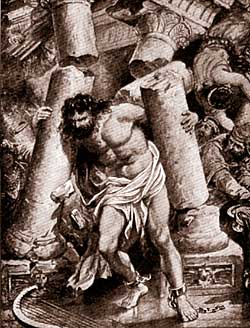
Samson the Prophet kills 3,000 Philistines, self, in Gaza.

Then, after defeating their enemies, the Jews again begin to stray, chasing after foreign Gods, and the cycle repeats itself.


A map displaying Philistia in relation to the areas of Jewish settlement in the times of King David.

This proceeded for four hundred years, until the rise of King David in the year 2883 (877 BCE.) The people abandon their narrow tribal interests in exchange for a rising national consciousness, and King David is at last able to decisively able to route the Philistines at the battle of Emek Refaim (then a valley outside of Jerusalem today a happening Jerusalem singles neighborhood.)

From this point forward, the Phillistines, smashed and broken, gradually fade into history. Almost exactly 1,000 years later, having defeated and exiled thousands of Jews in the final Jewish revold, the name “Palestina” is revived by the Romans as to replace the term “Eretz Yisrael,” the Land of Israel, to linguistically sever the connection between the people and the Land of Israel. And today, the name has been revived, as “Palestine,” (Falastin in Arabic) for the same purpose. So my next trip is to see the thorn in our side, Gaza of the Philistines.

Getting together with the Yavneh Olami group on King George/Keren Hayesod Street, Jerusalem.

Bumping into Yaakov on the bus. We seem to end up on all the same tours.

A nice little hilltop Jewish settlement west of Jerusalem.


I thought that's a cool shot of a "ghost car" driving the wrong way down the street.

Kiryat Gat, a Jewish city on the ruins of the ancient Philistine city of Gat. Today it houses the Intel computer chip manufacturing facility, which provides most of the town's employment.


The term "Philistine" is still associated with unsophisticated brutishness.

Monday, March 12, 2007

The Shidduch Lifestyle

Another phone call, another meeting, another bright, smiling face. So we sit down and try. Usually, she's shy, so I have to start off.
"It's a little town half an hour east of San Francisco... Yes, yes, Walnut Creek sounds like a hick town but it's got a traffic light or two."
"Yes, I know my name means 'rock' in Hebrew."
"No, the scar on my neck isn't from a knife fight, it was a bronchial cleft cyst."

The key, as I'm learning, is to synthesize the two extremes. It's possible to show up for a date thinking, "This could be it, but if it's not, I've lost nothing." The first thing I learned was that date number one is always a throw-away. Any girl who's been dating for a reasonable amount of time has her shields up on the first date, and is usually reluctant to contribute too much to the conversation, so all I can do is talk. Ask questions, listen to the answers, and just try to dip my toes in the water. There's a saying that, if you go into any museum and look at the couples, you'll notice that the couples where the guy is doing all the talking are dating. The couples where the woman does all the talking are married.


The fact is, I've never gone out with a girl who was just "bad." They're all unique and beautiful in their own way, and I don't see why I can't just marry them all. After all, the Arabs are always complaining that Israel doesn't "fit into the local culture." Why not strike a blow for peace by reinstituting polygamy? But realistically, I'll start with one. I haven't struck gold yet, but I'm learning how to look.

In the beginning, my nervousness would start as a tiny crack in the subconscious about twenty four hours before the date. I'd pretend it wasn't there, look the other way, busy myself with work, but it grew just the same. I'd lie in bed until late at night practicing my moves, trying to figure out how to put my best foot forward. By the time I made it to the first meeting, I would be so exhausted I would begin to make a Pavlovian association between dating and sleep deprivation.

Without much experience under my belt, I took advice from more successful friends. The problem is that everybody seems to have the opposite advice.
"You've got to show up thinking that this could be it."
"Nah, show up thinking, 'I've got nothing to lose from this.'"
Some guys go out with two girls a week, some with one a month. One of my fellow Yeshivah guys married the fourth girl he dated. Cousin Shmulik got married after over 200.

The second date, I start getting to know the person, she's a bit more comfortable, and she'll open up a bit more. Her personality usually comes out on the end of the second/beginning of the third date. One thing I'm finding useful is the walk-and-talk. I'll set a meeting point, think of an endpoint, and then we can walk along, and there's less pressure to talk. The silences are more comfortable, until she asks, "Um, why are you walking so fast?" I have to snap out of it, as what I would consider a casual stroll, others experience as the Bataan Death March.

The trick is to find the happy medium. On the one hand, it's important to take dating seriously, and not to move forward blindly. But thinking about the date constantly is very destructive. I try to let my subconscious chew on it a bit, like a cow working its cud. On the one hand, I to keep the pace going, but on the other hand, dating can't rule my life. I always call back the next day, but that doesn't mean I have to go out every other day. I try to go out two, or a maximum of three, times per week. I try to bear in mind that if there is any question, I can always go on another date (unless she says no.) Just the knowledge of this fact takes pressure off the date I'm on. But every date I go on with the wrong girl is lost time.

To approach this calmly, it's important to integrate dating into an overall "Shidduch Lifestyle." Yet, at the same time, I can't get too comfortable. It's important to remember that the entire goal of this lifestyle is to reach that endpoint where it all comes together, and I leave the dating world forever. It's easy to despair, but then I go to shul, look around, and see all the other guys who got married, and figure my number is bound to come up some time. It's in God's hands, but I hope it's sooner rather than later.

Thursday, March 08, 2007

Off to Ein Tzurim

Well, I WANTED to write a post about dating, etc., but I'm going to Kibbutz Ein Tzurim for Shabbat. Pictures will be forthcoming! There's so much to blog... a visit to outposts outside the security wall/fence, a trip to Modiin including the archaeological ruins from the Hasmonean Period, a tour of the Jordan Valley and Tiberias. And there's lots more coming up, including a two-day trip to the Golan in a couple of weeks.

But it takes an hour to get downtown, and my bus leaves in 50 minutes, so I'm already late and have to get out the door!

Shabbat Shalom!

Wednesday, March 07, 2007

Underneath the City of David

Continued from previous posts...
Location of the City of David
From the initial crossing of the Jordan river after the death of Moses, the Jews (then Israelites) gradually conquered city after city in the land of Israel. Despite the biblical imperative to appoint a king and build the holy temple in Jerusalem, the Jews doddled for a period of 400 years. During this period, the Jews would lapse into idolatry, only to be defeated and oppressed by one of the neighboring peoples, after which they would cry out to God. God would then inspire a prophet, who would come to rally the people, bring them back to Torah, and throw off the foreign oppressors. Only to have the cycle repeat itself time and time again. Finally, after the appointing and failure of King Shaul (Saul,) King David took power to unite the tribes.
Jerusalem, then called Jebu, was the home of the Jebusite tribe of Canaanites at the time. Despite the conquest of Giloh, Ramot, Givon and various other towns (today Jewish suburbs of greater Jerusalem which carry the same names,) Jebu had stood as a Canaanite stronghold for too long. King David had attempted to take the city frontally, but the Jebusites were so confident behind the cities defensive walls that they could taunt the besieging David, ""You will not come in here, but the blind and the lame will ward you off -- thinking David cannot come in here."
Neither frontal assault nor siege worked, so it was time for plan C. The Gihon spring, outside the city walls, was drawn into the city by means of a network of underwater tunnels. David, with his best men, swam through the underwater tunnels, killed the guards on watch, and conquered the city from the inside.

Going down... down... down, into the tunnels under the City of David.
King David captured the city through these same tunnels.

Towards the end of his reign, David's eldest son Adinoyah, acting without the blessing of his father, with the help of a duplicitous Cohen (high priest) and support from David's own right-hand man Yoav, crowned himself the new King. Upon hearing of his son's treachery, David acted quickly, abdicating his throne to his son Shlomo (Solomon.) He took the young Shlomo, placed him on the royal donkey, and led him to the spring of Gihon to be annointed king, all to shouts of "Enduring Life for King Solomon." When the people's cries, echoing through the Kidron Valley, reached the ears of "King" Adinoyah and his camp, his men abandoned him and fled, fearing punishment for their treachery.

The new King Shlomo stayed Adinoyah's execution, but later, when Adinoyah married a widow of King David, apparently attempting to better his claim to the throne, King Shlomo sensed a plot and had him, along with the traitorous Cohen and Yoav, executed.

Looking down an ancient well in the excavated Gihon spring, where King Solomon was crowned.

Entire new caverns and roads from the ancient city have been discovered here in recent years, largely due to the archaeological salvage excavations triggered by Elad's building projects. Elad continues to fund most of the archaeology here, and new discoveries are constantly being unearthed.

One technique for building is to excavate shafts down to bedrock, then sink columns. The columns then support the building overhead as excavation and preservation work continues below. Several buildings have been constructed in the old city using similar techniques.


New excavations at the Gihon Spring. The new building is above, the excavations below, and we stand on a platform built to display the excavations.

Four centuries later, long after the split of the Kingdom of Shlomo into the northern Kingdom of Israel and the Southern Kingdom of Judah, the Assyrian King Sennacherib was on the move. Conquering one country after the next, he prevented rebellion from his new subjects by mixing them around, exiling them to other parts of his empire, unfamiliar settings. King Hezekiah of Judah saw as Sennacherib invaded the northern Kingdom of Israel and exiled the ten tribes therein, who have been lost to history until today.

Hezekiah expected the Kingdom of Judah to be attacked next. In 701 BCE, in order to better withstand the coming siege, he had his engineers dig a tunnel stretching for a half kilometer to bring water from the Gihon Spring flowing into the city walls. Two teams assembled on either side and began digging blind, straight through the rock. The plan worked, and the steady water flow into the city saved Jerusalem and the southern tribes from Sennacherib's conquest. Water still flows through the tunnel today.

At the spring of Gihon. The entrance to Hezekiah's Tunnel is in the center of the photo.

We didn't get in the water and walk the length of the tunnel, though I've done it in the past. We did, however, walk through a different tunnel, now dry, which had been used for a similar purpose before King Hezekiah built his extended tunnel.


Me in the old dry tunnel.

Yours truly outside the tunnel, Silwan and some First Temple period burial caves behind me.

Tuesday, March 06, 2007

Purim Day

Another mitzvah of Purim is to provide gifts for the poor. The minimum is to provide enough money to buy two poor people one full meal (generally, at twenty shekels each, this is estimated at forty shekels.) Giving more than the minimum is always encouraged, and so tzedukah (charity) organizations are out in force with mobile donation trailers.

Giving tzedukah.

Meanwhile, the rest of the gang heads towards the Kollel (married men's yeshivah) of Rabbi Mordechai Eliyahu. He is a former Chief Rabbi of Israel, and, after retiring, became one of the the spiritual leaders of the National Religious camp and a close advisor to the National Religious party. He also happens to be my cousin Rafi's uncle. Israel is a very small country.

Outside of Kollel Darchei Orah, where Rabbi Eliyahu teaches.

Looking through the window.

There was barely breathing room inside.

The rabbi, in black hat.

The rabbi gives a brachah to all the single men and women to get married. It might be a bit easier if the mechitzah dividing us were temporarily, eh, moved aside.


Rabbi Dov Bigon, head of Machon Meir, at Rabbi Eliyahu's, delivering a lesson, with Fez.
Outside the Kollel, I bumped into old friend and Walnut Creek native Adam Neril, here shown in "Hug Me" mode.


On the trip back to our yeshivah, we made a procession out of it.

And obstructed traffic the whole way back.

In front of the Machon.
Yours truly with Adam.
Adam on the guitar.
Asher, the cave man. Yes, those are wine corks up his nose.

Of course, the final mitzvah of Purim is to make a Seudah (festive meal) at which one becomes so drunk he can't tell the difference between "Blessed is Mordechai" and "Cursed is Haman."


Avishai makes the blessing over wine.


Yours truly at the meal, in "undercover reporter" mode.


Monday, March 05, 2007

And now for Something Completely Different...

We interrupt this blog for a special announcement... Our normally scheduled programming on the City of David will resume in two days.

Last night, walking to shul, the explosions started. Bangs echoing off buildings, bombs set off in public squares. Is it Hizbullah? Hamas? Is the Jihad on again? Nope, it's just teenagers setting off explosives in celebration of... PURIM!

The holiday celebrating the defeat of the evil Haman, and his plot to use the Persian Empire to exterminate the Jews, is celebrated in Jerusalem one day later than in the rest of the world.

Why? Well, while Haman's minions of darkness were spread across the Persian Empire, the major concentration of Haman's power was in the Persian capital of Shushan. After the events of Purim, which ended with the King's granting permission for the Jews to spend one day eradicating Haman's forces before they had time to act, there were so many of Haman's men in the capital that the Jews of Shushan still hadn't finished the job by the end of the first day. The King therefore granted the Jews a second day to finish off Haman and his sons. Therefore, in Shushan, the holiday is celebrated a day later. However, the sages looked at this with dismay. That a foreign city, Shushan, could be granted such honor, yet the cities of the Holy Land itself would not? Would this somehow imply that the cities of Eretz Yisrael are on a lower level than Shushan?
To correct this potential misunderstanding, it was decreed that all cities which were walled cities in the Book of Yehoshua (Joshua), a city wall being a sign of prominence, would also celebrate the holiday one day later.

In fact, the only city in Israel which was for certain a walled city in the time of Yehoshua is Jerusalem.


Jerusalem, sadly it is again today a walled city.


Preparations began a week ago, as decorations went up throughout the Yeshivah. One of the niceties of learning in a Zionist yeshivah is the unashamed patriotism.


"And the Jews will rule their enemies." Posters of Israeli jets bombing Iranian nuclear factories adorn the halways.
Meanwhile, I began my own preparations for the holiday. One of the mitvot (commandments) of the holiday is to give food items called Mishloach Manot, "delivered portions" to friends. I headed down to the Machaneh Yehudah market to pick up some goodies to deliver about town. While there, I took a few interesting photos.
A bizzare vegetable of some sort.

An arched stairway.

Later, the holiday begins with the reading of the Megillah, after the afternoon Minchah prayers. All of the kids, and plenty of adults, show up in costume.

Shaliach Tzibbur (prayer leader) with an, eh, interesting yarmulke.


Cousin Rafi with the boys.

Rafi, behatted.
Later, on Purim day, everyone is in costume.


Even the beggars wear funny hats.


I headed out to Kiryat Moshe to get together with the guys from my yeshivah, Machon Meir. Rav Sperling from Machon Meir, who teaches my halachah (Jewish Law) class.

Next stop, the yeshivah of Rabbi Mordechai Eliyahu, spiritual leader of the Sephardi/National Religious community.

Sunday, March 04, 2007

Excavations in the City of David

And now.. back to the City of David.
Today, the land purchased by the Jewish Agency nearly a century ago which does not have Arab "absentee tenants" is in the hands of Elad. However, because this land is on such an archaeological gold mine, and because the ancient City of David was build on such a steel slope, it is very difficult to build. Each new building triggers an automatic archaeological salvage operation by the Israel Antiquities Authority. The discoveries made during these digs typically result in major finds. Once the initial state-run archaeological dig is over, Elad donors often finance a continuation of the dig.
I went with the Machon Meir group. We had to wake up quite early for minyan.

Since my last visit to the City of David in 2000, there have been major changes. For 33 years, the State of Israel had claimed the land, and was eager to avoid conflict with neighboring Muslim countries by staking a claim, so archaeological exploration was limited and very few Jews were allowed to live here. Today, what used to be a few rocks poking out of the ground has, thanks to private donations for archaeology and restoration, become a massive, high-tech visitor's center. Tours include a 3-D movie recreating the ancient city, as well as guided trips through the tunnels and walls buried below.

Entrance at the visitor's center.


Standing on the City of David visitor's center platform, looking East across the Kidron Valley towards Ras Al Amud, today an Arab neighborhood, one can still see burial caves from the First Temple Period, from 3935-3320 (825Bce-510BCE) carved into the cliff face between the homes.
Looking east. Burial caves carved in stone bottom right.

A close up of burial caves.

Looking south, in the direction of Hebron, one can see excavations of the First Temple Period city walls. Staircase down to look at the ancient city walls.

The Machon Meir group looking at the city walls.

At the base of the city walls are the ruins of ancient residences. Seals from vases, likely used to contain administrative documents, have been discovered in the ruins. Some of the seals bear the names of prominent individuals and families mentioned in the book of Melachim (Kings) or of prominent priestly families.

One discovery includes a carved bowl with a hole in the center. It is, in fact, a First Temple Period toilet. Analysis of some of the, eh, "organic matter" still on the toilet indicate the presence of pathogens and parasitic worms which are typically contracted after eating raw meat. This would seem to jive with the Tanachic explanation of the long siege of the city prior to its destruction, a time of great scarcity during which wood was unavailable for cooking meat.


The First Temple Period toilet.

Continuing on our merry way, we pass a few houses bearing Israeli flags, interspersed with the Arab. The neighborhood is being gradually reclaimed one house at a time, using the same process used by Ateret Cohanim in the Old City. Today, the City of David is creeping up on a Jewish majority.

Foreground: Ancient city walls. Midground: Kollel (yeshivah for married men with families.) Background: Silwan.

Next we go down the stairs, into the tunnels and caves beneath the city surface.

Stay tuned...