Thursday, November 09, 2006

Elon Moreh

Jumping from my hitched ride in Elon Moreh, I am greeted by two baying donkeys, simultaneously mowing and fertilizing a lawn on the settlement. From an imposing structure down the street, kippa-wearing teenagers, their first sprouts of beard growth still a bit frizzy, approach clasping folding tables under their arms.

Soon, tables and chairs are unfolded as the first busses arrive. Registration forms flap in the breeze as Jewish pilgrims from all over the land of Israel come to Elon Moreh for parashat Lech Lecha, the yearly Torah reading where the biblical Abraham first pitches his tent in the Land of Israel, in Elon Moreh, after leaving his native Ur (Iraq.)

I call Sasha by cell phone, which doubles as a walkee talkee in this country. In seconds, he comes bounding over the hill to greet me and drags me into his house.

"We don't have a bed. We were going to put you on the couch but my friend Chaim wouldn't hear of it. You'll be staying at his place. You want to eat something? Drink something? Um... eat something?"
He sees me looking out the window, knee jittering, and gets the idea.
"You've been sitting down for an hour. Let's go for a walk."

Outside his window is a great ramp of layered rocks and scrub brush. He points to a small stone shrine, plopped on the summit of the mountain as if it were a cherry on a sundae, "This is mount Kabir. The Arabs named it after Kabir. He was an African Muslim, third in line after Mohammad. Actually, there are three or four other sites in Samaria which are also claimed to be the grave of Kabir." After some speculation as to which is the real Kabir, we hypothesize that perhaps they decided to share his remains. It's as good an answer as any.

In the book of Joshua, as my host explains, the Jews were instructed to cut down all the oak trees they found on the Samarian mountain tops after defeating the native Canaanites. The Canaanites had worshipped them as idols. The local Arabs still have a custom, forbidden by their religious clerics but still widely practiced, to plant oak trees next to graves on mountaintops. Traditions die hard in this part of the world.
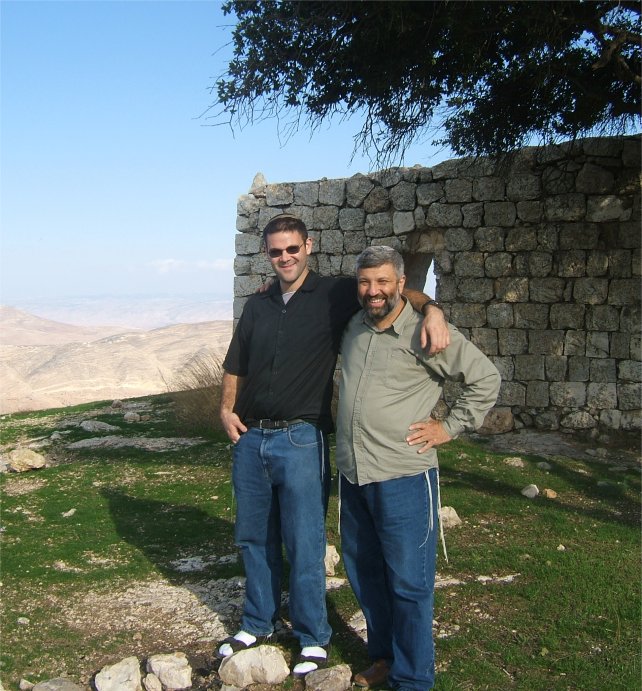

On mount Kabir with Sasha. Note the oak tree next to the grave.
Cresting the peak, we reach the high ground, the valley of Tirtzah stretching before us.
An Israeli Army Base (the pentagon at center,) abandoned during the Oslo negotiations, now inhabited by Arabs, in the Tirtzah valley.

In the Torah, Tirtzah was the daughter of Zelephohad, a religious zealot, who, after seeing that the Jewish people had begun straying after receiving the Torah, so he violated it by collecting sticks on the Sabbath for a fire, and incurred the death penalty, making an example of himself.
Yours truly, at the shrine on Mount Kabir.
When the time came to apportion inheritance in the Land of Israel before entering, it was found that he had no male heirs. His daughters, among them Tirtzah, petitioned Mosheh (Moses,) and Tirtzah was given this valley as her portion, hence the name of the valley and the large town at its center.
Two Shabbat visitors on Mount Kabir.


Looking through a window in the grave of Kabir towards the village of Tirtzah.
Turning around 180 degrees, we see the mountains of Gerizim and Ebal. As the Jewish people entered the land under the command of the biblical Joshua, they were divided into two groups, one sent to the top of Mount Ebal to pronounce the curses on those who violate commandments, and the other to Mount Gerizim to pronounce blessings on those who observe them. Tucked between the mountains is the biblical city of Shechem, today a purely Arab city. In ancient times, after the Roman conquest, the city was destroyed and, in an attempt by the Roman emperors to eradicate the Jewish connection to the land, renamed "Neapolis" (New City,) and the Land of Israel was renamed "Palestina." Centuries later, the first nomadic Arabs passed through. Arabic not having the letter "P," the Arabs can not pronounce words such as, "Neapolis" or "Palestine," so today the city's name is pronounced "Nablus," and "Palestine," a name not spoken for eons until being revived by the British, is pronounced by the Arabs alternately as "Balestine" or "Falastin."
A Security Bunker on Mount Kabir, overlooking the town of Shechem (Nablus)

The tomb of Joseph, the biblical ancestor of the Jewish people who first went down into Egypt only on condition that his bones be returned to the Land of Israel, is located at the center of the city of Shechem. In 2000, at the outset of the second intifadah, rioters, backed by the well-armed Palestinian police force, attacked, killing one soldier and forcing a retreat. The Palestinian Authority desecrated the holy shrine, torching and demolishing it. Today it stands forlorn and unreachable, buried in garbage, a monument to the apparent impossibility of Jewish-Arab coexistence.

Standing on Mount Kabir, I drink in the panorama one last time. to the east, The valley of Tirtzah, and beyond, the Jordan Valley.

The Valley of Tirtzah

To the south, the rebuilt town of Elon Moreh.


Elon Moreh
And to the west, Shechem. Looking towards the Shechem overlook, I see Ezra, who had given me a ride that morning. As I wander off towards the defensive bunker, Ezra begins speaking to Sasha in a Hebrew that's faster than I can follow.

Ezra and friends at the overlook.
"Ephraim, come back!"
I wander back over as Ezra's car pulls up.
"Do you want to see a new Jewish outpost?" Sasha asks me, holding the door open.
Stay tuned for pictures...

Tuesday, November 07, 2006

A Samarian Drive

Leaving Erev Shabbat (the day before sabbath,) we had only a few hours to get to our destination before sunset. The settlement of Elon Moreh is located about as far into Samaria (northern west bank) as you can go without falling out of the other side. The drive from Jerusalem takes us along route 60, running the spine of the Samarian mountains.


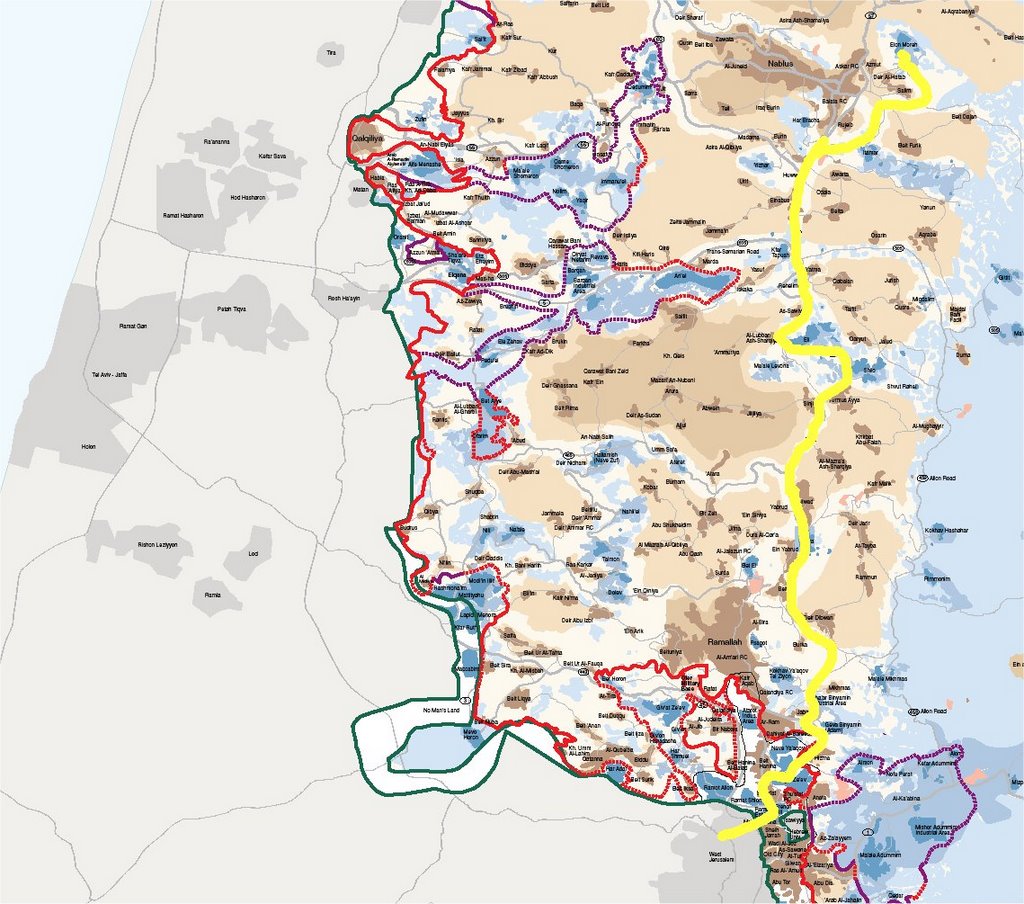
Route 60 Shown above in Yellow

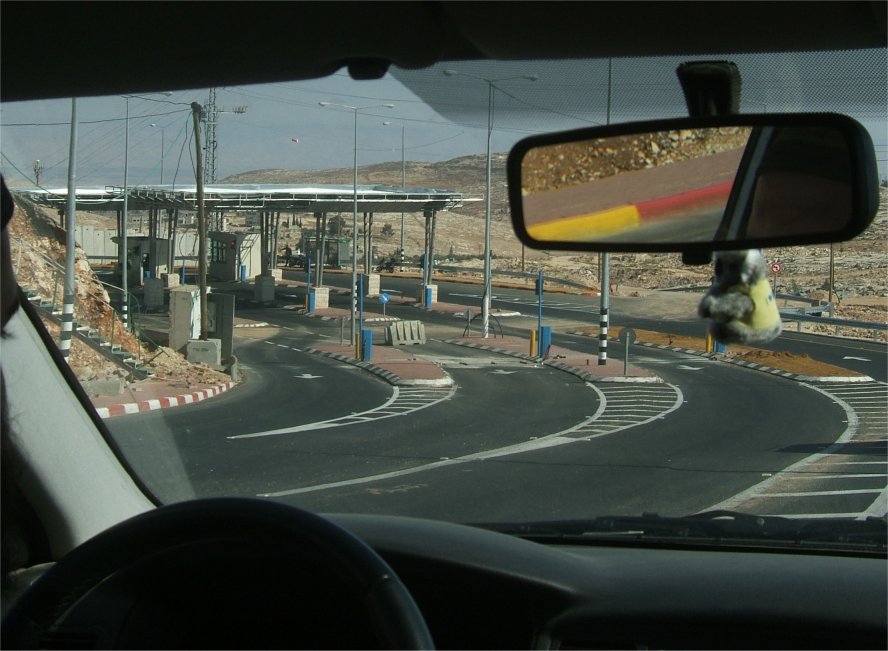
But first, it’s necessary to pass through Israel’s new four-lane pseudo-border crossing, the Hizma checkpoint. The thick concrete walls and endless spirals of razor wire instill a deep sense of unease, like walking into a leopard’s cage. The physically intimidating fortifications imply the need for protection from an equally massive destructive force.

The Hizma Checkpoint

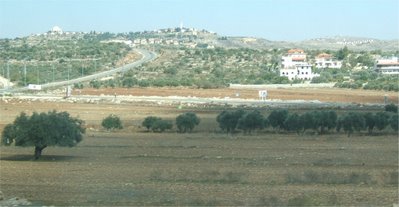
Winding down route 66, small Arab villages fly by my window, chaotic and organic, settled in the valleys. Anchored to the hilltops are tight, regimented rows of identical red-roofed homes, the Jewish communities of Samaria, rebuilt on land captured after Israel repelled the 1967 Jordanian invasion.

Looking back over the fence at Pisgat Ze'ev

From the perspective of one who lives on the Israel side of the fence, it seems to be made to instill a sense of comfort and protection. But as Malkah, who lives on the opposite side of the fence, told me, “It’s trying to send a message to us on the other side that our lives are for nothing. That we should stop wasting our effort building our Jewish communities because they are on the other side of the fence and will eventually be destroyed anyway.”


New trailers outside the Jewish town of Beit El

My own feeling is that the fence is an expression of the Israeli ethos of the “New Jew,” the spiritual person melted down and recast in the image of a secular nationalist. The Arabs, in their persistent and apparently irrational refusal to recognize the legitimacy of Jewish independence, long after they have shook hands and broken bread with virtually all other nations in the world, are an eternal reminder that despite Zionism’s best efforts they still see and hate us as Jews, not Israelis. Likewise, these settlers living here, with their head coverings and unashamedly Jewish ideology, are a shameful reminder of the failure of Zionism to re-make the people. The fence sends a message to it’s makers, “No, don’t look behind that concrete curtain over there. We have glass skyscrapers in Tel Aviv, our academics win Nobel Prizes, we have Olympic gold medalists. That’s us. Over there is not us.”


The fence, and the Jewish town of Adom in the background

After a few minutes cruising between the hilltops, the eyes grow accustomed to the sights, and the fact that we are no longer separated from the Arab population is less and less alarming. Mountains are punctuated by flat valleys, lined with olive orchards. Vineyards are squeezed into the terraced steps running up the hillsides.

Side-routes to Jewish and Arab villages feed off the highway. Along some portions, the road is lined with barbed wire and concrete watchtowers.

Concrete towers on the road

At others, there is seemingly little security. At one point, the road passes straight through the Arab village of Huwwara. Felafel stands, auto mechanics, and grocery stores all display prominent signs in both Arabic and Hebrew. Reminders of better days, when Jews came out here to do business, go shopping, or just take a day off in these places. Despite the seemingly benign appearance, not too different from the offramps and rest stations along California’s route 5, one dare not stop.

The deterioration of the security situation along this road over the last two decades bespeaks a deeper problem. When a people surrenders the moral high ground, it can be just as lethal as an army surrendering the physical high ground. The only reason all of these fortifications are necessary is because the Israeli government imported, armed, and empowered some of the country’s worst enemies. And the only reason they did that was because they relinquished their own unique claims to the land in the 1990’s. It was this surrender of the moral high ground that lead to the surrender of the physical high ground.

As the road passes around Nablus, it gradually twists and winds its way up the hill, to the town of Elon Moreh, one place which has surrendered neither the moral nor the physical high ground.

On the road to Elon Moreh


Coming around a bend in the road, we are confronted by a sign welcoming visitors. This is Shabbat Lech Lecha, the portion of the yearly Torah cycle where we read about the biblical Abraham first arriving in the land of Israel, first visit.

And Avram passed through the land
until the place of Shechem,
until ELON MOREH,
and the Cananite was then in the land.
And HASHEM was revealed to Avram, and said:
to your descendants I will give this land,
and he built an altar there
to HASHEM who was revealed to him.
Breshit (Genesis) 12: 6-7


This being the first mention of Elon Moreh in the bible, the yearly reading of this portion has become a day of pilgrimage to the rebuilt city.


A sign "Here it comes, Shabat Parashat (portion) Lech Lecha"

Stay tuned for pictures from Elon Moreh!

Monday, November 06, 2006

Cleaning Gan Tekumah

Last Friday, we had another get-together with the combined groups of Kumah, Yavneh Olami, and Magshimey Herut, which I met on the Nahariya Shabbaton a week before.
We met at the Zion Gate and proceeded to Gan Hatekumah, an archaeological garden in the old city.
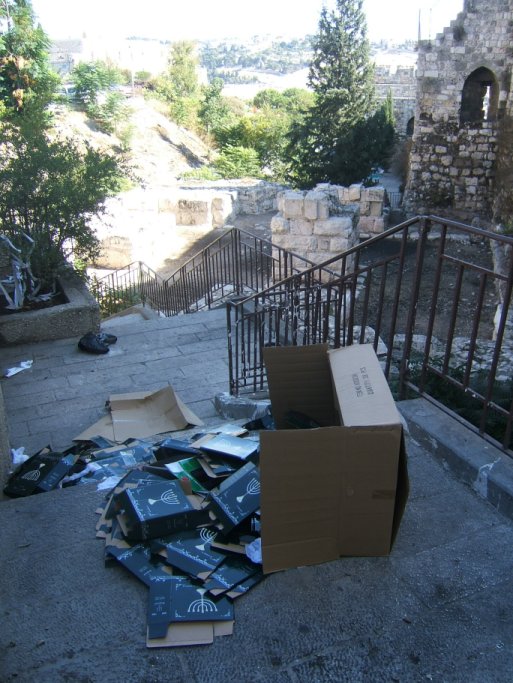
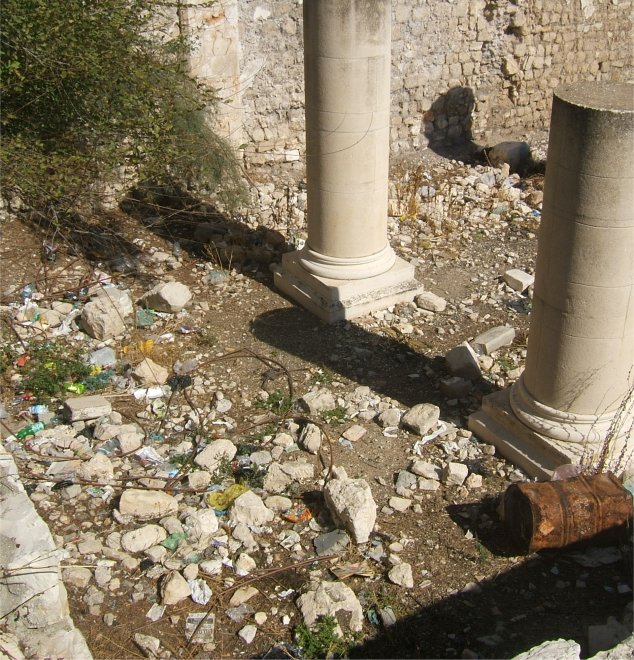
The garden was excevated through several layers including Byzantine, Greek, and even some second temple period ruins. And there's one more layer; a layer of 20th and early 21-st century garbage.


Second Temple Period columns surrounded by trash.

We set up on a recently excavated ping-pong table.

The group got to work, scampering over the rocks and filling bag after bag with trash.

Note to self: do not wear open-toed shoes to trash pickup.


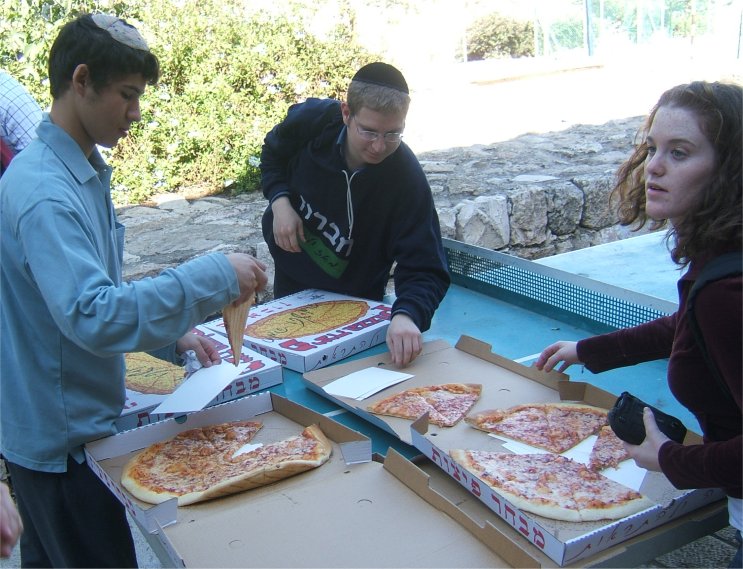
After two hours of trash collecting, we broke for pizza.

Yshai delivered a lecture on the different archaeological exhibits we had just cleaned.


All in all, it was a productive day. I would have gone through to shoot some "after" photographs, but I was talking to Sasha, my Shabbat host in Elon More. Someone overheard me and mentioned that Ezra (one of the Kumah group) was driving out there, so I was able to hitch a ride up. Stay tuned for photos of the drive to Elon Moreh...

Saturday, November 04, 2006

The Miracle Man of Nahariya

"You might get to see the Rav tonight," Nissim tells me with relish as we splash along the damp streets of Nahariya. "He cured my sister's cancer."
"Cured?"
"Well, he made it so she never had any. We brought her in. The doctors were sure it was cancer. Told her to come back the next day for some deeper tests. To find out how much cancer she has, where in her body it is. I went to the Rav. He said, 'don't worry. Go home. Take her in tomorrow. There won't be anything.' And I took her in, and the doctor said the same thing, 'Go home. There isn't anything.'"
Twirling his beard about his index finger as he bounced along Ga'aton Street, this live-wire Moroccan seemed a bit out of place in Nahariya. Herding his Shabbat (sabbath) guests around the flashing neon restaurants and nightclubs, weaving between a flock of teenagers ornamented with dangling ipod earpieces, dodging a five-foot scowling sparkplug of a man whose leather-jacketed arm was wrapped around his compensatory six-foot Russian knockout blonde, this didn't seem quite the setting in which one would expect to find a man dressed like a biblical shepherd. On Shabbat no less.
"This is the best place to be a Jew on Shabbat!" Nissin exclaimed, drinking in the energy. "It just needs a few changes. I grew up here. Not religious. Nobody was religious when I was young. I remember when we saw a man with a kippah. A kippah! On Ga'aton Street! We thought he must have been lost. But things are changing. Now we have schools, synagogues, mikveh, everything. And we're building more. Now I teach at a religious school. It will take a generation, but we'll move the world. Real change takes time. "
As we turn the corner, my hand brushes against a sign pole, it's cold smoothness suddenly giving way to a sharp scratch. Glancing down at the pole, I notice it's ripped and punctured, as if some enormous prehistoric beaver attempted to use it to dam the Ga'aton River. There's only one thing that can cause that kind of damage.
Yes, Nissin nods. He points to the street, at what looks like a pothole, except with gouges radiating outward. The impact crater of a Katyusha rocket. Pausing to take in my surroundings, I notice that not only did the shrapnel chew up the sign pole, it pocked and peppered the concrete wall of the building next to us.
"They messed up that war," Nissim says.
"Yeah," I tell him, rehashing the mantra I've heard ad nauseum since arriving, "the officers and soldiers sat in their bases and let the soldiers do the fighting, they sent out orders to attack and retreat, minutes apart, they didn't have enough food-"
"No!" Nissim interjects, "They made one big mistake. They didn't call ME! I called them. I begged them to let me fight. Begged! I have experience too. I'm combat. I fought the first Lebanon War. Went in in 1982. Three years fighting against Fatach. I've never had so much fun! We could have won. We could have smashed Hizbullah forever."
I've heard quite enough of the 'we could have won' line. "Look," I tell him, "as long as the Arabs hate us, it doesn't matter if you smash their organization. Whoever survives will just make up a new one and keep killing. You fought Fatach, now we're fighting Hizbullah. The only way have complete quiet would be if nobody lived there at all."
Nissim smiles at the idea. "You are wise."
Pushing throught he door to the apartment stairwell, I'm confronted by a black-hatted, smiling face and an outstretched hand.
"Shabbat shalom," I shake.
"Shabbat Shalom."
We all receive the greeting. Launching himself up the stairs, Nissim flaps his hand as if it were singed. "The Kedushah burns. That was the great Rabbi! His grandfather is the Holy Baba Sali! You were fortunate tonight."
After five stories of stairways, we burst into the apartment. I stroll towards the window. We're only two kilometers from the border with Lebanon. I should be able to see it from here.
"Is that Lebanon?" I ask.
"No," Nissim tells me, "By the merit of our holy Rabbi, Lebanon fell into the sea during our Shabbat prayers."
"But what are those lights out there?"
Nissim naps his fingers in disgust. "Lebanon." he sighs.
"Some day, they will never bother us again. You can move mountains if you are patient. Real change takes time."

Thursday, November 02, 2006

More Photos

Because of blogger's limit on photo uploads, there are a few photos that I wanted to upload earlier but wasn't able to.

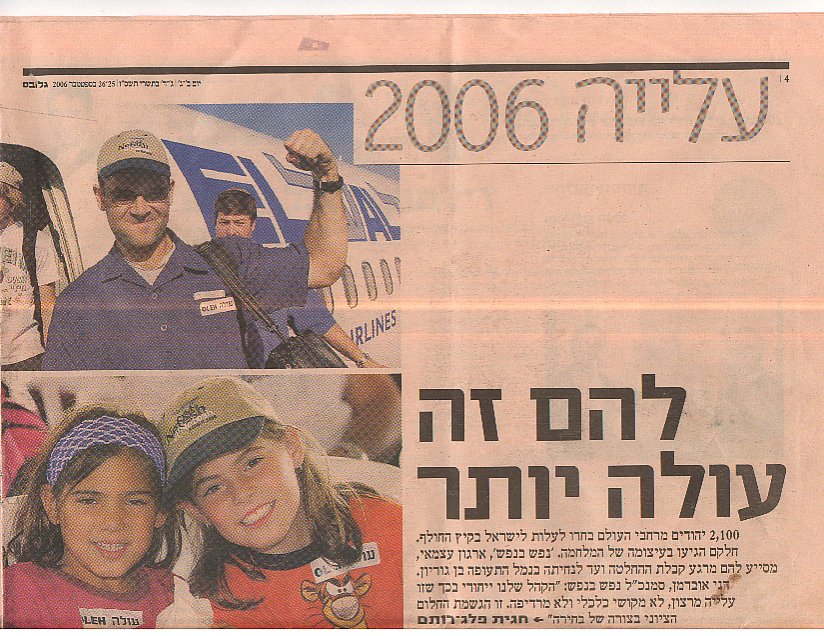
First off, here are the photos relating to my post of October 31st, here is the newspaper article featuring yours truly (or at least my Arm and Hammer victory fist.)
Below is a photo of my old bed.


And below is a picture of my new bed. Baleboosteh noted that I might hit my head. Actually, the bigger problem is that I've been smashing my elbow into that radiator in my sleep. Also, you can't see it here, but there's a bookshelf way up high right over the bed. This might present a safety hazard of fallin sifrei Tanach. I think I'm going to have to rearrange the furniture a bit.


The next three photos were taken on my trip to Moshav Benei Darom. This strange swamp-thing looking tree sinks down roots from its branches, resulting in multiple trunks. Looks as if the ground is reaching up and trying to pull it back down.


The picture below was taken in the shul (synagogue) at Benei Darom, right before Shabbat. First customer.

These are my farmer cousins, from left to right, Sarah, Achikom, and their son Uri. (Uri's pockets are bulging with sunflower seeds.)

Every time I visit, Sarah loads my backpack with Benei Darom products to take home.

Wednesday, November 01, 2006

Nahariyyah Photos

The following pictures are from the town of Nahariyyah in north-west Israel, near the border with Lebanon. Despite the rocket attacks suffered during the war, the town itself is actually quite serene.

Originally built as an agricultural settlement, the town has now grown to a modest city of 50,000. A long promenade stretching along the beach provides plenty of room for fishing and swimming.


Fishermen and tourists on the jetty.


The Ga'aton river runs through the center of town, between the easbound and westbount lanes on the main street, called, appropriately, Ga'aton street. Cross streets pass over the river on small bridges.

The town includes some small parks and gardens. During my visit, it was intermittently raining and sunny.


Walking along the shoreline promenade after a brief rain.


Surf fishermen.


Another surf fisherman.


Walking towards the beach.

Tuesday, October 31, 2006

01-Bed1

This photo has been moved to my new post HERE.

We Interrupt this Blog for and Important Announcement

Photos from my Nahariyyah (yes, I will spell it differently every time) shabbaton will be posted shortly.

However, today is a great day in Planet Israel history: I have a bed!

It all started when my air mattress popped. One night of sleeping on the cold Jerusalem stone floor, bones grinding against one another every time I tried to roll over, convinced me that it was time to finally break down and buy a real bed, a process which I described in greater detail in this post. Fortunately, I was able to call on friends and neighbors in Pisgat Ze'ev, and most people still haven't put away their foam matts from sleeping on the ground during Sukkot, so I was able to stack up several foam slabs and build a makeshif sleeping pile. But pulling myself off the ground had been getting old.

Finally, Thurdsay, a knock at the door.
"You ordered the bed?"
"Bring it in!"

Wow, they were 5 days earlier than expected. How could that be? But watching them drag in the pieces of the new bed, I realized that it didn't quite look like the one I had bought. Finally, Miri the landlady, popped her head out the window from upstairs, "Eh... that's my bed." Turns out we both ordered beds.

So pretty soon Avi the landlord and Miri the landlady were asking me to take their old bed which they had just replaced off their hands. It's a bit frustrating, one of my negotiating points on the apartment was that it came with no furniture. Meanwhile, I figured I could use their bed until mine came. Since everything shows up two weeks late in this country, at least I'd have something for the time being.

Of course, my bed was the first and only item I've ever ordered which showed up here on time. So now, after two and a half months of sleeping on the floor, I've got two beds! I'm thinking of trying to transform one of them into a sofa.


Meanwhile, even better news came... after working with my company for the last few months trying to figure out how to get money deposited into my account while I'm all the way over here, my first telecommuting paycheck has finally been deposited! Wow! I celebrated by buying a water heater, seltzer machine, new pots and pans, real sheets (the ones I have now are hand-me-down teddy bear sheets), a little doormat to dry my feet, fresh tzitzit, and cooking utensils. I dropped 700 shekels in 30 minutes.

Also... fellow Olah and blogger Movin' on Up noticed my picture had shown up in an Israeli paper (Globes) and took the time to scan it and send it to me. My reputation preceedes me! All around, a great day.

Monday, October 30, 2006

The Keep Making Aliyah Shabbaton in Nahariyya

A-Plus: 2 Months, 2 Weeks, 1 Day

Last weekend's "Keep Making Aliyah" shabbaton (Sabbath gathering) was the first of its kind. The idea of, "Keep Making Aliyah," is that the physical act of landing in Israel is not the end of a journey but only a first step on a very long process, that we olim chadashim (new immigrants) have both an opportunity to continue to develop a connection to the land as well as a responsibility to improve the country through personal action.

The idea of the "Keep Making Aliyah" shabbaton being to help the country as well as the immigrants, the shabbaton was held in the northern city of Nahariyya (or is it spelled Nahariyyah, Nahariya or Nahariyah, Naharriyah, Naharriya?) Located two kilometers from Israel's northern border with Lebanon, the city was one of the hardest hit in last summer's war.


Nahariyah on the Map


Last August in Nahariya


Leaving Jersualem on Friday morning, storm clouds began forming over the hills of Shomron.

A group of us met up at the Yavneh Olami center on King George Street in Jerusalem. There were enough of us to rent a van heading north, so we didn't have to deal with the busses.

Ya'akov, fellow passenger, participant, and oleh.

The program was sponsored by Yavneh Olami (a National Religious outreach and learning organization) and Magshimey Herut, (a right-wing political party) with programs designed by both, as well as Yishai and Malka Fleisher of Israel National Radio (a conservative internet radio station located in Beit El.)

Yishai and Malka

As our van pulled in from Jerusalem, other participants showed up from every corner of the country. Some were soldiers on leave for the weekend, national service volunteers, yeshivah students, all olim or potential olim from the U.S., Mexico, Hungary, England, and Canada to name a few.

The forces gather.

The shabbaton began Friday night with davening (praying) at a local Sephardi shul (synagogue.) Afterwards, we realized we were in the wrong shul, so we wandered over to the Benei Akiva (National Religious Youth Movement) shul, where the group was parceled off to different families to spend our Shabbat dinners with the locals.

The day included much programming and talks from volunteers and activists from all over the country. But most importantly, we met and got to know other people who were experiencing similar issues surrounding aliyah, had like-minded ideas about what we loved about the country, and what needed fixing.

In the end, we packed up, cleaned up, and agreed to stay in touch. May this be the first of many.

The shabbaton is over. Uniforms back on.

Stay tuned to Planet Israel for more photos from Nahariyyah. (or is it Nahariya? Or Naharriya? or...)

Thursday, October 26, 2006

Who has the Power?

A-Plus: 2 Months, 1 Week, 3 Days
 
I could see the crowd swarming before me.  With tiny spasms of nervousness corkscrewing up my spine, I looked the mass of nameless faces smack in the eye and, with carefully sharpened words, lit the way to our future.  Inhaling the humid odor of the crowd, I thrived and built on their energy, until they weren't listening to what I was saying any more, they were just listening to me. 
 
In my mind's eye, that is.
 
There's a story that the American President, talking to the late Israeli Prime Minister Golda Meir, told her, "You just can't imagine what it's like to be president over two hundred million Americans."  To which she immediately responded, "You just can't imagine what it's like to be Prime Minister over two and a half million Prime Ministers." (Israel's entire population at the time.)  It's a true story, at least the part about every Israeli being his or her own Prime Minister.  I sit at barbecues or over the Shabbat table and people discuss exactly how Israel botched the Second Lebanon War.
 
"We should have dropped the big stuff on day one, gotten all the bunkers."
"No, no!  We didn't have the intelligence on the bunkers, and our air force would have missed.  We should have taken out the leadership in Damascus first, our Sayeret Matkal (special forces) could do the job!"
 
I used to live it too, sucking in the headlines nicotine.  After all, this is the first Jewish commonwealth in 2,000 years, trying to build a tiny free state in the midst of scores of Islamo-fascist tyrants.  Out-maned, out-gunned, and vastly out-financed, one wrong step and we're done for.  The fate of the free world hangs in the balance!  
 
I watched expectantly as a new messiah arose every couple of years, a great white hope with purity and promise.  But slowly, reality would begin to intrude, and his sweet talk turned sour to the ear as his failed theories on how to bring the new age smashed to pieces against the rock-hard realities of existence here.  Eventually, he would be disposed of like spoiled milk, making room for the next false messiah.
 
I used to watch the elections, coalition negotiations, secret deals, and corruption scandals with delicious intensity.  Israel is a political thriller of a country, with no government standing for long amid the boiling religious, ethnic, and class tensions, not to mention a war every five to ten years.  But after a time, the politics started to read with the predictability of an airport paperback.  I remember when the crowds called out " Bibi Melech Yisrael!" Bibi (Netanyahu,) King of Israel!  Within a few years, the bumper stickers read, "Bibi... TRAITOR!" and the crowds chanted "Arik (Sharon), Melech Yisrael! "  By the time he fell into a coma, the bumper stickers read, "Arik... TRAITOR!"  Today Arik's former palace servant, the suddenly-promoted way-out-of-his-league Ehud Olmert, is in rapid decline, Avigdor Lieberman's star is rising, and I couldn't care less.
 
Part of my disillusionment stems from a realization of just how powerless the nominal power-holders truly are.  Yitzchak Rabin was elected in 1992 on a platform of the "Three no's," no Palestinian state, no negotiation with PLO terrorists [read:Arafat], and no negotiations for a retreat from the Golan Heights captured from Syria in 1967.  By the time he was assassinated, he had already violated all three promises.  Netanyahu was elected in 1996 on a platform of reciprocity, "If you don't give [stop terror,] you don't get [the land, money, and weapons promised the Palestinians in the Oslo Peace Accords.]"  Anyone with experience in Arab culture knew that they are incapable of restraining the psychopaths among them, so it was understood that this meant an end to Oslo.  But by the end of his term in office in 1999, the blood was still flowing freely and Netanyahu had already signed over more territory than any other Israeli Prime Minister, before or since.  In marched the ex-Army Chief of Staff Ehud Barak with promises of a final accord to bring true peace with the Palestinians.  Eighteen months later, out he walked in the midst of the worst terrorist war Israel had ever faced.  Then in 2000, Ariel Sharon, the indestructible, "Arik the bulldozer," rolled in on a promise to never negotiate under fire, to fight to the end and not give one inch!  Even the remote seaside settlements of Gaza were to be the beginning of a future seaport, never to be abandoned.  By 2006, the Gaza settlements lay in ruins and he was rolled out in an ambulance.  But then, out from under Sharon's enormous shadow popped Ehud Olmert, here to lead the courageous retreat from the Judean hills, to end the alleged "occupation" (his words) and bring Israel down to manageable size.  Within six months his entire plan was derailed and he sat with thousands of soldiers in an authentic military occupation of that hell-on-earth of southern Lebanon.
 
Today, one can't talk about a "right" or a "left" political affiliation in Israel.  Under the old system, "left" meant "give our enemies everything we think they want, then they will leave us alone and the Europeans will finally love us," and "right" meant, "build settlements, kill terrorists, and don't give an inch, and they'll finally get used to us."  But in the last election, the left saw Peretz demanding that the fence and assumed future border be put on the green line (the pre-67 cease fire line,) Olmert in the center planning to put it a few meters up the hill, and Netenyahu on the supposed right demanding it be a few meters further still.  It was the same snake oil with three different labels.  Needless to say, voter turnout reached record lows.
 
So you'll forgive me if Avigdor Lieberman's declarations that, "To the right of me is the wall!", his chin high, jowl quivering in honest-looking determination, eyes wide with hunger, doesn't elicit so much as a passing glance from me any more.  I maintain my concern about the real issues and perils facing this battered land, and I still have the same enthusiasm for moving the country my way as I did when I lived here before, during the intifada.  But the perspective of four years, and my experiences in the United States, have clarified both the nature of the root problem here and the proper course of action for solving it.
 
It is my belief that Israel is a country forever cowering in fear from its true self.  Israel charity benefit videos and United Nations speeches notwithstanding, Zionism in it's original, eutopian-socialist sense, was not intended to cure the problem of the oppression of Jews in Europe by creating a place of refuge for Holocaust survivors.  By the time of the Holocaust and mass exodus to Israel, all the organs of the state, from de-facto government to labor unions to newspapers to a nascent army were already in place.  Most importantly the pre-natal yishuv, or "settlement," as the entire Jewish enterprise in the Land of Israel was called at the time, had a strong ideal of the sort of person the new country was supposed to produce.  The sabra (native-born) child in Israel would be the "New Jew."  If the Europeans hated Jews for being bookish, believing, rootless, cliquish, and sentimental, then the "New Jew"  would be muscular, faithless, rooted to the land, broad-minded and tough.  By inventing this fictional character, the early Zionists made the same mistake that is made, in some form, by every generation of Jews; they accepted the reasons anti-Semites give for hating Jews at face value.  They genuinely believed that, by modifying these basic character traits on a national level, they would finally be accepted by the Europeans amongst whom they had always been despised and outcast.  Two thousand years of exile would finally come to an end!
 
Toward this end, the early Zionists the discarded the faith and re-wrote the historical memories that had sustained their people over the mellinia.  The "New Jews," eager to revive a mythical ideal of "Muskeljudentum," muscle Jewry, as envisioned by Dr. Max Nordau at the second Zionist conference in Basel in 1898, opened a new Jewish Olympics, the "Maccabiah Games," named for the ancient Jewish rebel warriors, the Maccabees.  Never mind that the Maccabean revolt was fought by a band of scholars who took up arms to drive out foreign Greek influences, including the Olympic games.  The holiday celebrating the success of these untrained and unlikely Maccabee victors, the eight day festival of Channukah, was transformed form a celebration of faith over physical might into a day of military swagger and jet-fighter overflights.  The festival of Shavuot, remembering the giving of the Torah at Mount Sinai, was re-scripted as an agricultural holiday celebrating the first harvests of the year.  The "New Jew" became a mere imitation of Zionist stereotypes of the "Non-Jew."
 
Today, the "New Jews" who rule the roost in Israel find themselves without answers.  They face an Arab, and specifically a Palestinian adversary, who has learned to pluck out a tune on the heartstrings of American and European sympathizers, "we are dispossessed... this land is ours... it is not theirs."  That this faux nationalism has no basis in reality is irrelevant, it gets them sympathy, which brings them money, which buys them weapons, with which they kill us.  On the Israeli side, one simply does not find an Israeli leader in any party who is willing to make a counter-claim.    The left's response has been to repeat the same tired mistake of previous generations of Jews by accepting antisemitic grievances at face value.  By offering ever larger quantities of territory, land, and weapons, we can prove to the Arabs that we don't want to colonize or occupy them, to the Europeans that we aren't stingy or cruel, and to ourselves that we are "New Jews."  The right's response has been to grasp at "security concerns."  After all, anything we give them has and will be used to attack us.
 
While either of these arguments may receive a passing grade in a Political Science 101 bull session, they inspire neither confidence in the people necessary to persevere nor the respect abroad that Israeli culture so desperately seeks.  For while Israel's adversaries weep over their rights, the Jews refuse to claim any.  To directly claim that we live here as a positive right, not as a reaction to the Holocaust or for defensive measures, would require the leadership to make an authentically Jewish claim, one based on religious and historical ties to the land.  The same religion and history erased by the first generation of "New Jews."  To make such a claim would be to confront the failure of their own ideology to deliver on its promises, and of their own rationale for aspiring to power in the first place.
 
So I still read the headlines from time to time.  The political talk over the Shabbat table is as intense as ever, barbecue discussions over leaders and war strategies still elicit shouting matches.  But I watch it all go by, content to chew on my burger and sip on a Sprite.  The real change must take place on a deeper, spiritual level.  It will happen. It will take time and work, but I'm patient and determined.