Friday, October 13, 2006

Hoshanah Rabbah

Today is Hoshanah Rabbah. We put away the lulav and etrog, and say goodbye to our sukkot. The shabbat siren just wailed over Pisgat Ze'ev, warning the town to light candles before the onset of the sabbath. My landlord invited me over for the evening, so I'll be getting to know him, and the whole family that lives upstairs from me, a little better.


My Cousin Rafi learning in the Sukkah


Tonight begins Shemini Atzeret and Simchat Torah. One of the most joyous days of the year. There will be much rejoicing and consumption of alchohol tonight and tomorrow. Chag sameach from Jerusalem!

Thursday, October 12, 2006

Settling In

A Plus: 1 Month, 3 Weeks, 5 Days
 
The Sukkot holiday is winding down.  In shul this morning, people's arba minim, the unpoened palm fronds, myrtle and willow branches, and etrogs shaken together during morning prayers for the Sukkot holiday, are starting to look a bit worn.  The leaves on mine have all but dried, and some fall off every time I shake them.  Tomorrow is Hoshannah Rabbah, the last day we use the arbah minim before the end of the holiday.  Meanwhile, I'm seeing more and more familiar faces as my local friends who left on vacation drift back into town.  Saturday is Shabbat (sabbath,) plus the festivals of Shmini Atzeret and Simchat Torah, three major celebrations wrapped up into one.  On Simchat Torah, we read the end of the Torah, rewind, and start again for the new year.  We also begin reciting the daily prayer for rain, marking the official onset of winter on the Jewish calendar.  As I was walking home from shul this morning, I found myself splashing through puddles.  Winter has jumped the gun, the rains started two days before we even asked. 
 
After the last thrilling couple of months, it's a relief to finally have a routine down.  I've got my place.  I have a fridge.  I know the town.  I'm working.  I'm here.  There don't seem to have been any technical glitches so far with my telecommuting scheme, and I'm now busy with two design projects.  Per my agreement with my employer, I am in my office from 6 PM until 10 PM Monday through Thursday (8 AM through Noon Pacific Standard Time,) so that they have dedicated hours when they know they can call and get a hold of me.  I am also free to work other hours as is needed, and they send me enough to keep me very occupied.  The advent of high-speed internet, which was just coming on line in Israel when I lived here four and a half years ago, has made a major shift in the entire aliyah experience.  When I set foot in my office, it's as if I've stepped back into California.  I can sit here in my Jerusalem office, talk over a nearly perfect phone connection to friends and coworkers in the states.  When I call equipment vendors, I usually don't even mention that I'm not in Walnut Creek any more, and they don't know to ask.   I listen to my familiar Bay Area radio stations, all of which have internet broadcasts, while I work.  Other olim (immigrants) still keep up with their local sports teams and watch internet broadcast television from the states.
 
Despite the major advantages of telecommuting; not having to start over all at once with a new career, new language, and a new, lower budget, the main drawback is that puts me into an Anglo-hermit lifestyle.  I can sit here in my apartment for the entire day, just listening to broadcast news and English talkshows while I work.   In the short run, it's comforting to swim in my own language, but at the end of the day, it's depressing to live without human interaction. 
 
Another problem I've been having has been getting shidduch dates.  When I first arrived I was amazed at how many offers I was hearing about, but there's very little follow-through, and ideas for shidduchim don't necessarily result in real dates.  The problem is that nobody comes directly to me, they usually go to cousins or friends to ask about me or mention potential shidduchim, so I only hear whispers that someone was asking about me, and I don't know where to go to follow up.  The fact that I disappear into my telecommuting bubble for most of the week doesn't help matters either.
 
So my next mission is to pop the bubble.  The local ulpan (intensive Hebrew course) starts next month, but it only convenes once a week, and the other Ulpanim don't start until January.  I have some open hours in the morning, and the holidays are ending, so I'm researching different programs or courses which will be starting up over the next couple of weeks.  Jerusalem is a big city, and I'm sure there's a spot for me out there somewhere.

Monday, October 09, 2006

Sukkot In Yerushalayim

Not much to report these days. I'm finally settling down into a routine, exercising again, and working evenings. The shidduch (dating) scene is a lot tougher than I thought it would be, but most things worth doing require hard work. The main problem is actually getting dates. I hear whispers (mostly through my cousins) of people asking about me, figuring out with whom I should be set up, but it doesn't always amount to much. People see me on Shabbat, they have the nice thought of setting me up, and then within a few hours it slips their mind. Because they never come directly to me, I can't really follow up after them.

Well, I do have a date tonight, and hope springs eternal.

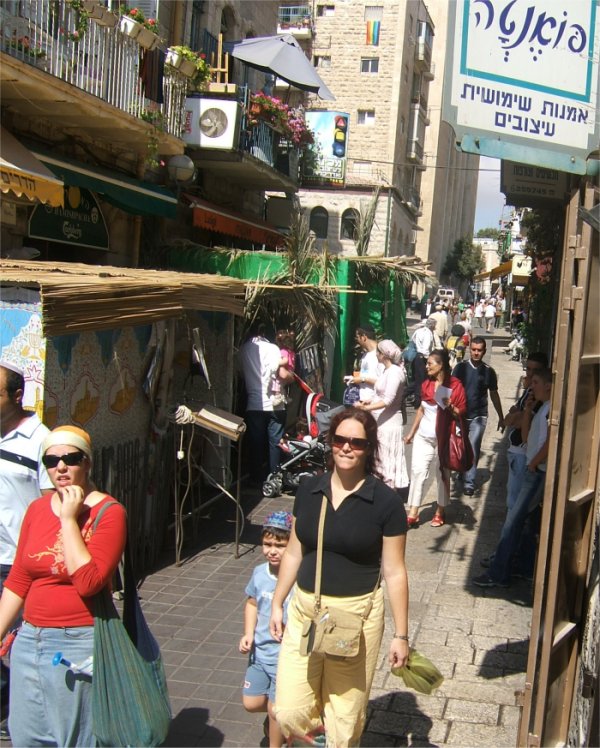
In the mean time, Sukkot is moving ahead full steam, so here are some pictures. I went downtown to meet a friend for breakfast, and got a nice view of downtown Jerusalem during sukkot.

During the festival, one must eat all their meals inside of these sukkot (temporary dwellings made from vegetation.) In order to stay open, many restaurants in the city build their own Sukkot for outdoor seating.

A restaurant sukkah.

Sukkot in the Ben Yehudah area.
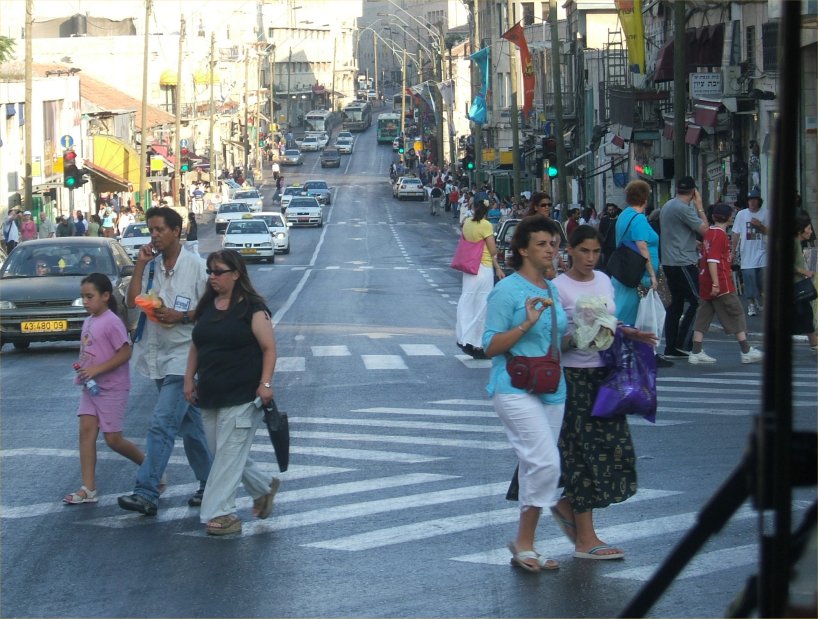
I decided to visit the Kotel (Western Wall) in the old city while I was at it. The city was extremely crowded. Reminds me of early 2000, before the intifadah.
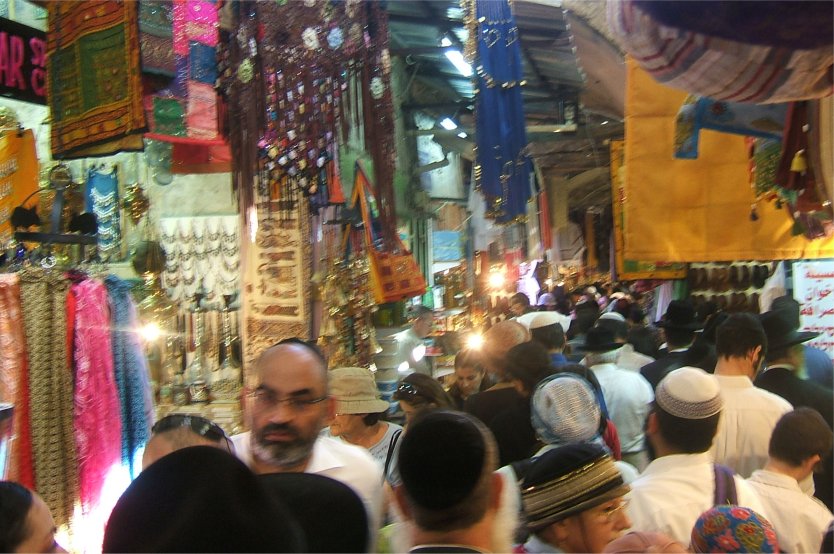
Walking down the main strip.


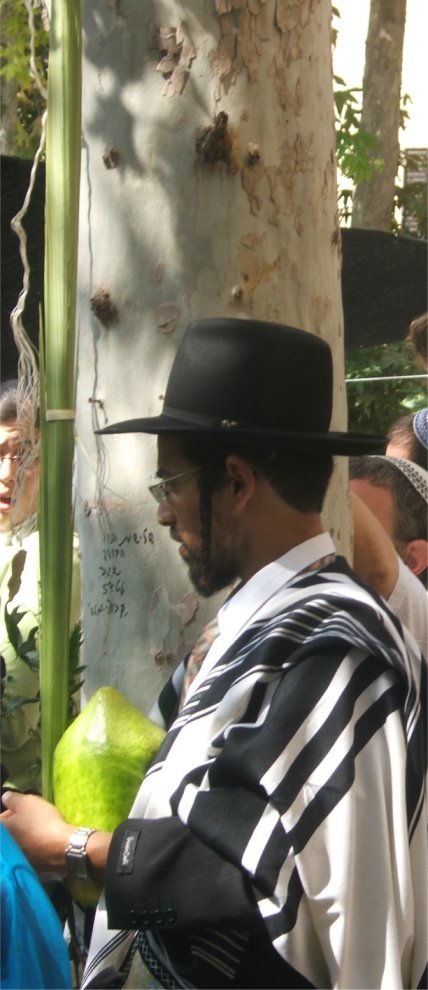
The Yemenites have these absolutely enormous etrogim (the big fruit he's carrying.) They leave them on the branchces for several years to get nice and large.

Rishon L'Tziyon, former chief Rabbi Mordechai Eliyahu. (He's the one with the turban and fancy coat.) Taken in the Jewish quarter of the old city.
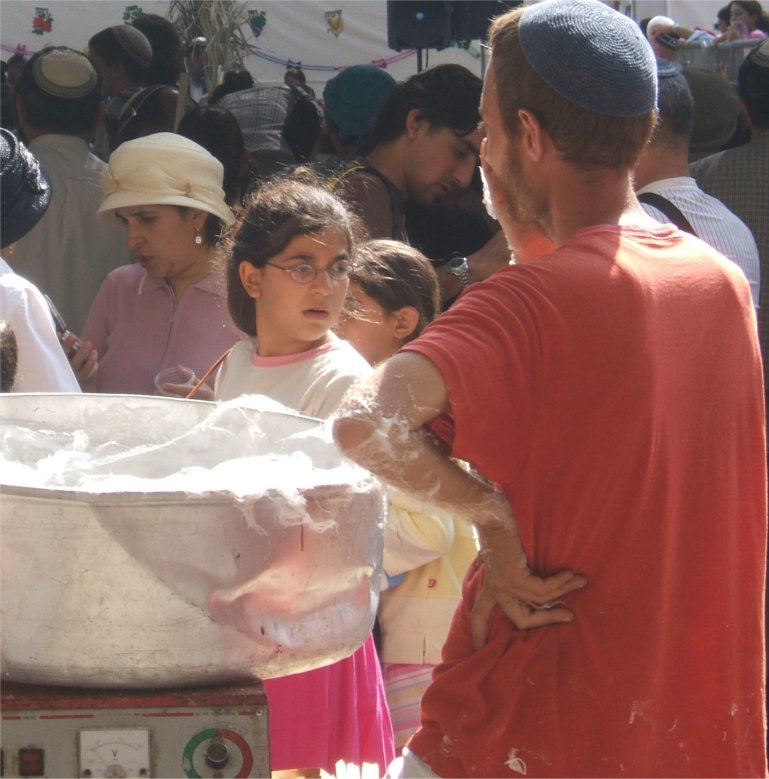
The cotton candy man.


At the Kotel, learning to shake a lulav.

Another one of those enormous etrogim.
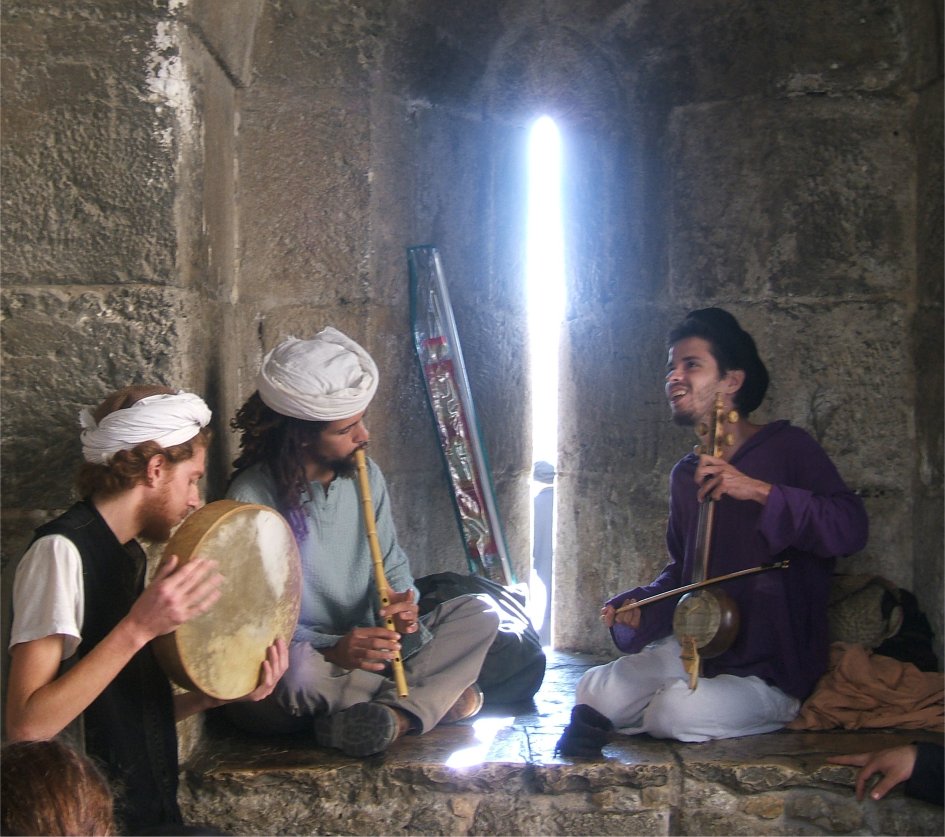


Musicians sitting in the city gate playing.
Saturday, October 07, 2006

Landscapes of Israel

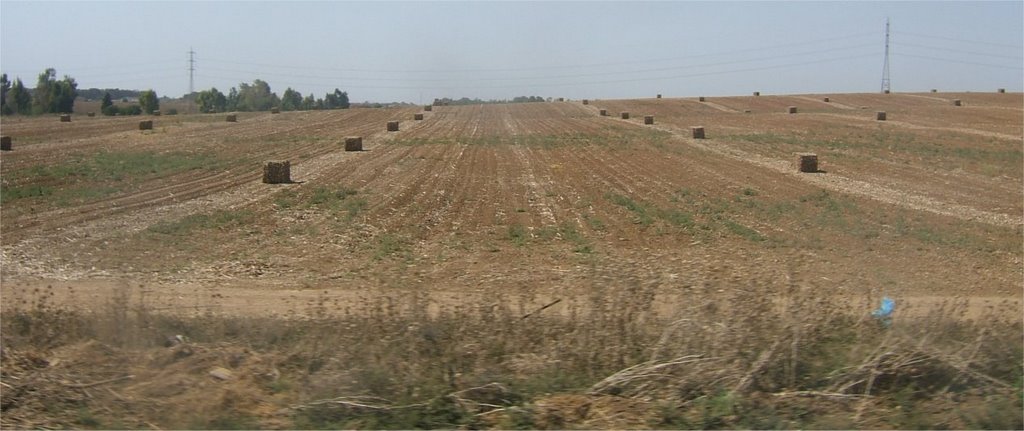
I took the following pictures from my seat on the bus on the way down to Be'er Sheva a week ago.


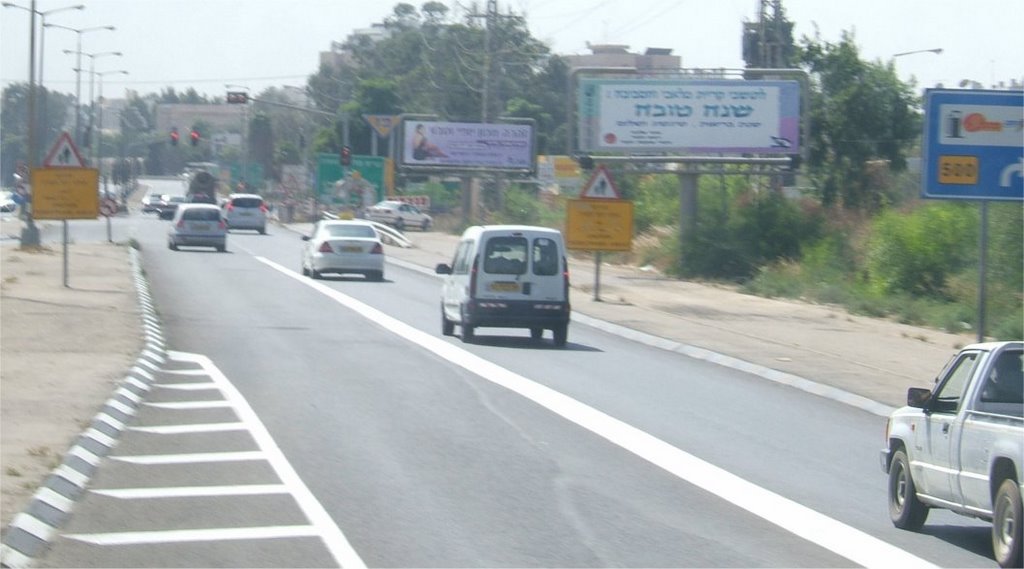
The main street in Kiryat Malachi.


Most of the northern Negev seems to be hayfields, small moshavim (agricultural settlements,) and Bedouin encampments. There are a few larger towns.


Driving into Kiryat Gat. This is the town where most Intel chips are made. One of the tings I like about Israel is that the towns are very compact, without much urban sprawl. You drive through mile after mile of farmland, and suddendly you're in the city. In the states, these fields would instead be tract housing.
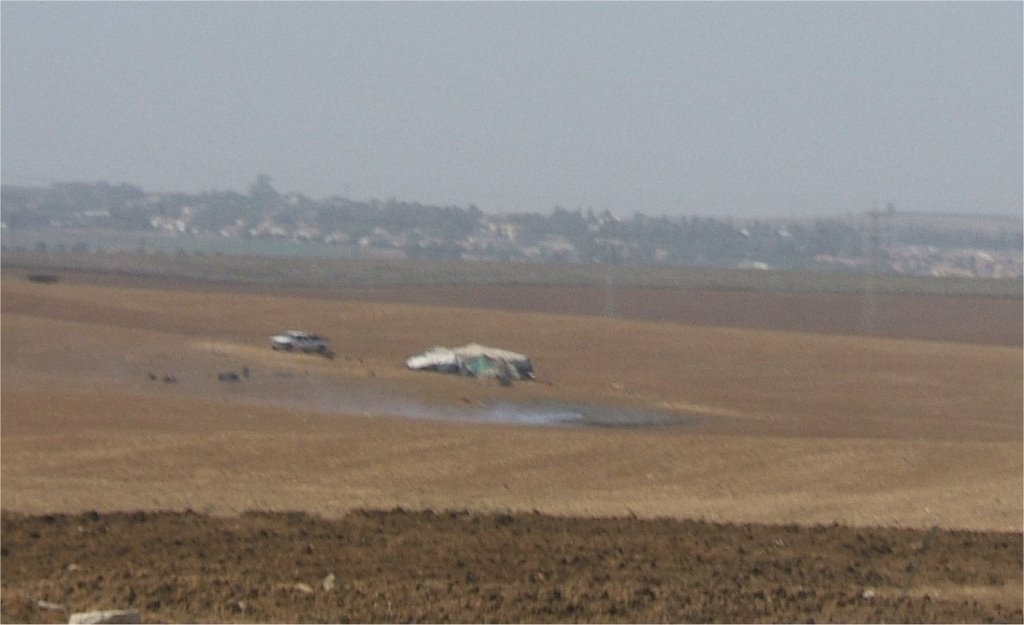
A small bedouin encampment, with some sort of camp fire.
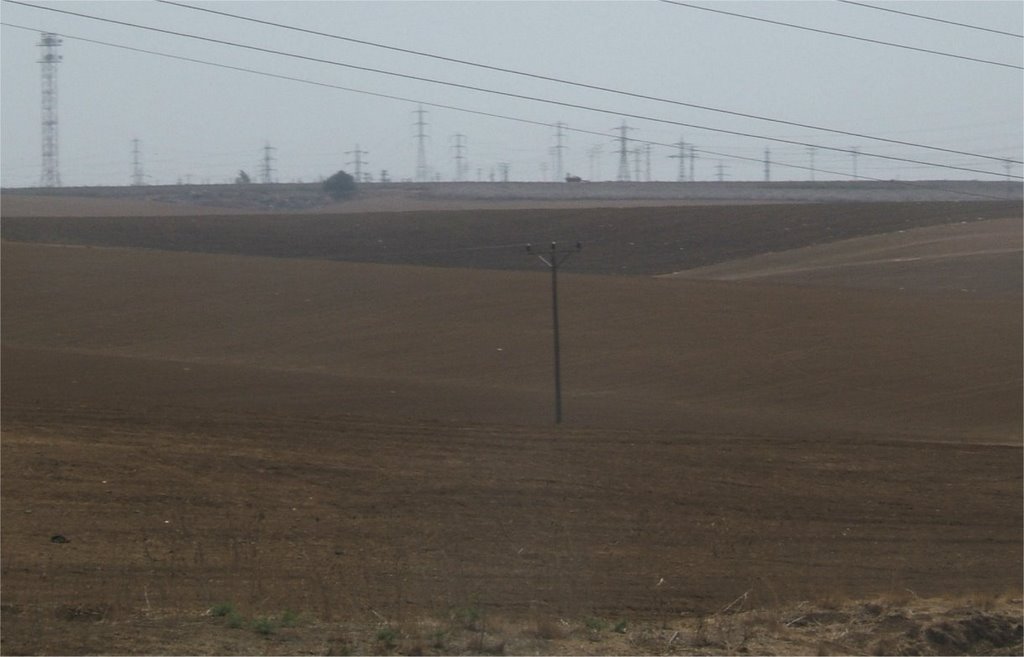

Mile after mile of hills (and power cables.) Recently plowed fields, waiting for the first rains.
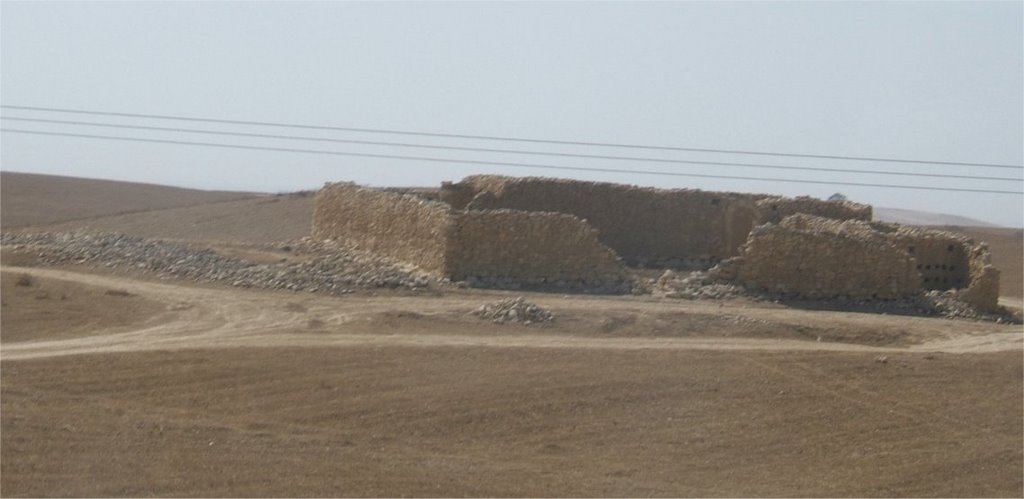

The ruins of a house north of Be'er Sheva.
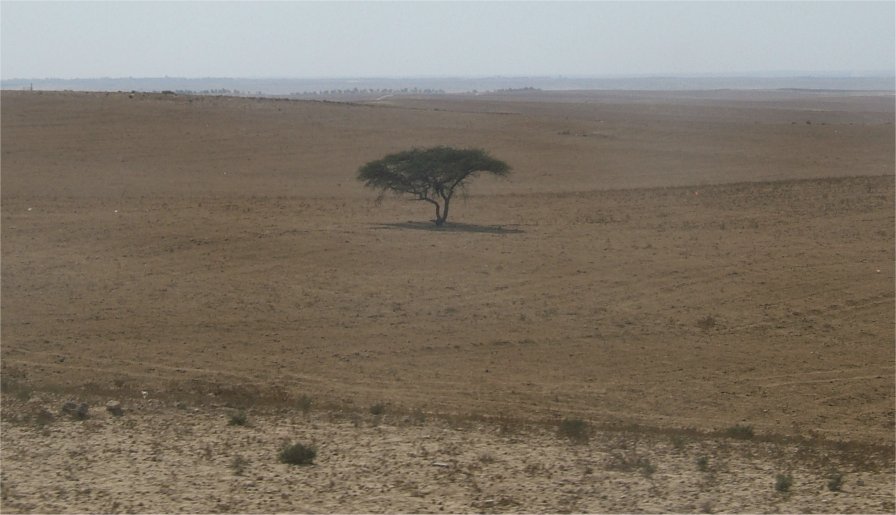

A lone acacia tree in the desert.
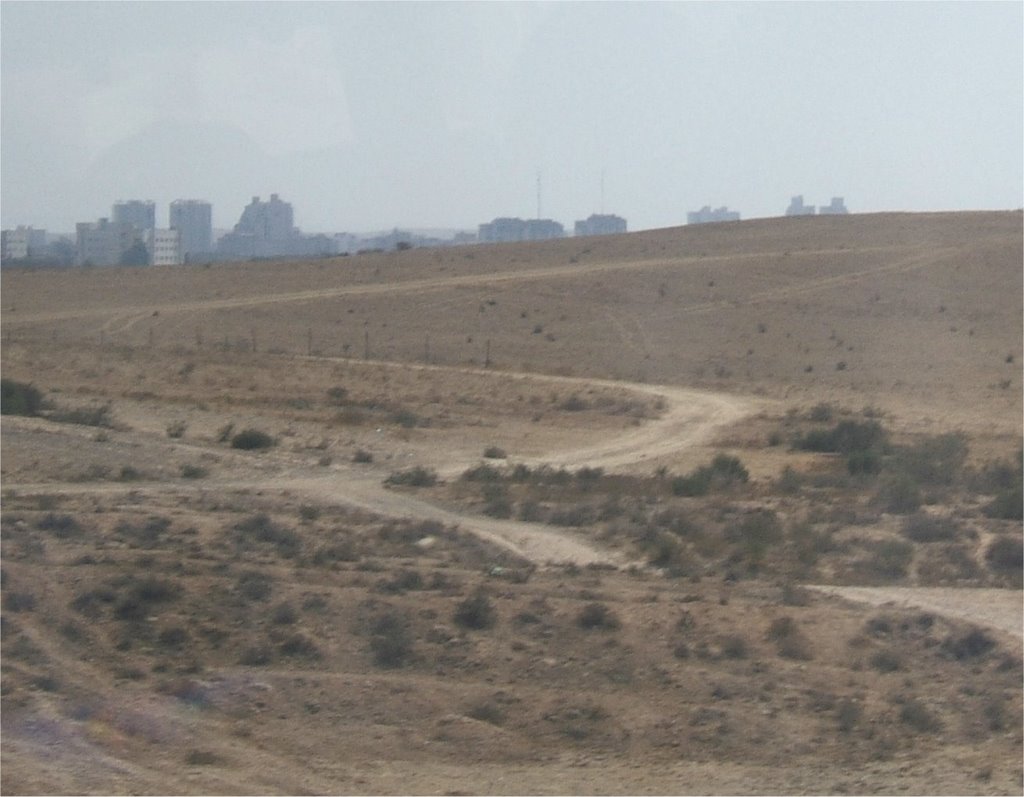

The towers of Be'er Sheva rise over the Negev hills. This is my favorite part of the drive.


The new courthouse building in Be'er Sheva. I used to live across the street from this one.

Friday, October 06, 2006

Sukkot is Coming!

But before we talk about sukkot, how about my fridge? Well, it's HERE! At last!
The fridge was to be delivered between noon and 4 PM yesterday, so naturally they showed up at 9:30 AM while I was at my cousins' house. I had to hop on my bike and fly down the hill to receive them. After they finished delivery, the mover holds out his hand.
"One hundred fifty shekels."
"I thought I paid at the store."
We called up the store. No, as a matter of fact, I didn't pay at the store. It just shows up on my receipt to warn me that I'll have to pay these guys.
"Do you take visa?"
"No, cash or check. Welcome to Israel."
But I couldn't find my checkbook. We worked out an arrangement. They have one more fridge to deliver in Pisgat Ze'ev. I will ride my bike up to the mall, take out money from the ATM, then meet them there. Unfortunately, the house they were delivering too was the highest altitude in Pisgat Ze'ev, and mine is the lowest. Pisgat Ze'ev means literally, "Wolf Mountain," and the whole town is built on a pretty steep slope. But I made it! And I was able to hand him 150 sweat-drenched shekels, and be on my way.

The fridge is absolutely enormous. I don't know what I'm going to do with all that space.
On the way back, I picked up arbah minim for sukkot. Sukkot is the festival after Yom Kippur, during which Jews from all over the land of Israel would bring sacrifices to the temple in Jerusalem. While staying in Jerusalem, people would build little huts (called sukkot) out of branches and palm fronds and live in them. The festival is clearly described in the Torah, and there are many detailed mitzvot to fulfill, one of them being the taking of the arbah minim (four species) as shown in the picture below. They are brought together and shaken in the sukkah and during morning prayers.


The lemon looking thing is called an etrog. In America, you order them weeks before hand, wait for them to be delivered from Israel, and hope that they are still kosher and nothing was damaged in transport. In Israel, you can pick them up at the grocery store.


In America kids sell lemonade. Here they sell the arbah minim in front of the grocery store.

I bought my etrog, brought it home, and noticed it didn't have a pitom on it (a tiny twig that sticks off the bottom.) This renders it unkosher. Turns out I had bought a Yemenite etrog. I did some research, and it turns out that the pitom actually falls off the Yemenite etrog during growth, which does not render it unkosher. But then I called a local rav, and he told me that Ashkenazim (Jews of eastern European descent) do not necesarrily hold by Yemenite etrogim (there are conflicting rabinnic opinions,) so I should try to get one that was under supervision of the Jerusalem Rabbanut (rabinnic council.) I went back to the store, they had the type I was loking for, the prices were the same, so we exchanged them. No problem.\n\n\nI told Rafi the story and he was a bit upset, being militantly Sephardi (of middle eastern descent) himself.

"Everybody knows that the etrogim from Yemen are the best!" I could have argued the point, but I get sort of sick of these little hangups everybody has. My etrog is kosher. End of story.

The lemon looking thing is called an etrog. In America, you order them weeks before hand, wait for them to be delivered from Israel, and hope that they are still kosher and nothing was damaged in transport. In Israel, you can pick them up at the grocery store.

In America kids sell lemonade. Here they sell the arbah minim
in front of the grocery store.
I bought my etrog, brought it home, and noticed it didn't have a pitom on it (a tiny twig that sticks off the bottom.) This renders it unkosher. Turns out I had bought a Yemenite etrog. I did some research, and it turns out that the pitom actually falls off the Yemenite etrog during growth, which does not render it unkosher. But then I called a local rav, and he told me that Ashkenazim (Jews of eastern European descent) do not necesarrily hold by Yemenite etrogim (there are conflicting rabinnic opinions,) so I should try to get one that was under supervision of the Jerusalem Rabbanut (rabinnic council.) I went back to the store, they had the type I was loking for, the prices were the same, so we exchanged them. No problem.
I told Rafi the story and he was a bit upset, being militantly Sephardi (of middle eastern descent) himself.
"Everybody knows that the etrogim from Yemen are the best!"
I could have argued the point, but I get sort of sick of these little hangups everybody has. My etrog is kosher. End of story.

The holiday lasts a full week, so I'm looking forward to being invited over to other peoples' sukkot. Fortunately, Israel set the clock back by an hour last week, and America doesn't set the clock back for another month, so until October 29th, I finish work at 9PM instead of 10PM. That means I'll still be off work early enough to visit other people's Sukkot.

Wednesday, October 04, 2006

The Ortho-Hippie Wedding

I always assumed that the sixties ended at midnight, December 31st, 1969, but they're still burning strong at Moshav Modi'in! The moshav was founded by followers of the 1960's inspirational musical and Jewish revivalist guru Shlomo Carlebach. The Moshav has the feel of an eastern spiritualist retreat, a traditional synagogue, and a Jewish hilltop outpost all mixed into one. I came on a bus from Jerusalem with many of the guests from a Yishuv called Bat Ayin, in Judea (southern West Bank), another Carlebach-type hippie colony.

A friend of mine from Berkeley, Hillel, came all the way out to Israel to get married, and will be making aliyah, God willing, next year with is new wife Chaya. It's... well... let's just say it's not exactly my crowd, but I had a really great time and think we sent the Chatan (groom) and Kallah (bride) off into their new life together with a bang


The guys getting Hillel ready.


Peyos (sidecurls) and bongo drums.


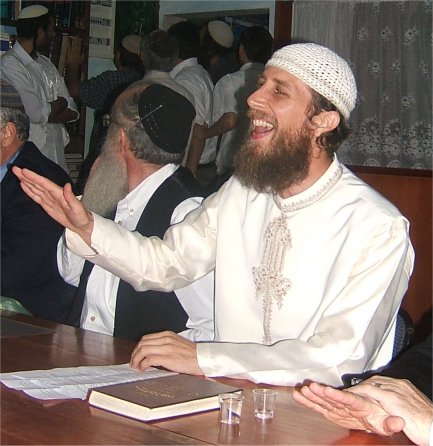
The Chatan


Dancing outside the Yichud room, where the Chatan and Kallah go to be together for a few moments after the official ceremony.
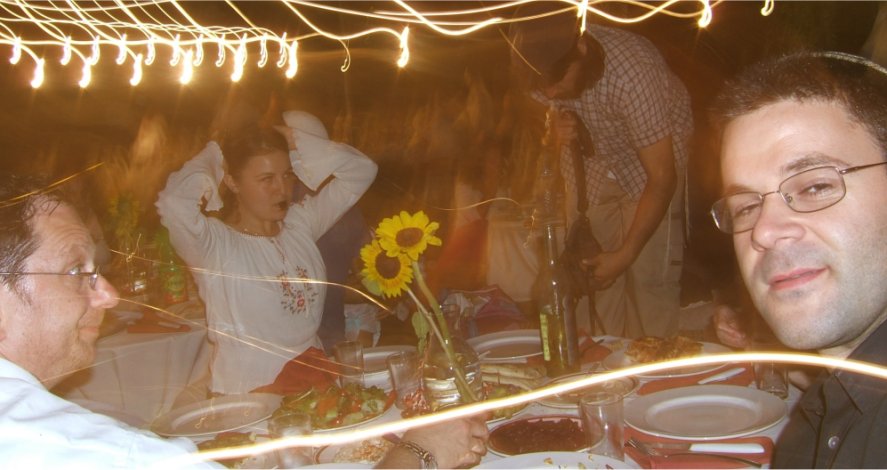

At my table. I did a weird sort of flash combined with long exposure which resulted in the streaks, but given the psychadelic nature of the whole wedding, I figure it encapuslates the experience pretty well.


We all sat on cusions and had a parve meal (neither meat nor milk products.) Brown rice, vegetables, a shmorges board of Berkeley cuisine.

Chatan and Kallah dance over the mechitzah (separation between men and women for dancing.)

At the wedding, I bumped into Johnathan, another oleh (immigrant) from Walnut Creek. He's living in Bat Ayin, learning in yeshivah studying Judaism and environmentalism now.
Monday, October 02, 2006

A Day in the Life

A-Plus: 1 Month, 2 Weeks, 2 Days

Friday, 8AM. I rolled out of bed and into my life in an instant. I walked to my living room, found my glasses, and stared at the empty spot between the counter top and my desk, where the fridge is supposed to go. The fridge which was supposed to arrive yesterday. It's too early to deal with this. After all, I'm only a new immigrant, and I can't be expected to solve everything in a day.

Before I can deal with any of this I have to ride my bike up to Shacharit (morning prayers.) But I don't have a bike yet, because it's in Be'er Sheva, two hours south of Jerusalem, with two empty tires. I'm going to Be'er Sheva for Shabbat, and the last bus leaves in four hours. But I still have to get to the mall to figure out what happened to my fridge, and it takes an hour just to get out there. First comes Shacharit. I do my best to focus on my conversation with God, but fridges and bikes keep floating by in my mind's eye. Focus man, focus! I tighten my tefillin (prayer boxes and straps) and beseech the one on high for divine assistance.

While I'm packing my bag for Shabbat, Yehoshua, my host in Be'er Sheva calls me. I explain my fridge and bike problems to him.
"Let me handle the bike. It's not in bad shape and I can get it fixed."
Now there's a friend. Haven't seen him in over four years, and he's spending his morning getting my bike fixed.
"And before you go to ask about the fridge, practice pounding your fist a couple of times."

Backpack loaded, I head for the bus stop. As I'm walking towards the intersection, I see the bus zip by. I do a quick spacial calculation, measuring the ratio of my speed divided by distance to the nearest bus stop compared to the bus' speed and distance, and determine it is impossible to make the bus. Can't win every time, and I can catch the next one in twenty minutes. I decide to run anyway. I come sprinting around the corner and see he's now pulling away from the bus stop, but has slowed down because a car is pulling in front of him. I run harder. He sees me in his side view mirror. It's a test of wills, and he's trying to escape, but he's too late, because I've caught up with him and am incessantly banging on the door and yelling at him.

I leap through the open doors.
He rolls his eyes at my victory air-punch and exclamation, "Ah HAAA!"

The bus spits me out at the mall, closer to my goal, but with an hour lost. A guard stands in the way.
"Gun?" he asks.
"No."
"You sure?"
"Yes."
"Cookie?"
"What?"
He reaches into a box of free sample cookies.
"Kosher?" I ask.
"Yes"
"Dairy?"
"Parve," (contains neither milk nor meat products.) He waves his metal detector at my backpack, "Open."
I open the bag, and there he sees my tefillin and siddur (prayer book.) His eyes widen as he carefully bends over to stroke the tefillin and kiss the siddur. "May you be inscribed in the book of life for a sweet year."

My legs pumping me towards the electronics store, I try to get my angry juices flowing. I realize, however, that this violates a major principle in Judaism, that of self-control. In the religious Jewish world, a truly heroic person is one who has mastered control over his emotions. The Gra (a major Torah luminary of 18th century Lithuania) once told someone who had seemingly moved his hand without purpose that he was a, "Wild man." Rambam (Maimonades) states that if one becomes so angry that he breaks a dish, it's as if he has committed idol worship. And I'm supposed to go in there and do what, start yelling? At the same time, I don't want to be taken for some push-over new immigrant American, so I decide to go deadpan. No yelling, but no friendly handshakes.

The employee who sold me the fridge last week sees me and approaches.
"Where is my fridge?" I ask.
"Pashut ayn," he answers, matching my deadpan expression. There just isn't.
"But where is it?"
He punches up my order number.
"Ah here it is. It will be arriving in Israel in two weeks."
"Two weeks?"
"It will take two weeks to get to Israel. Expect another week before delivery."
"But you said it would be here before yesterday."
"Pashut ayn."
"But I was here last week, and you took me right over to that corner, and you showed me the fridge, in its box. It was here! You said it would be delivered before Thursday."
"Pashut ayn."
It's obvious to both of us what happened, but it doesn't seem to register with him why I have a problem here. Just because he sold my fridge to someone else, expecting me to wait quietly for an extra month, by what leap of logic should I be holding him responsible?
My tactic isn't working, so I take another tack.
"Look, I know you're busy, but understand that I haven't had a fridge for two weeks already. I'm ordering felafel and pizza every night. And the holidays are coming! How can I have guests without a fridge?"
"Let me talk to my manager."
Five minutes later, I'm being offered a fridge that's 275% larger for 15% more money, to be delivered after Yom Kippur. I grab the offer, on condition I don't pay until delivery.

Heading out, I'm feeling pretty good. The bike is being fixed... victory! I might have a fridge next week... victory! ...And why is everything turning black? Food! A quick mental calculation indicates I haven't eaten in sixteen hours. I veer a hard right and head for the food court. Coming up to the counter, the chef and I argue over what goes into a swharma.
"You can't eat harif (hot sauce), you're Ashkenazi (eastern European,)" he teases.
"Just give it to me."
When I ask for amba, a tangy mango sauce that makes most mouths Ashkenazi mouths pucker, he does a real double-take.
An American tourist wanders by and the chef immediately innundates him with English, "Shwarma like you not taste before! Twenty shekel! You love this felafel!."
But he didn't speak to me in English. He didn't mistake me for a tourist! Victory!

I head out the door for the bus, pass the guard, and lean over to grab another bag of free sample cookies. I've just had meat, but I remember they're parve, so I'm in the clear.

Riding the bus down to Be'er Sheva, I pop my headphones on. Listening to Hassidic techno pop, I watch the forested hills west of Jerusalem give way to orchards of Beit Shemesh, which gradually turns to flat farmland near Kiryat Malachi, and eventually to dusty desert hills near after Kiryat Gat, until the concrete towers of Be'er Sheva rise over the sizzling horizon. Jumping off the bus I'm back in my old town, where I lived as a student four years ago. I walk to my old apartment. The streets are emptying for Shabbat, businesses are closed, but one door is still open, "Georgie's bakery," where I used to buy treats for my hosts on Shabbat. But that was four and a half years ago. Nobody is going to remember me from that long ago.

As I walk through the door, the baker shoots upright from his chair, "Is that really you?" he asks, "You've lost weight!"
We spend half an hour trying to make up for four years. Yes, I'm really an engineer now. Wow, he's really decided to go to university? No, I'm not married yet. Yes, he is. Maal tov mazal tov.
I leave loaded with goodies, some of them complementary. I arrive at Yehoshua's, it's been too long, but it's great to be back! I am reunited with my bicycle, in his storage locker, caked with four years of dust but in excellent working condition.

The sun sets, full stop! Now it's Shabbat, and I'm back at the old Hungarian synagogue, with the old crowd, glad to see me again. May you be inscribed in the book of life for a sweet year! And why aren't you married yet?

Friday, September 29, 2006

Heading Down South

Today I'm leaving Jerusalem for the first time since I landed here. That is, if I can ever get off this blog and get moving!

Heading down to my old diggs, Be'er Sheva, the city most often mentioned in the Book of Bereishit (Genesis.) I have lots of friends and my old bicycle waiting for me. But I have to move fast, because the bike needs repairs, the bike shop closes at 2PM today, it takes half an hour to get to the bus station, and another two hours to get to Be'er Sheva, and it's already 10:15 AM.
And did I mention that my fridge never showed up, so I have to go to the mall and pick a fight with the salesman? And the work is still pouring in? And I don't know where I'll be for Yom Kippur? And.... aaaaaaugh!

Come to think of it, why am I sitting here writing this at all?

Shabbat Shalom Planet Earth from Planet Israel!

Wednesday, September 27, 2006

Photos from the Pisgah


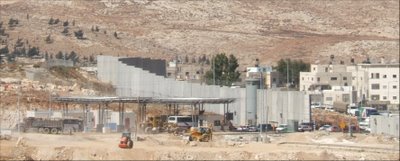
The Hizma Checkpoint (Per Yesterday's Email)


The barrier being built between Pisgat Ze'ev Mizrach (East Pisgat Ze'ev) and Anata
Succot is coming. This is at the store on Meir Gershon Street. Notice the little "kid's sukkah," and the larger one, "Now with Windows!"
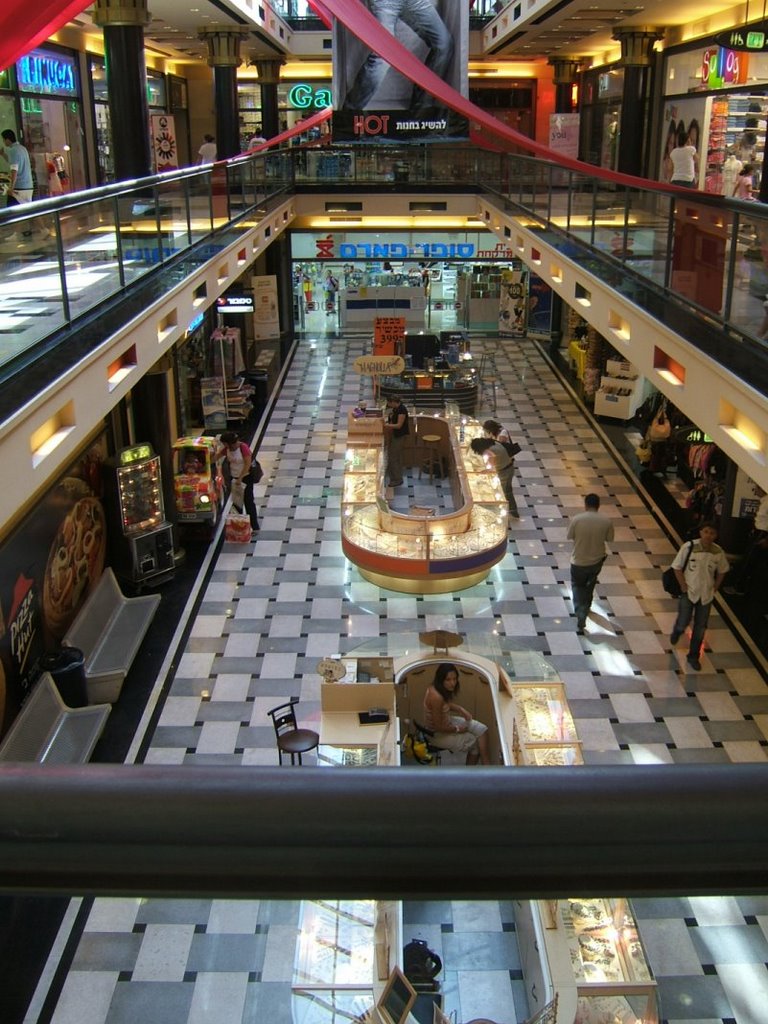

Kanyon Hapisgah (The Pisgah Mall) Notice how dead it is at mid day. It's a nice place but there isn't much to buy there.
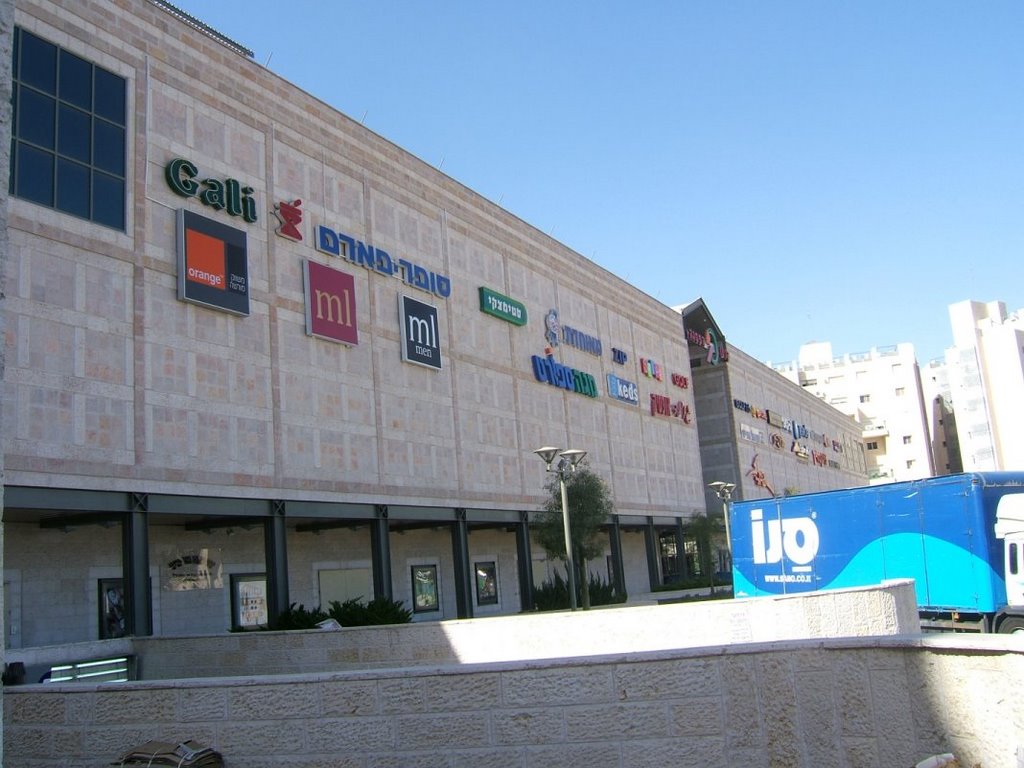
Outside the Kanyon.
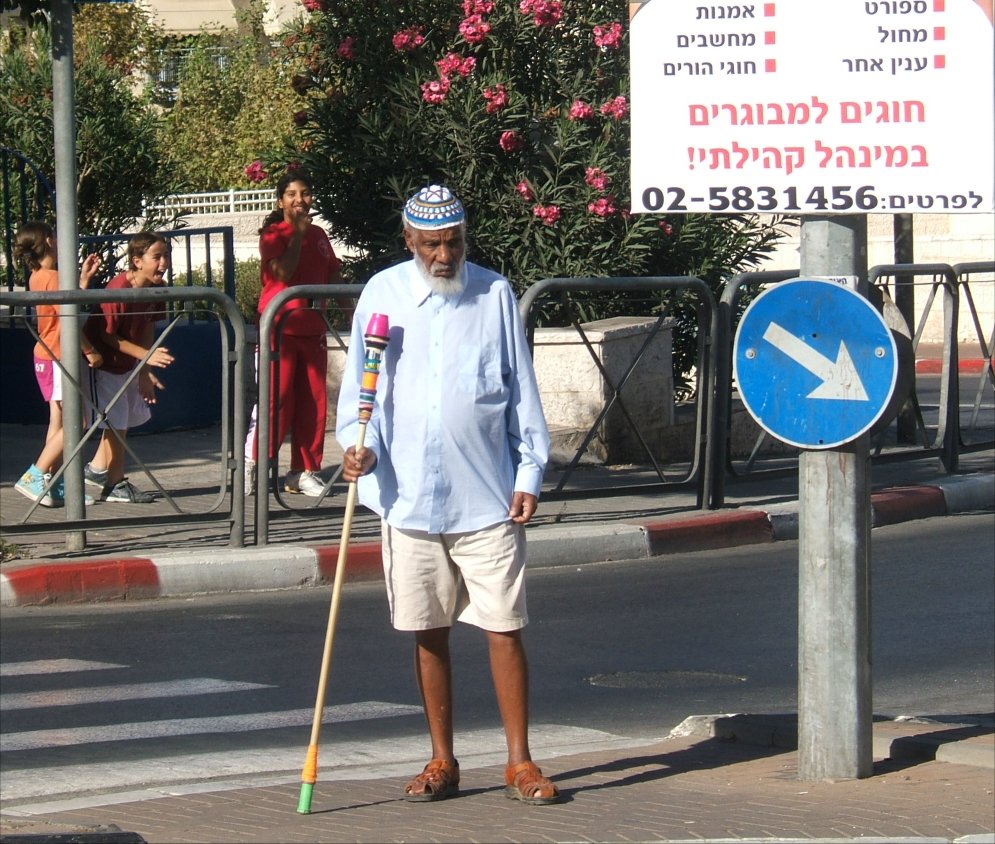
Ethiopian immigrant. Some day when my Hebrew is better I'll ask him about the staff.
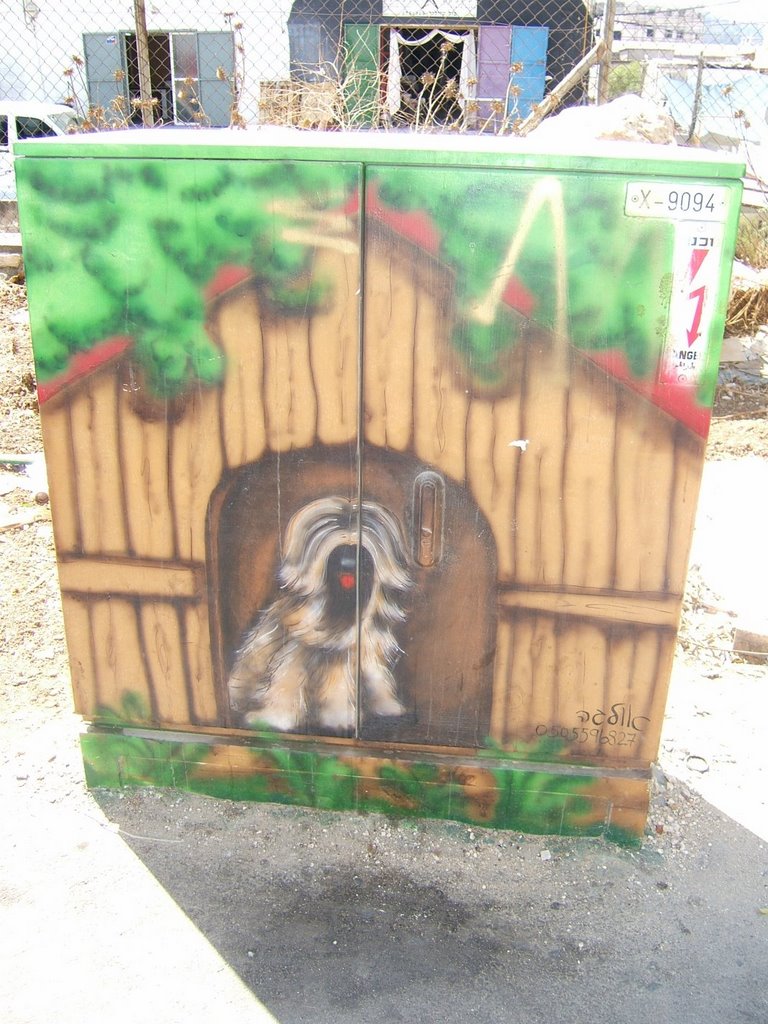
Graffiti on a Transformer enclosure. Okay, it's in Talpiot, not Pisgat Ze'ev, but it's cool so I put it here.


Miscellaneous Buildings


Tuesday, September 26, 2006

The Wall

Cruising along Pisgat Ze'ev's Meir Promenade in Steven's station wagon, the shelves he just donated to me wedged between our seats, our necks automatically veer leftward. I've been in my apartment for fifteen days, he's lived in his house for fifteen years, but for both of us, the view can still interrupt a conversation. Gentle, glowing hilltops, square patches of cultivated fields in the Jordan Valley, a winding green vein of vegetation on the banks of the Jordan river, and the mountains rising in the distance. And the wall.
"Yeah, it's really great. That wall there," he tells me with obvious sarcasm, thumbing towards mile after mile of precast concrete panels stood on end. "It's stopped all terrorism. It's going to stop all the Katyusha rockets too."
It certainly spoils the biblical view. One tries to imagine Abraham or Isaac walking across the landscape with their herds of sheep, and it's inconceivable today. How did they get past the anti-vehicle ditch and the motion-sensors?

There was no wall in 2002, the last time I was in Israel. During those dark days of the Intifada, on Shabbat when everyone else was asleep, I would hike through archaeological sites, stroll through the center of town, and come down to what was then the new housing construction sites at the bottom of town, not realizing at the time that I would be living in one of them today. I remember looking across the small valley separating us from the nearby Arab village of Hizma, thinking, "My God, they can just walk over here in five minutes." But actually building a wall was far too politically sensitive at the time because, regardless of the diplomatic double-speak about "security purposes only," everyone knew that whatever ends up on the "wrong" side of the wall will be next on the chopping block. This sparked hostility from both the left, who want to give away everything, to the right, who would surrender nothing. And never mind that actually building such a massive engineering undertaking seemed as realistic as building an elevator to the moon. But one or two suicide bombings a day for what seemed like an endless string of weeks had a way of ending the public debate and motivating the government in a way no think tank position paper ever could. The first sections of the barrier were actually erected by farmers up north who had had it with the constant attacks and marauders passing through their fields. The government later picked up the idea and started the serious building project.

Long before the actual building of the fence began, the psychology of fortification was already established. During the first Intifadah, in the late 1980's, an exhausted Zionist movement, soon to transform into the new Post-Zionist movement of the 90's, began avoiding the enforcement of certain critical laws. First, the Palestinian flag, which had been banned alongside the Nazi flag, began appearing in public. Then, people who threw stones at passing vehicles with murderous intent were no longer prosecuted. In response, those living in the settlements welded rock-proof steel screens to protect their windows.
"That's when we lost everything," one settler friend tells me, "when we put the screens on instead of catching the stone throwers."
Soon, law enforcement turned a blind eye to another law, the one forbidding talks or negotiations with a terrorist entity, and the entire situation Israel faces today was born.

Watching dump trucks and bulldozers cart dirt around to prepare the next section for concrete panels, I ask Steven, "When was it built?".
"Most of it has been built over the last year. It's like we just woke up and there it was."

The next day, Galila volunteers to give me a ride out to Rami Levi, a discount grocery store in the Sha'ar Binyamin Industrial Area. On the other side of the wall. Her eyes widen as we pass through the Hizma security checkpoint. "None of this was here when I left for Montreal two months ago."

What used to be chain link fences, and an army jeep or two, and a couple of soldiers checking identity cards has now been poured in concrete. At this break in the twenty-foot tall concrete wall now stands a four-lane plaza with drive-through booths. Soldiers sit behind air-conditioned glass enclosures, waving some cars through, stopping others for searches. But the wall and checkpoint don't generate as much despair as the four Israeli flags fluttering in the plaza over the waiting cars.
"It's like this is the new border."

We're on the Ramallah bypass road, one of a series of roads built by the government to allow drivers to avoid passing through densely populated Arab areas. These bypass roads are often referred to by enlightened publications such as the New York Times or the International Herald Tribune as "Jews-only" roads to smear Israel as an apartheid state, in spite of the fact that three out of every four cars on the road is Arab. Fifty feet to the left of the road is the security barrier, a barbed wire fence wriggling across the desert, hugging the road. Fifty feet to the right is the first row of houses in the Arab village of Hizma.
"Rafi called me a few months ago when he was driving out here to tell me about this fence. They built this whole fence," she says, pointing out to the line of barbed wire reaching over the hilltops, "without a word in the news. Nobody told us anything."

The whole landscape has the feeling of a world gone seriously awry. An offramp from the bypass road connects to a freeway underpass, leading who knows where. The offramp is empty, the underpass filled with boulders and dirt mounds. No explanation. Continuing on our way, we glide up to an electronic gate which slides open as we are waved through, and find a spot close to the entrance. Guards, iron gates, twenty-foot steel fences. This grocery store and furniture outlet could easily be mistaken for a prison.
"How long has it been since I was here last?" Galila asks rhetorically, "Three months? I don't remember any of these fences."

Shopping cart in tow I head for the entrance, met by the usual security guard with her usual metal detector asking the usual question, "Gun?"
"No."
"What?" An unusual reaction. She does a double take. "Are you sure you don't have a gun?"
And that's what it's coming down to, as areas on the Israel side of the wall become more civilized, the other side becomes wilder.

The car loaded with vegetables and melting ice cream, we pass back through the Hizma checkpoint without delay. It feels good, very good, to be on the "right" side of the wall. But is the wall really good? Ask any local and they'll tell you, in no uncertain terms, that the very idea of building the great wall of Israel is beyond insane, it's an act of surrender.

It is, however, important to remember that Pisgat Ze'ev is a right-wing stronghold within the conservative fortress of Jerusalem. Driving over the bridge on route 1 into Pisgat Ze'ev, anyone can peer over the barrier to see for themselves the huge sections of empty Land of Israel, and the settlements bustling with tens of thousands of Jews, which are being placed out of reach, in territory now psychologically classified as "hostile" by virtue of its being on the "wrong" side of the wall. And anyone who can sense the proximity of the hostile Arab villages beyond the wall, and thus under looser Israeli control, to the nation's capital in Jerusalem is more than a little apprehensive.

Meanwhile, the wall is looking pretty good from the distance of Tel Aviv. Along the coast, where Israel's decision makers live, cities like Holon, Rishon L'Tziyon, and Hadera have seen major benefits. The most obvious is the virtual disappearance of the suicide bombers. Hamas' and Fatach's claim of "deciding" that suicide bombings are not in their best interest notwithstanding, the wall, combined with the hunting down and killing of their leadership and the military re-occupation of areas previously abandoned during the negotiations of the 90's, has had a major effect on reducing terrorism to tolerable levels. In 2002, suicide bombers struck these areas at least twice a week, leaving scores of innocent victims murdered or maimed every time. Now the bombings have been reduced to about once every six months, if that, with much weaker effects. And that's not to mention the steep reduction in car theft, burglaries, and muggings committed by criminals who used to flee back over the invisible border to find protection under the Palestinian Authority.

The current government was elected on the platform of destroying all Jewish life on the other side of the barrier. According to this scheme, Israel would then turn a blind eye as the Palestinian Authority, now under the command of Hamas, carted off the land on the other side to create their new Islamic Kingdom. This would turn the barrier into a de-facto border with the new Palestinian state that everyone in the world except the Palestinians is demanding. The existence of a Palestinian state would then absolve Israel of responsibility for the health care, education, sanitation, and civil rights of the Arabs, who would have to turn to their own state, and Israel would no longer be an outcast in the international community. Sure, it would cost a quarter of the country's land mass, but how many government ministers or their children live out there anyway?

Israelis, at least those who make the decisions here, are constantly convincing themselves that this is a national conflict, with one nation, called the "Palestinians," who are fighting an independence war against the other nation, called "Israelis." This is psychologically comforting to many as it makes the solution clear: just give them what we think they want; land and power. But the recent war with Lebanon has caused a re-think, not of building the wall, which continues at a furious pace, but about the goals of Israel's enemies. It was a war fought by a non-state, Hezbollah, on behalf of a group of people who adamantly refuse to build a state, the Palestinians. The rocket bombardment from Lebanon didn't manage to pop the Tel Aviv "bubble," they only reached as far south as Hadera. But now, with a hostile border not ninety but nine miles away, it's hard to see how Tel Aviv can avoid being hit by one of the Katyusha rockets Hamas is promising to fire. As a result of the war, plans to destroy the Jewish communities outside the wall's embrace have been abandoned for the time being. As more twisted razor wire and concrete fortifications spring up by the minute, nobody knows where this ship is headed, or who is at the helm.

Monday, September 25, 2006

Shanah Tovah

Word is out among the families here that I have moved into town, so now I'm receiving invitations by phone from people I've never even met. Fortunately, Rosh Hashannah is a two-day holiday, so it gave me the opportunity to meet many of the families who have been trying to get me to come over.

Friday night, I went to Tzvi's house (his wife's name escapes me.) He is from Miami, his wife is from Iraq. He had one son at home, one is in yeshivah, and his oldest son lives in Berkeley (20 minutes from Walnut Creek.) For the first night of Rosh Hashannah, Ashkenazim like me just eat apples and honey and call it a wrap, but they followed the Sephardi tradition of taking a plate loaded with different fruits and foods, and saying different blessings over each for a successful the new year. I.e., we eat a fish's head and say that, "We should be as the head and not the tail."

Saturday morning I woke up at 5:20AM to daven Netz, the earliest time it's possible to say the morning prayers. Being Shabbat, there was no shofar blowing so we were finished at 9:30 AM. Steven (my American dentist friend) invited me over for kiddush and breakfast. He, his sons, and I went through some Mishnayot and learned about the origins of the two-day yom tov, or at least we learned as much as we could with his seven rambunctious kids squirming in their chairs.

At 11:30, Steven's chevrutah (study partner) came over and I headed downhill to Moshe and Nogah Cohen, friends of my cousin Galila. I tried to follow the conversation, as it was all in Hebrew, and I was at least partially successful. They both immigrated to Israel from Iran twenty years ago, so we ended up talking about their own immigrant experiences, seeing what was the same and what was different.

At 1:30 I went to shul for minchah (afternoon prayers) but realizing I had arrived late, I decided to catch the next one at 6:30, so I went to the washroom. When I came out, everybody was gone, and I was locked in the shul! Unfortunately, most of the windows were protected with iron bars, but I was able to find one unprotected window after half an hour of searching, and I crawled out through that. I spent Saturday night at my cousin Rafi's father's house.

On Sunday I met the Samuels', who had invited me over a week ago without ever having met me. He's from Toronto, she's from London. Almost all of the English speakers have some connection to me since Galila teaches high-level English for at the local school. I ate, played with their kids, slept, and generally hung around their house for something like seven hours until the end of the holiday.

Today, Monday, is a fast day, so last night I decided to load up on water so as not to be thirsty. And here we see the perils of living without a fridge. I didn't remember at the time, but I had opened the liter of water I had been drinking before the holiday, almost 36 hours ago. I guess the water had spoiled because I became violently ill and have been spending the last 15 hours or so rotating between sleeping, trying to sit up and do some work and blogging, exploding from the inside for a while, falling back a sleep again, getting up... well, you know the picture. Fortunately I think I've gotten through the worst of it, but I'm still feeling a bit foul. At least I'm not in the least bit tempted to break the fast! And I did purchase a fridge on Friday, at long last, so it should be arriving some time this week. Until then, I'm just going to have to be more careful.

Thursday, September 21, 2006

Photos from Jerusalem

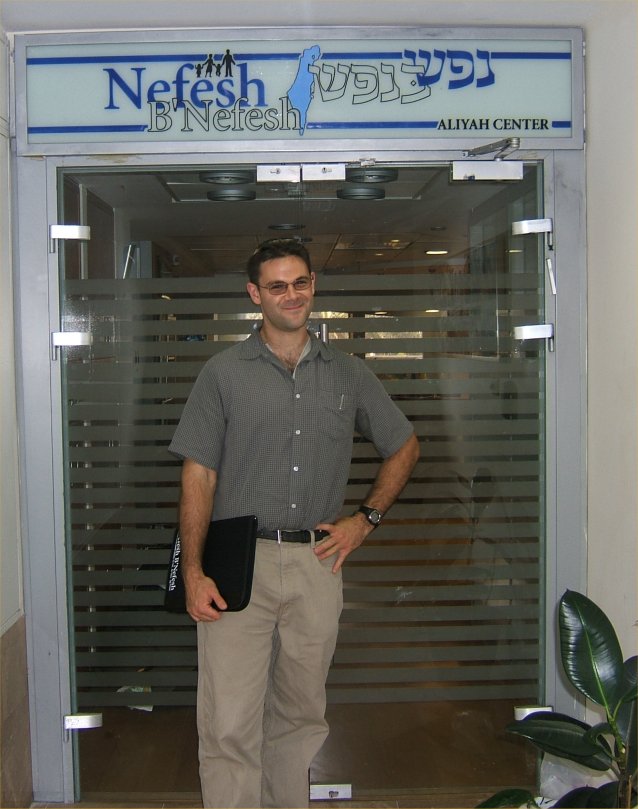
Me in front of the Nefesh B'Nefesh offices.


Positive-thinking graffiti on Hillel St.
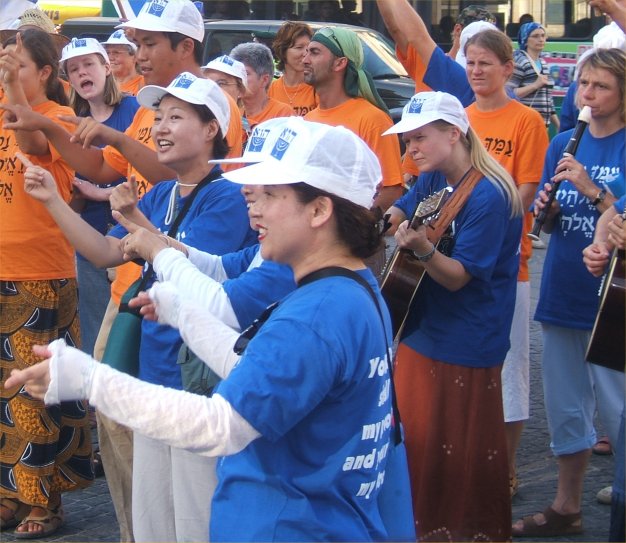

A Pro-Israel Demonstration of Christians in Zion Square


More of the Christian Zionists


Bustling Jaffa St. as seen from a bus window


Jaffa St. Next to the central post office


The Kotel (Western Wall,) new with polished floors, great lighting, and air conditioning!
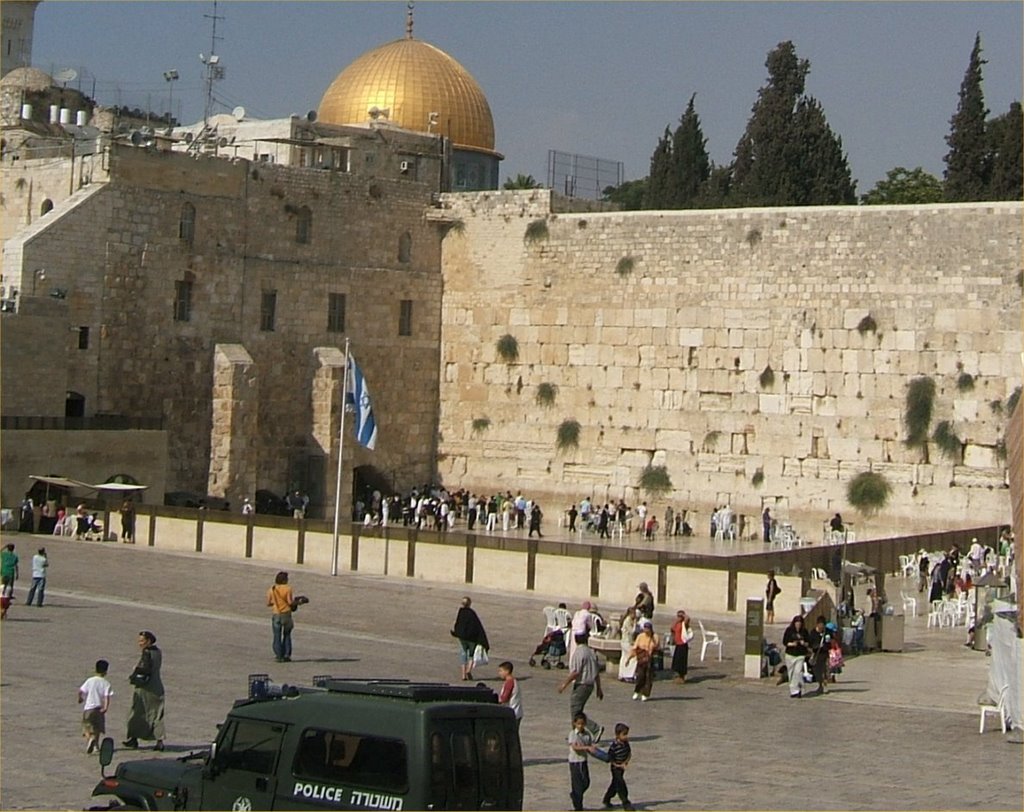

The outdoor section of the Kotel (Western Wall)

Wednesday, September 20, 2006

Life in the Neighborhood

A-Plus: 1 Month, 5 Days
 
(Note: This was written about events yesterday.)
 
It's so easy to forget where we live.  While shaving this morning, I clicked open my internet browser and opened National Public Radio via live webcast, enjoying some familiar sounds from the Bay Area.  With the razor in one hand devouring my beard stubble I surfed over to the Ace Hardware Israel homepage and noticed that there was a 50% off sale.  They had just what I need, new shelves for my apartment, and I can get them for half off!  I called cousin Galila on my cell phone and she agreed to let me hitch a ride with her towards the Ace branch in Talpiot.  She swung by, I hopped in, and we were on our way.  We turned left onto the bridge from Pisgat Ze'ev to downtown Jerusalem, and only once we had passed the point of no return on the one-way onramp did we see it.  Traffic backed up solid, in all lanes.  An accident?
 
"It could be an accident," Galila tells me.  But even I know better.
 
Motorcycles buzz between the lanes on either side of us.  Black.  The straddling them wear monochrmatic uniforms.  Black.
 
Drivers try to pry themselves through gaps in the traffic.  One truck driver threatens to use his big-rig on the Volkswagen in front of him as a battering ram.  A few minutes later, both drivers stand staring at the Volkswagen's smashed fender while exchaning phone numbers and insurance information.  Some slither past us in the emergency lane risking a 1200 shekel fine.  Among those cars coming from behind, more and more painted army olive drab with flashing lights.  As the sun creeps across the sky, the honking eventually subsides.  It's a waste of effort, nobody is getting through.  Gas is running low so we turn off the car, and with it the air conditioner, roasting in the heat.
 
"It's not an accident," Galila tells me, "it's a mechabel."  A terrorist.  She switches to Galgalatz radio, with traffic every ten minutes, and the music simply bounces along as if this were just another sunny Jerusalem day.  Traffic reports nothing wrong, as if they simply missed the thousands of cars frozen in the heat.  Eventually she switches the radio off.
"They're not going to tell us there's a traffic jam."  The bridge serves not only Pisgat Ze'ev, but also the Arab villages of Shuafat, Ramallah, and the entire Shomron (Northern West Bank.)  A traffic report would alert the terrorist who is on his way to Jerusalem, who can't be allowed to escape, so we all suffer.  I've had enough, so I get out of the car head towards Jerusalem on foot.  As I come around the bend, I see the black-uniformed special police services sliding van doors open, rummaging through peoples' trunks,  jumping onto busses.  A temporary tripod-mounted reflective sign announces, "Machshom," checkpoint.  Two cars pass through every 30 seconds or so.  Meanwhile cars are backing up at the rate of one per second.  Police reinforcements can't reach the checkpoint to speed the process because the emergency lane is blocked with illegal civilian traffic.  I eventually come to the checkpoint, receive a once-over from the black-clad policemen, and am on my way through.  Eventually I reach the bus stop at French Hill.  Behind me is the checkpoint I just passed.  To my right is another roadblock out of Shuafat.  Bus 173 pulls up to the stop.
"Central bus station?" I ask.
The bus driver just stares vaguely into the distance, as if speech, indeed all forms of higher brain function, have been lost to him, and he's just just using his primitive cerebral cortex to steer the bus.  I hop on anyway.  The woman sitting next to me asks me where the bus is going.
"I don't know.  As long as it's away from where I was."  As we drive into the city we pass in the bus lane, zipping past yet another checkpoint.
 
But I've got to get to Talpiot.  My shelves await me!  Jumping off the 137 at the central bus station I find the stop for the 14.  My phone buzzes.  It's Moshe.
"Hey, man, are you still trying to get to the city?" he asks me.
"I'm in the city.  I'm going to catch a bus to Talpiot."
"Be careful.  My mother just told me there's an alert.  There's a mechabel out there somewhere."  Yeah, I figured that out.
"Where is he coming from?" I ask, seeing my bus coming around the corner.
"Shchem."
I do a quick mental calculation.  Shchem is north of the city.  The road we were coming in on is in the north. It's unlikely that there will be problems going to the south to Talpiot.  If I try to catch a taxi back to Pisgat Ze'ev, I won't be able to get a ride, as the drivers know that they won't be able to get back into the city.
"Shchem is north of the city.  I'm going south.  I'll be fine."
The doors hiss open and the driver punches my bus card.  Driving through the city, the scene looks the same as any other day, but feels different.  The crowd on the bus is more subdued.  Or perhaps it only seems that way.  My eye is on everyone in that bus.  I'm not edgy or nervous, just aware.  The phone buzzes again.  The associated press is doing a story on telecommuting and wants to interview me.  No problem, just call.  Strange patches of everyday life that would come and go in an instant now leave stains on my memory.  The red shirt that the woman sitting in front of me is wearing.  The crooked nose of the crouched old man two seats down the aisle.  The flower pattern on the hijab of the Arab woman at the front of the bus.  The crinkling of her bag.  Carrying God knows what.  To hell with it.  I need shelves.
 
The bus spits me out in front of the Lev Talpiot mall, and there it is... ACE!  Praise the lord and pass the ammunition, I've made it. 
I call Moshe, "Moshe!  I'm HERE! I really made it."  We both chuckle.
"You don't have to worry," he tells me, "they ended the terror alert."
And suddenly the world looks like it used to, like it's supposed to.  Nothing has changed, it's all perception.  Moshe comes by Ace, we load up the shelves and zip back through the city to Pisgat Ze'ev, the checkpoints and searches a fading memory, all the way Moshe insisting I give no directions.
"No, no, don't tell me which way to turn, I need to learn the city."
"But Moshe, I need to be back at my apartment at 6 PM.  6 PM here is 8 AM there, and this is an American company.  I actually have to be there on time!"
"Don't worry, we'll be fine.  And don't tell me which way to go."
"This is no time for driving lessons, it's 5:50!"
"Don't worry, I know I made the right turn because you're smiling.  You would be yelling at me if I didn't."
 
We come flying through the front door in the nick of time.  I fill him up with leftover pizza and begin sending and receiving emails, phonecalls, and faxes with my calm American coworkers, and soon I'm an American again myself.  Talking with engineers about colums, beams, pumps and pipelines.  Worried about my project deadlines and design calculations.  Oblivious to the call to prayer drifting in from the Arab village of Hizma across the hills.

Tuesday, September 19, 2006

One Month in Israel

A-Plus: 1 Month, 5 Days

First off, now that I have an internet connection, I have finally been able to upload some photos.

This week marks the completion of my first month in Israel. I remember the day I landed as if it were... well, only a month ago. The exhillaration of landing was mixed with worries. As the airport taxi hauled its cargo of groggy olim to their new homes, I looked over the dry, dusty landscape, the pains of jetlag banging in my head, and hoped I had done the right thing coming here.

One month later, despite the various obstacles I have encountered so far, I must say that every day I am more happy that I made it here. Life in the land is sharper, more real. The air is thicker, people's personalities are stronger, and the news, well, it's always newsworthy. It's taken a lot of work, but now I'm sitting here in my own apartment, doing my job, making new friends and getting to know my neighborhood.

I remember the last time I tried to live here, as a student at Ben Gurion University in 2000. At the time, I was studying in a graduate program taught in a language I didn't speak, learning a subject in which I had no experience. I remember the exhaustion of living in a new culture, with a new language. I would sit in my apartment for hours and look out through the window watching construction workers doing their physically exhausting labor, and I was so jealous.
"Imagine," I thought, "fulfilling it must be to have so simple a task in front of you, and to know how to do it."

It took enormous effort just to step outside into that strange, loud, Hebrew world. I remember feeling like a baby channeled into the body of a 22 year old, not being able to ask for so much as a can of olives at the grocery store. I was also under incredible financial strain, and was at the point where I was taking courtesy ketchup from Burger King to season my boiled potato dinner because it was all I could afford. I was sick from the bacteria in the water, and I was far from family.

I came expecting a repeat of this experience, and geared myself up for the full onslaught. I keep waiting for the 20-ton anvil to fall on my head, but so far, everything has moved very smoothly. I'm healthy, my language skills are good enough and Israelis are friendly enough for me to be able to do everything I need to do, and my savings from America are enough to keep me from starving. And if I can manage to hold onto my job, well then, things are really looking up.

So far the most difficult issue to deal with in my aliyah hasn't been the usual wars, famine, and pestilence you see coming out of the region on television. The greatest single obstacle has been the tendancy of life to simply overwhelm and devour you here.

My friend Sasha, who I met in Walnut Creek, who came out from his settlement in Elon Moreh to take me out for a tour of the Ethiopian section of Jerusalem, explained it to me.
"You know, it's such a small country, it doesn't make sense. You can get from anywhere to anywhere in about half an hour. But for some reason there is simply no time for anything."

Most Americans are used to having a huge block of time from 5PM to 10PM of liesure time. This is simply unheard of here. One reason for this is the size of peoples' families. If you have four kids, a realatively modest family size for my neighborhood, watching Law and Order every night takes a back seat. All these families mean there's always a brit (circumsition), bar mitzvah, or wedding to go to. But it's also the attitudes people hold towards schedules, rules, and the general order of life. Everything in this country, from its legal system, which is based on a hodgepodge combination of the British, Turkish, and Jewish systems as well as dictates from the high court, down to the buildings, which may or may not have had permits when built, was thrown together from what was found laying around, patched up, and, through arrangement and haggling, fixed up enough to get by. This is also reflected in people's lifestyles, in which the concept of "tomorrow" is simply not on peoples' radar. I haven't yet heard the expression, "I have to get up early tomorrow so I'm going to sleep now."

Receiving Sasha's tour of downtown Jerusalem, we are interrupted by a cel phone call.
"Ephraim, I'm sorry, I have to go now. I was supposed to meet these book dealers at four."
I look at my watch, which reads two.
"They showed up now," he continues, "at two. That's how it is in Israel. If they say four, they might mean two, or they might mean six, but they never mean four."

Still, this casual attitude towards rules, schedules, and all the underpinnings of western civilization, has something to be said for it. The Jews of Israel are outnumbered one hundred to one by our enemies. Anybody who sat down and did a serious accounting would immediately throw up his hands in bewilderement. How could such a country possibly exist in the first place? But here it is, because nobody read the rulebook, the one that says that countries surrounded by enemies don't survive.

When I had finally had enough of Israeli life four years ago and decided to head back to America, I stored boxes of my possessions; fans, dishes, pots and pans, blankets, etc. with my cousin Uri all the way down in Moshav Bnei Darom, two and a half hours south of Jerusalem. When he heard I was back in town, he drove all the way out the next morning to deliver the boxes, and spent two hours just talking to me, trying to make up all the lost time. So who'se system is really the better one?

Sunday, September 17, 2006

Beutiful Pisgat Ze'ev

I spent some time hiking through the different areas of Pisgat Ze'ev snapping photographs, and here are a few of them. Pisgat Ze'ev is actually comprized of five neighborhoods, Pisgat Ze'ev North, South, East, West, and Center. The suburb of Neve Ya'akov is also contiguous with the town. Pisgat Ze'ev Mizrach (East) is where I live. It tends to be the most religious, and it is also somewhat better off than the other sections, though not by much.


Sunset over Pisgat Ze'ev Mizrach (East Pisgat Ze'ev) taken from the Maccabi building. To the left (North) in the midground is the Arab village of Hizma. This photo is looking towards Jordan. On a clear day you can see straight over the Jordan valley.

This picture is taken from a lookout point (and the site of an ancient Canaanite village) in Pisgat Ze'ev Merkaz (Center) looking towards Pisgat Ze'ev Mizrach (East, where I live), the security barrier, and the Arab village of Anata. I live in the clump of houses to the far left.
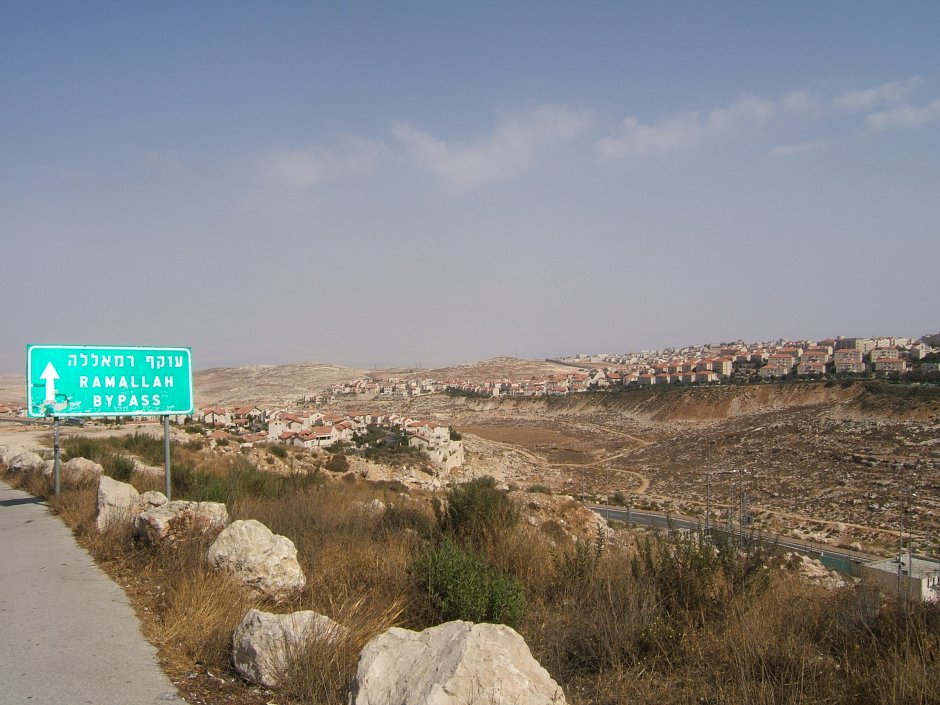

A photo taken of Pisgat Ze'ev Mizrach (East) taken from the side of the road at Pisgat Ze'ev Merkaz (center.) As you can see, there are large open spaces between each neighborhood which are gradually being filled in. This was taken on the Ramallah bypass road, which leads to many of the more outlying communities.
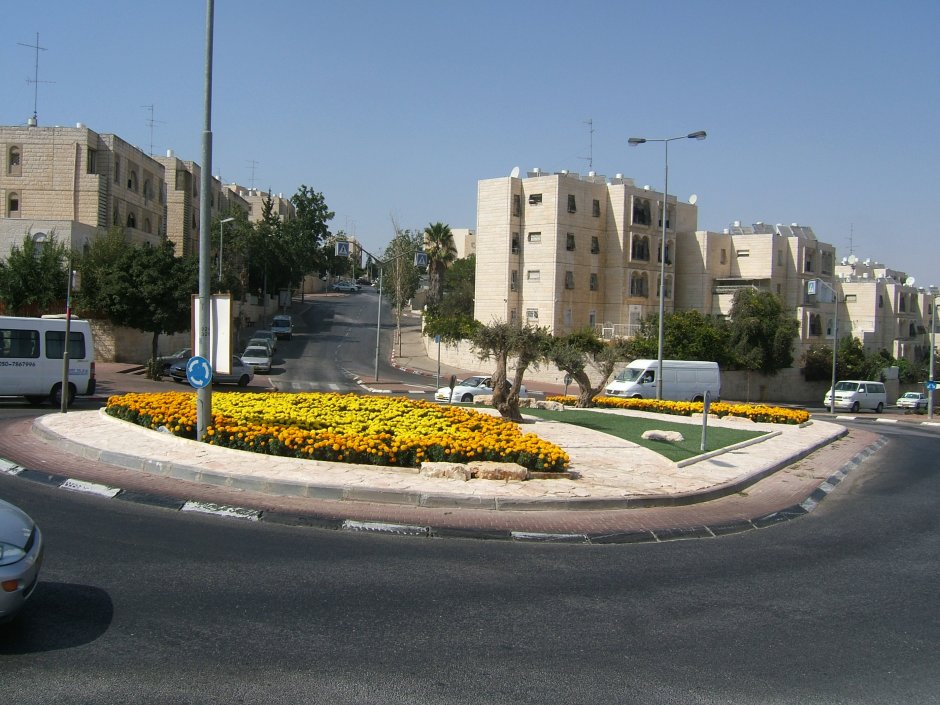

To take this photo, all I had to do was turn around from the previous photo. The town is full of roundabouts like this. There are very few traffic lights, and there is always room for parking.


Another photo taken from the archaeological site in Pisgat Ze'ev Merkaz (center), this time looking North East. In the foreground are some planted trees. More planted trees in the background show the Neve Ya'akov "forest." The snaking road to the left is the security barrier. The snaking road to the right is the Ramallah bypass road. The village in the midground is the Jewish settlement of Adam. In the background are various Arab and Jewish settlements.
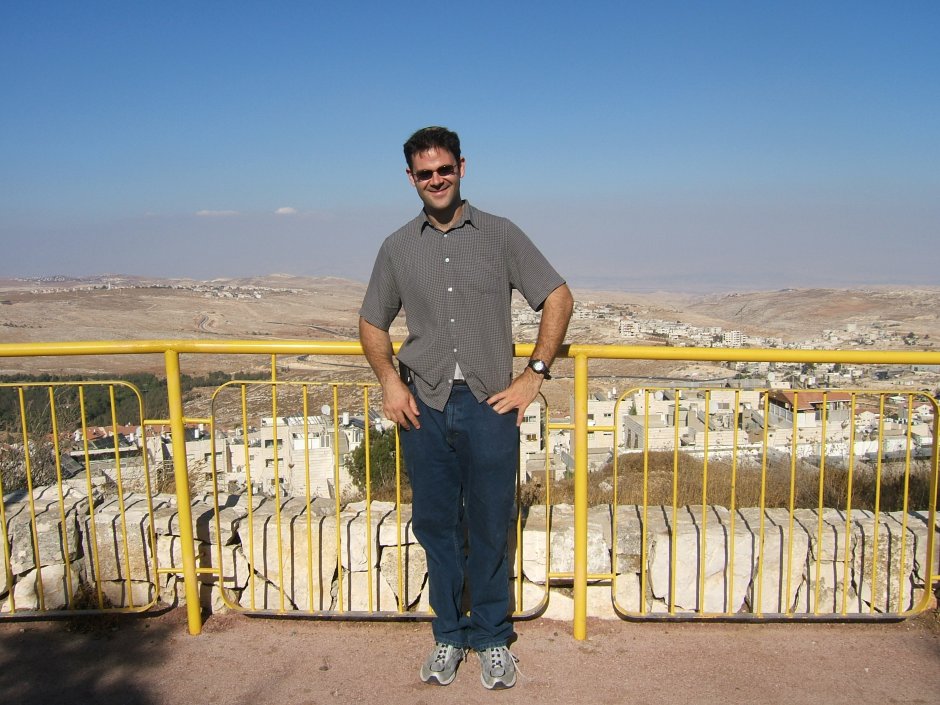
Yours truly.